Turkish coffee pots: how to choose an ibrik or an electric maker
By FITTO Trade Desk · Last updated 29 October 2026
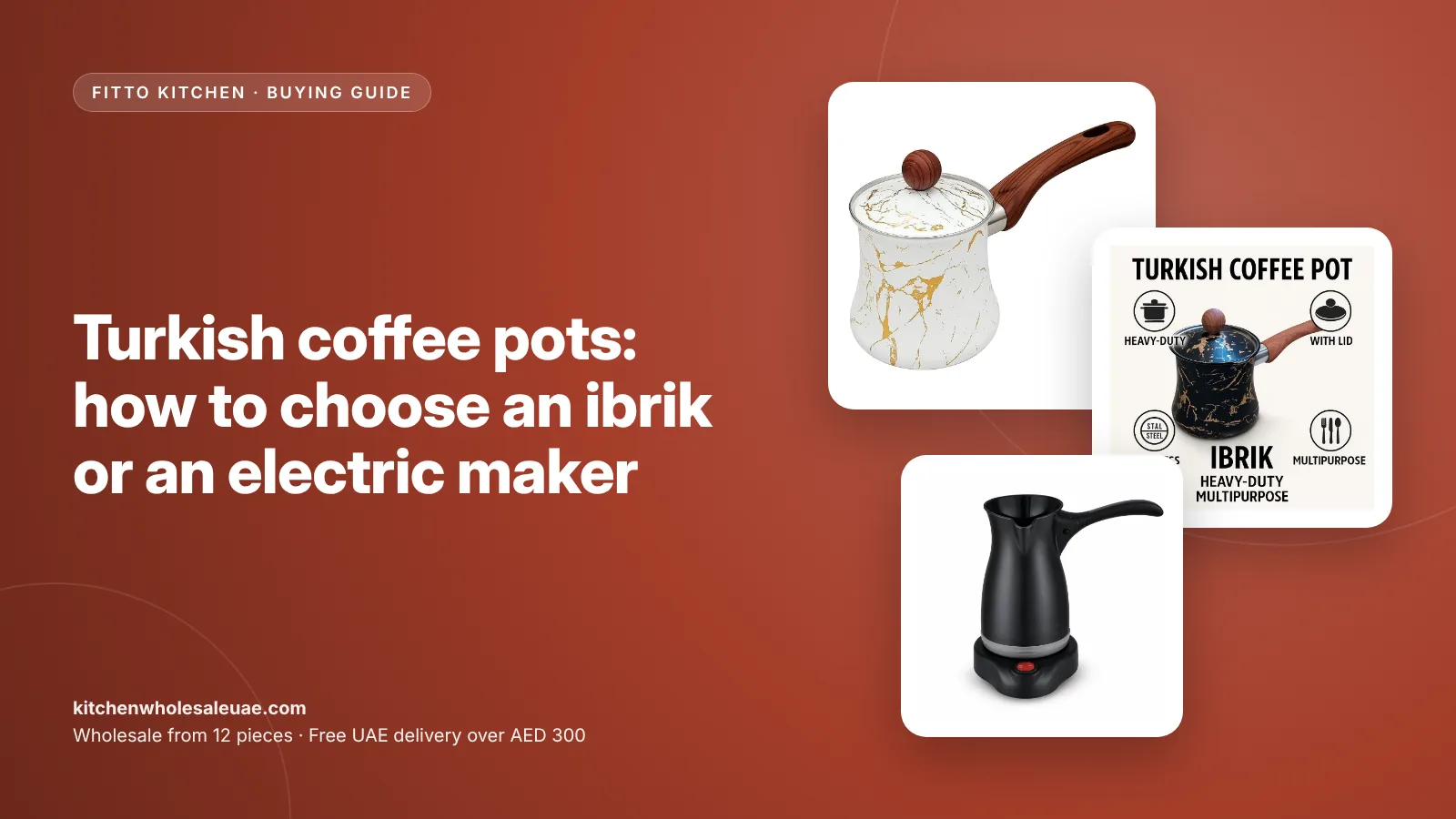
Choose a Turkish coffee pot by how many cups you brew at once and where. A small stainless steel ibrik on a hob gives the best foam for one to four cups. An electric Turkish coffee maker suits offices, pantries and desks without a hob. Check for a cool handle, a clean-pouring spout and a base that suits your hob.
Key takeaways
- Size the pot to the cups you usually brew: about 70 ml of water per cup, plus room for the foam.
- Stovetop ibriks give the most control over foam; electric makers give speed and repeatable results.
- A long handle with a wooden or heat-resistant grip keeps hands away from the flame.
- Cafés need several small pots; gift buyers pay for finish and presentation.
A Turkish coffee pot that is too big gives flat coffee with no foam, and a dripping spout stains every saucer. For a café, that means slower service and cups sent back.
At FITTO Kitchen, a wholesale coffee and tea supplier in the UAE, we supply ibriks and electric makers to cafés, offices and gift retailers. This guide settles which type and size to buy.
What is the difference between an ibrik, a cezve and an electric maker?
An ibrik and a cezve are the same thing: a small, narrow-necked pot with a long handle for brewing Turkish coffee on a hob. An electric Turkish coffee maker does the same job with its own heating base.
"Cezve" is the Turkish name, "ibrik" is common in English, and many Arabic speakers say rakwa (ركوة). A wide base heats the coffee evenly, and a narrower neck pushes the foam up for spooning into cups.
Traditional pots are tin-lined copper. Stainless steel pots, like ours, are harder wearing and never need re-tinning.
Stovetop or electric: which Turkish coffee pot should you choose?
Choose a stovetop ibrik for control over the foam; choose an electric maker where there is no hob, such as an office or pantry. Both work well with extra-fine coffee and cold water.
A stovetop pot lets you watch the foam and lift it off at the right moment. It costs less and stores in a drawer, but walk away for 20 seconds and it boils over.
An electric maker heats from a base plate at the press of a button, so it suits staff pantries, hotel rooms and desks. Before buying in bulk, confirm the plug and voltage suit UAE sockets (230 V, Type G) and whether the model switches off by itself.
What size Turkish coffee pot do you need?
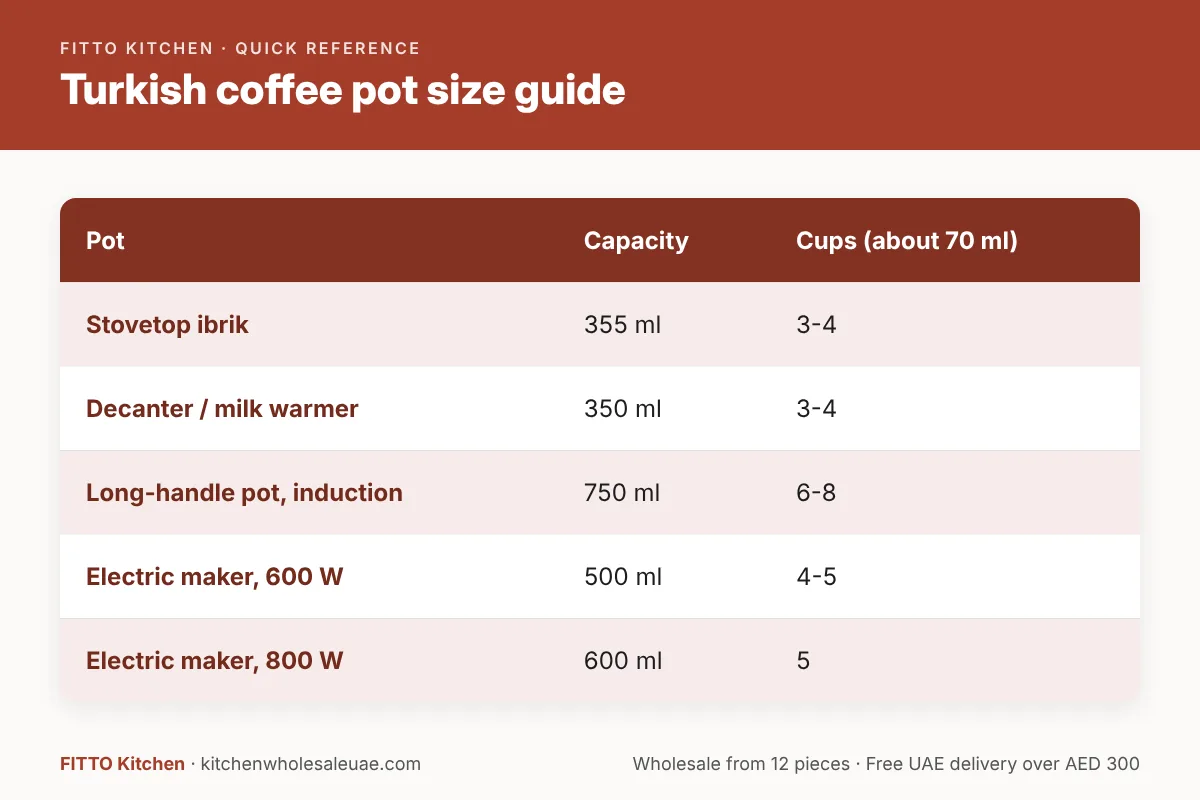
Plan about 70 ml of water per cup and leave roughly a quarter of the pot empty for the foam. A 350 ml pot therefore brews three to four cups.
Foam forms best when the pot is filled close to the neck, so one big pot used for a single cup gives poor results.
| Pot | Heat source | Capacity | Cups (rule of thumb) | Best for |
|---|---|---|---|---|
| Stainless steel ibrik with lid, white | Stovetop | 355 ml | 3–4 | Homes, café orders of 2–4 cups |
| Stainless steel decanter / milk warmer | Stovetop | 350 ml | 3–4 | Coffee, warm milk, melted butter |
| Long-handle stainless steel pot with lid | Stovetop, listed for induction | 750 ml | 6–8 | Families, majlis, warming milk |
| Electric Turkish coffee maker, black | Electric, 600 W | 500 ml | 4–5 | Homes, desks, gifting |
| Electric Turkish coffee maker | Electric, 800 W | 600 ml | 5 (as listed) | Offices and staff pantries |
| Glass electric tea and coffee maker | Electric | 17 oz (about 500 ml) | 4–5 | Tea and coffee, small offices |
Use one heaped teaspoon (about 6–7 g) of powder-fine Turkish coffee per cup; a coarse grind sinks and gives no foam.
How do you brew Turkish coffee in an ibrik?
Mix cold water, coffee and sugar in the pot, heat it slowly, and take it off just before it boils. It takes three to four minutes.
- Measure cold water with the serving cup, one cup per guest.
- Add one heaped teaspoon of coffee per cup and any sugar (ask guests first), then stir.
- Heat on low to medium and do not stir again once it is warm.
- When the foam climbs to the neck, lift the pot off and spoon foam into each cup.
- Return the pot to the heat for a few seconds, then pour slowly into each cup.
- Let the coffee rest for a minute so the grounds settle.
What should you check in the handle, spout and base?
A good Turkish coffee pot has a long, cool handle, a spout that pours without dribbling and a flat, steady base.
- Handle. A long handle keeps knuckles clear of gas flames; wooden grips stay cooler than bare steel.
- Spout. A small, defined lip gives a thin stream, so foam lands in the cup, not the saucer.
- Base. It should sit flat; tiny pots can slide on large gas burners.
- Induction. Induction needs a magnetic base. The 750 ml long-handle stainless steel pot is listed as induction compatible; for others, test the base with a fridge magnet. Our induction cookware quick answer explains the test.
- Lid. Useful for warming milk, but take it off while brewing to watch the foam.
Which Turkish coffee pots suit cafés, offices and gifting?
Cafés need several small stovetop pots, offices need one dependable electric maker per pantry, and gift buyers want a striking finish.
Cafés brewing to order work fastest with a row of small ibriks, one per order, such as the 355 ml stainless steel ibrik. For the wider coffee bar, see our café coffee and tea tools list.
Offices and staff pantries suit the 800 W electric Turkish coffee maker, which brews five cups at once and has a cool-touch handle.
For gifting, the black-and-gold ibrik with a wooden handle looks good in a hamper; its page does not list capacity, so confirm it first. Coffee gifts are a common choice before Eid and for the cooler majlis season, often paired with dallahs from our Arabic dallah coffee pot guide.
How do you care for a Turkish coffee pot?
Rinse the pot straight after brewing, wash it with warm soapy water and dry it fully. Grounds dry hard on the base if left.
Use a soft brush, not steel wool, and do not soak wooden handles. For electric makers, keep the base dry and descale with diluted white vinegar or citric acid when white marks appear.
FITTO Trade Pick: A Turkish coffee pot for every counter Pair the 355 ml stainless steel ibrik for cafés and homes with the 500 ml, 600 W electric Turkish coffee maker for desks and gifting. Wholesale prices start from 12 pieces, with up to 20% off per piece in packs of 144.

The bottom line
Buy stovetop ibriks for control and foam, and electric makers where there is no hob. Size each pot to the cups you brew most often, at about 70 ml per cup plus room for foam. Then check the handle, spout and base before ordering in bulk.
Browse our coffee and tea range, request a quote for mixed pot sizes, or order a sample to test the pour first. Delivery is free over AED 300, and the Trade Desk is on WhatsApp at +971 55 672 6947. FITTO Kitchen: fit for the way you cook.
FAQ
Can you use a Turkish coffee pot on an induction hob?+
Only if the base is magnetic. Stainless steel grades vary, so a steel pot is not automatically induction-ready. Hold a fridge magnet to the base: if it sticks firmly, the pot should work. Very small pots may be too narrow for the hob to detect, so use the smallest ring.
How many cups does a Turkish coffee pot make?+
Divide the usable capacity by about 70 ml, the size of a traditional Turkish coffee cup, after leaving a quarter of the pot for foam. A 350 ml pot makes three to four cups, and a 750 ml pot six to eight, though foam is best when you fill near the neck.
Why does my Turkish coffee have no foam?+
The usual causes are coffee that is not ground fine enough, a pot too big for the amount brewed, or heat that is too high. Use powder-fine Turkish coffee and cold water, choose a pot close to the cup count, and heat slowly. Stirring after the coffee warms up also breaks the foam.
Is an electric Turkish coffee maker as good as a stovetop pot?+
For most offices and homes, yes. An electric maker heats evenly and repeats the same result, which suits shared pantries. Stovetop pots give an experienced brewer more control over the foam, so many cafés still prefer them. Both need powder-fine coffee.