8 coffee and tea tools every café counter needs
By FITTO Trade Desk · Last updated 29 October 2026
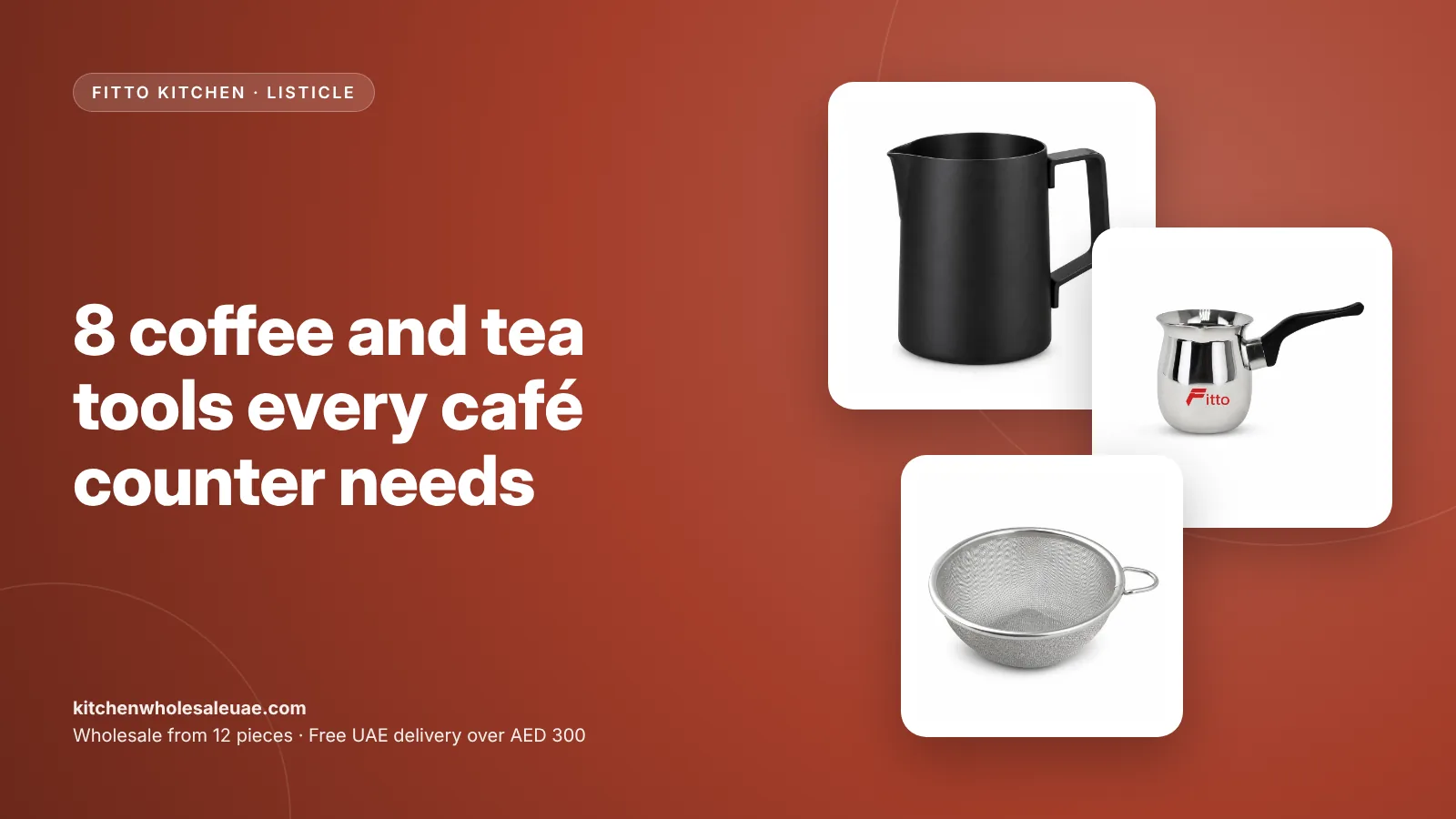
The café coffee tools every counter needs are milk pitchers, a backup milk frother, a grinder for Arabic coffee and spices, and small warmer pots. Add fine-mesh tea strainers, two kettles, a gram scale and syrup dispensers. Buy two of anything used on every order, so one is always clean while the other works.
Key takeaways
- Doubles beat singles: two pitchers and three strainers keep service moving while one set is washed.
- Keep separate, marked tools for plant milk and for spice grinding, so flavours and allergens do not cross over.
- A small electric frother is a backup and cold-foam tool, not a replacement for a steam wand on a busy counter.
- Water temperature matters as much as the beans, so pair a gooseneck kettle with a kettle that shows the temperature.
- Choose tools you can rinse in under a minute; slow cleaning is what slows a rush.
A missing pitcher or clogged strainer adds seconds to every drink in a morning rush, and regulars walk to the kiosk next door.
This list is for café and kiosk owners and hotel lobby cafés planning their counter tools (أدوات القهوة), with starting quantities for each. At FITTO Kitchen, a wholesale coffee and tea equipment supplier in the UAE, we stock the counter tools that sit around the espresso machine.
How did we choose these café coffee tools?
We picked tools that cut seconds per order, survive daily use and rinse clean fast. We left out espresso machines and commercial espresso grinders, because those are machine-level decisions covered in our café equipment setup guide and our wider coffee and tea equipment guide.
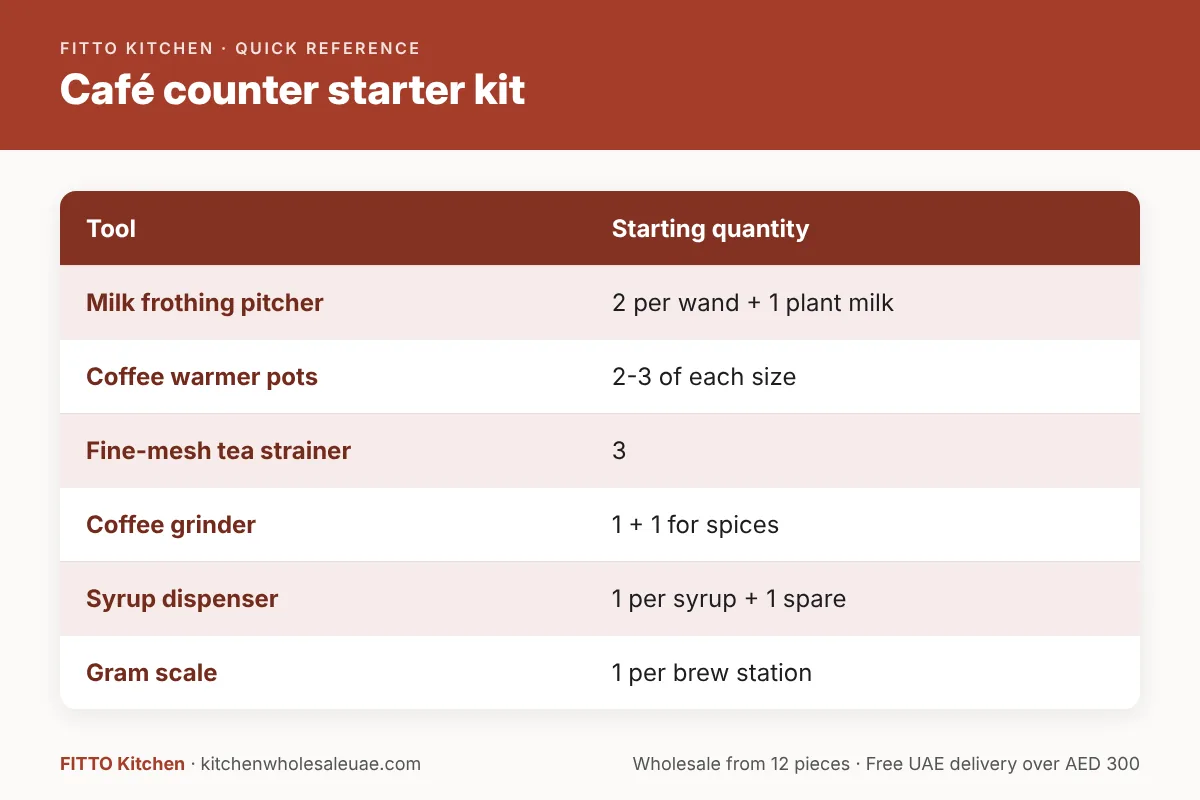
| Tool | What it speeds up | Cleaning time | Starting quantity per counter |
|---|---|---|---|
| Milk frothing pitcher | Milk drinks | Rinse, seconds | 2 per steam wand, plus 1 for plant milk |
| Electric milk frother | Cold foam, hot chocolate | Wipe and rinse, 1 minute | 1 |
| Coffee grinder | Arabic and press coffee | Brush out, 2 minutes | 1, plus 1 kept for spices |
| Coffee warmer pots | Turkish coffee, small milk | Rinse, seconds | 2-3 of each size |
| Fine-mesh tea strainer | Karak and loose tea | Rinse, seconds | 3 |
| Gooseneck and temperature kettle | Pour-over, green tea | Descale regularly | 1 of each |
| Gram scale | Doses of beans and tea | Wipe, seconds | 1 per brew station |
| Syrup dispenser | Iced tea, lemonade | Wash at each refill | 1 per syrup, plus 1 spare |
Quantities are starting points for a single-machine counter.
1. Milk frothing pitchers: why do you need more than one?
Because a clean, cold pitcher for every milk drink is what keeps a steam wand moving. One pitcher means waiting for it to be rinsed between orders.
Our stainless steel milk frothing pitcher has straight walls that help milk swirl evenly under the wand. At about 10 x 8 x 10 cm it suits single cappuccinos, flat whites and cups of karak. Keep a separately marked pitcher for oat or almond milk, so customers avoiding dairy get what they ordered.
2. Electric milk frother: when does it earn its counter space?
When you serve cold foam, hot chocolate or work at a kiosk without a steam wand. Iced drinks carry many UAE café menus through summer, and a steam wand cannot make cold foam.
The 500 W electric milk frother and steamer has four modes for hot and cold frothing. Its 190 ml jug makes roughly one drink at a time, so treat it as a backup and a cold-foam tool rather than the main milk station.
3. Coffee grinder: which coffee does it handle?
A chamber grinder suits batch-ground Arabic coffee, press-pot coffee and cardamom; espresso needs a grinder matched to the machine.
Our electric coffee grinder has a 300 W motor and a 600 ml stainless steel chamber. Grind cardamom in a second unit kept only for spices. Otherwise the next batch of filter coffee tastes of cardamom, and customers notice.
4. Coffee warmer pots: what do cafés use them for?
For Turkish coffee, heating small amounts of milk for karak and warming butter or syrup. The small pot is known locally as a rakwa (ركوة).
Stock the 12 oz stainless steel coffee warmer pot for one or two drinks and the 24 oz pot for larger batches and milk. Both have a black Bakelite handle and a shaped pouring edge. Two or three of each size let you run orders side by side.
5. Fine-mesh tea strainers: which size works over a cup?
A wide strainer that rests on the cup or jug frees one hand and catches leaves, cardamom and grounds.
The large 14 cm stainless steel tea and coffee strainer has a rolled rim and a deep bowl, so it holds a full pot's leaves without overflowing. Keep three: one in use, one drying and one spare. Replace any strainer once the mesh dents or tears.
6. Kettles: how do you get water temperature right?
Use a kettle that shows the temperature for the water and a gooseneck kettle for the pour. As a common rule of thumb, black tea and karak want water near boiling, pour-over coffee about 90-96 °C and green tea about 70-80 °C.
Our 2-litre 1500 W electric kettle with temperature display shows when the water has cooled to the right point. Fill the matte black gooseneck pour-over kettle from it, then pour in slow circles over a V60 or drip cone. Descale both regularly; how often depends on your water and filtration.
7. A gram scale: why weigh coffee and tea?
Weighing every dose keeps drinks consistent between staff and shifts, and it controls bean and tea costs.
The pocket scale weighs up to 500 g in 0.01 g steps, with a tare button. That suits dosing beans, loose tea and saffron. To weigh water as you pour, use a larger kitchen scale, since a cup, brewer and water can pass 500 g.
8. Syrup dispensers: how do they cut waste?
A lever-top dispenser pours a measured stream, so sweetness stays consistent and sticky spills stay off the counter.
Our 1000 ml sugar and syrup dispenser has thick tempered glass and a cast zinc top with a thumb lever. Use one per syrup and keep a spare. Wash it at each refill and label the date, rather than topping up old syrup. For dallahs and teapots for table service, see our guide to teapots for cafés and majlis.
FITTO Trade Pick: A counter kit in one carton Start with the milk frothing pitcher, the 12 oz coffee warmer pot and the 14 cm tea strainer. Ask for them as a mixed carton, and remember bigger packs cut the price per piece by up to 20% at 144 pieces.

The bottom line
The fastest café counters run on doubles: spare pitchers, strainers and warmer pots so nothing waits to be washed. Add a scale, the right kettles and separate tools for spices and plant milk, and drinks taste the same on every shift.
See our full coffee and tea range and kitchen appliances, request a quote for a mixed counter kit, or order a sample to test a pitcher on your machine. Wholesale prices start from 12 pieces, delivery is free across the seven emirates over AED 300, and the Trade Desk answers on WhatsApp at +971 55 672 6947. FITTO Kitchen: fit for the way you cook.
FAQ
Do I need a milk frother if my espresso machine has a steam wand?+
Not for hot milk drinks, because the wand does that job faster. A separate frother earns its place for cold foam on iced drinks, hot chocolate during busy periods, or a second station when the wand is tied up. Kiosks without a wand rely on one.
What size milk pitcher should a café use?+
Match the pitcher to the drink so you are not steaming milk you will pour away. A small pitcher suits single cappuccinos, flat whites and karak. Larger pitchers suit lattes or two drinks at once, but steaming small amounts in a big pitcher makes texture harder to control.
What water temperature is best for tea and coffee?+
As a widely used guide, black tea and karak brew best with water near boiling, pour-over coffee at about 90-96 °C and green tea at about 70-80 °C. Hotter water makes green tea bitter.
How do I keep tea strainers clean and free of stains?+
Rinse the strainer straight after each pour, before leaves and milk dry in the mesh. At closing, soak strainers in hot water with a spoon of baking soda, then brush gently and dry fully. Replace any strainer with dented or torn mesh.
Can one grinder handle both coffee and spices?+
It can, but flavours carry over. Cardamom, cloves and saffron leave oils in the chamber that taste in the next batch of coffee. Most cafés keep one grinder for coffee and a second, clearly labelled grinder for spices, which also makes cleaning quicker.