Coffee and tea equipment in the UAE: a complete guide for cafés, majlis and shops
By FITTO Trade Desk · Last updated 29 October 2026
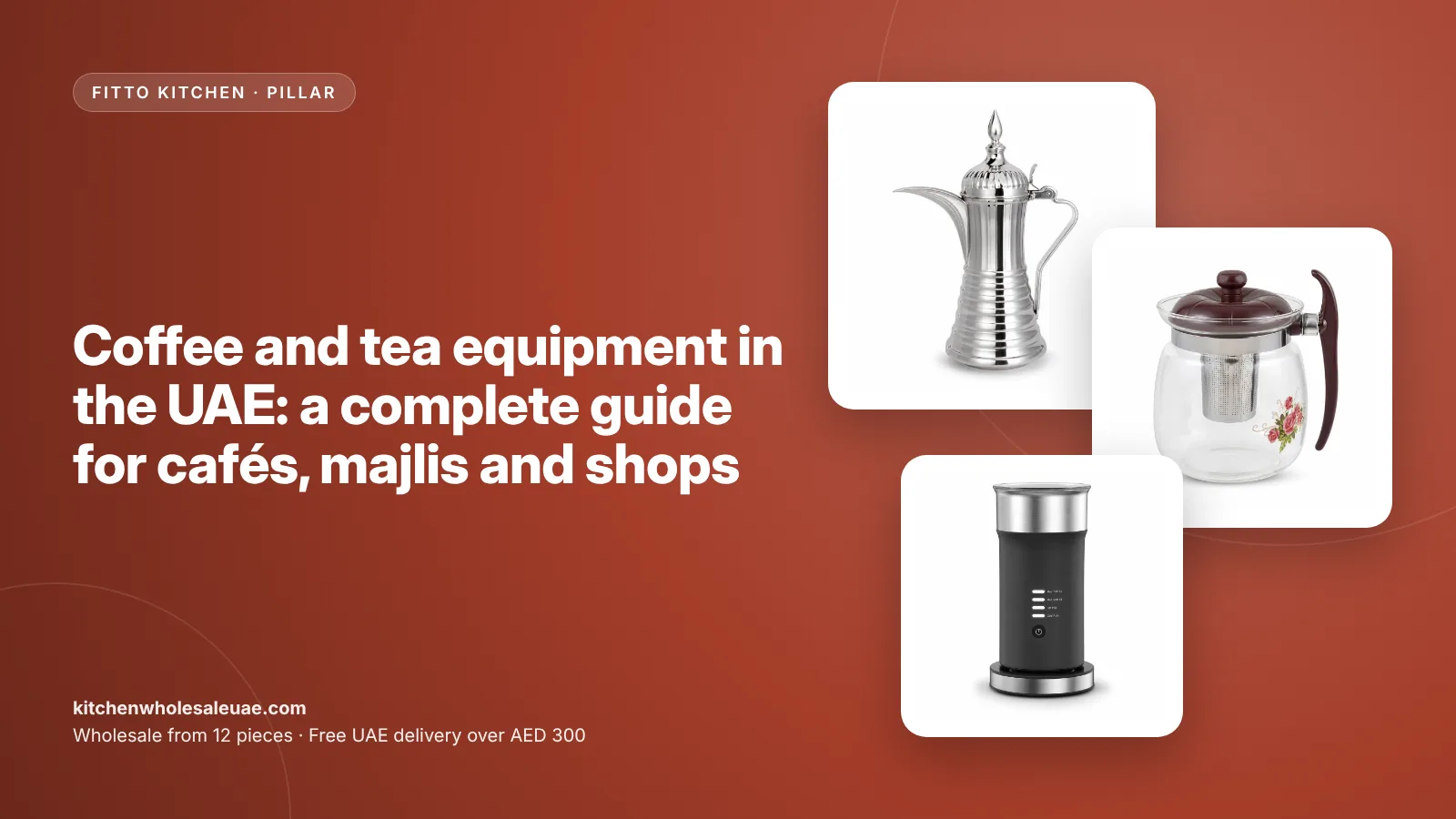
The coffee and tea equipment UAE buyers need depends on who is drinking. Majlis hosts need a dallah, strainers and a large kettle. Cafés need a grinder, a milk frother, press makers and glass teapots. Offices need kettles and simple presses. Gift shops sell boxed dallahs and decorative teapots. Stock by use first, then by size.
Key takeaways
- Match each tool to a job: brewing (ibrik, press, teapot), heating (kettles), finishing (frothers) and serving (dallahs, strainers).
- Stainless steel suits daily, heavy service; glass suits display brewing where guests see the tea.
- Beyond the espresso machine, a café's biggest quality gains come from a coffee grinder and a milk frother.
- Majlis and hotel buyers should plan by guests at the busiest moment, not by the number of pots.
- Limescale is the main reason kettles and teapots look tired in UAE water, so build descaling into the routine.
Buying coffee and tea tools one item at a time leads to mismatched pots, missing strainers and a shelf of slow sellers. The cost shows up as repeat orders, complaints about weak or gritty drinks and cash tied up in the wrong stock. This guide settles what each tool does, which material to choose and what to buy first.
It is written for café owners, hotel and office buyers, majlis hosts and the shops that supply them. At FITTO Kitchen, a wholesale coffee and tea equipment supplier in the UAE, we stock tools for each of these buyers, and the advice below follows the questions they ask most.
What coffee and tea equipment does a UAE business actually need?
A UAE business needs one tool for each step: brew, heat, finish and serve. Most buyers already own one or two of these and only need to fill the gaps.
| Tool | What it does | Typical buyer | Common material |
|---|---|---|---|
| Dallah (دلة) | Holds and pours Arabic coffee (gahwa) | Majlis hosts, hotels, offices, gift shops | Stainless steel, gold-tone or enamel finish |
| Turkish coffee pot (ibrik / cezve) | Brews thick coffee on the hob | Cafés, homes, restaurants | Stainless steel |
| Electric Turkish coffee maker | Brews Turkish coffee without a hob | Homes, small pantries | Electric base with pot |
| Press coffee maker (cafetière) | Steeps ground coffee, then filters it | Offices, cafés, hotel rooms | Glass with steel, or insulated stainless steel |
| Teapot | Brews and serves loose or bagged tea | Cafés, majlis, hotels, restaurants | Glass, ceramic, stainless steel |
| Glass kettle and teapot | Brews and serves tea for a group | Majlis, large families, cafés | Clear glass with handle frame |
| Milk frother | Foams milk for lattes, karak and hot chocolate | Cafés, offices, homes | Stainless whisk, plastic or steel body |
| Coffee grinder | Grinds beans fresh before brewing | Cafés, serious home buyers | Stainless steel chamber |
| Tea strainer and infuser | Catches leaves and cardamom pods | Every buyer above | Stainless steel mesh |
Our full range sits in the wholesale coffee and tea equipment category, and electric kettles sit with our kitchen appliances. If you are equipping a whole kitchen, our restaurant kitchen equipment checklist covers the other stations.
How do you choose a dallah for Arabic coffee?
Choose a dallah by how it will be used: plain stainless steel for daily service, decorated or gold-tone styles for gifting and display. The spout and lid matter more than the pattern.
A daily-service dallah gets poured dozens of times a day in a majlis or hotel lobby. Look for a lid that stays seated when tilted, a beak spout that pours in a thin stream and a handle that keeps knuckles clear of the hot body. Ribbed and fluted stainless steel bodies, such as the tall ribbed stainless steel dallah, hide fingerprints and light scratches in busy service.
Gifting dallahs are bought for how they look in the box. Gold-tone finishes, enamel bands and boxed presentation are the styles shoppers look for before Ramadan, Eid and UAE National Day on 2 December.
Many hosts brew gahwa in a separate pot and pour it into the dallah to serve. Unless the product page says a dallah is made for the stove, treat it as a serving pot. For sizes, finishes and coffee quantities per guest, read our guide to Arabic dallah coffee pots. For finjan cups and tea glasses to serve with it, our sister store stocks wholesale glassware and cups.
Which teapots and glass kettles suit cafés and majlis?
Glass teapots suit display service, stainless steel teapots suit rough daily use, and large glass kettle-teapots suit groups. Pick capacity by the number of cups you pour in one round.
- Glass teapot with infuser. The 2.4 litre glass teapot with a stainless steel infuser lets guests see the colour of the tea. It suits cafés, hotel breakfasts and family tables. Glass shows tannin stains, so rinse it after every service.
- Glass kettle and teapot. These large clear vessels come in 2.5 L, 3.5 L and 4.5 L sizes for majlis gatherings and big households. Check the product page for heat-source guidance before you put any glass vessel on a hob.
- Ceramic teapot. A white ceramic teapot holds heat well and looks clean on a restaurant table. It chips if knocked against a tap or tray, so keep one or two spares.
- Stainless steel and Moroccan-style teapots. A 1.2 L stainless steel Moroccan-style teapot with a domed lid and curved spout survives knocks in busy service. Gold-finish and embossed styles double as gift items.
As a rule of thumb, a 150 ml tea glass means a litre of tea fills about six glasses. A 2.4 L teapot therefore covers a table of eight for two rounds.
For hot water in volume, stainless steel stovetop kettles in 1 L, 1.5 L, 2 L and 2.5 L sizes cover most kitchens. A 5 litre stainless steel whistling kettle suits staff rooms and large majlis. Where there is no hob, a cordless electric kettle does the job.
Turkish coffee pots: stovetop ibrik or electric maker?
Choose a stovetop ibrik where there is a hob and a practised hand; choose an electric Turkish coffee maker where there is no hob. Both brew the same style of thick, unfiltered coffee.
A stainless steel Turkish coffee pot (ibrik) with lid is light, simple and hard to damage. It needs a low flame and attention, because Turkish coffee foams up and boils over within seconds once it starts to rise.
Electric Turkish coffee makers take away the hob. FITTO stocks a 500 ml, 600 W model with a foldable handle and an 800 W, 600 ml electric Turkish coffee maker rated at 5 cups. They suit homes and small pantries where nobody wants to watch a flame.
Before you order any electric model for resale, check the plug and voltage on the box. The UAE uses UK-style three-pin sockets at 220-240 V, and the Trade Desk can confirm the details for a specific model.
Press coffee makers: glass or insulated stainless steel?
Glass press makers suit cafés and homes that want to watch the brew; insulated stainless steel press makers suit offices and hotel rooms where heat loss and knocks matter.
A glass cafetière with a stainless steel frame and plunger is the classic choice. It is light and easy to clean. The glass beaker can crack if it is dropped, or if boiling water goes into a beaker straight from a cold fridge.
The 600 ml insulated coffee press in 304-grade stainless steel uses a 3-level filtration system and has dishwasher-safe parts. Its insulated body keeps coffee warm for longer, which suits meeting rooms and hotel rooms where a pot sits on the table.
Press makers also brew loose-leaf tea and cold brew, which makes them a useful two-in-one item for resellers and offices.
Do cafés need milk frothers and coffee grinders?
Yes. After the espresso machine, a grinder and a milk frother are the two tools that most change drink quality. They also extend the menu to lattes, karak, hot chocolate and cold foam.
Milk frothers come in three levels:
- Handheld battery frothers. Light, low-cost and good for offices, homes and gift baskets.
- USB rechargeable frothers. Adjustable speed and two whisk heads, with no batteries to replace.
- Electric frother and steamer. The 500 W, 190 ml frother and steamer with 4 modes heats and froths milk hot or cold. It suits small cafés, coffee carts and office pantries.
For coffee, the electric coffee grinder with a 600 ml stainless steel chamber and 300 W motor is a dedicated coffee-grinding appliance. For cardamom, cloves and other spices, use a separate multi-functional electric grinder with 4 stainless steel blades. Keeping one grinder for coffee and one for spices stops cardamom flavour reaching every cup.
As a rule of thumb, grind beans just before brewing. Ground coffee loses aroma within hours, and the gap is easy to taste in a press or a Turkish pot.
Which tea strainers and infusers sell best?
Fine stainless steel mesh strainers sell steadily because every teapot, dallah and kettle buyer needs one. They are low-cost, easy to gift and quick to restock.
Popular formats include a 5.3 cm stainless steel tea ball for single cups and a 7 cm pipe-handle strainer for pouring from a pot. A 9 cm teapot-shaped strainer with a fine stainless mesh adds a playful gift option. Mesh strainers with wooden handles suit both tea and Arabic coffee, catching cardamom and saffron pieces.
For resellers, strainers are the obvious add-on at the till, placed next to teapots and dallahs.
How should you stock coffee and tea equipment in the UAE?
Stock coffee and tea equipment in the UAE by business type, starting with the tools used every day and adding display or gift items later. Use this order:
- List your drinks. Write down every coffee and tea you serve, or plan to sell tools for, from gahwa to lattes.
- Match a tool to each drink. Use the table above, so every drink has a brewing, heating and serving tool.
- Count your peak. Plan for your busiest hour or largest gathering, not an average day.
- Add spares. As a rule of thumb, add 20-30% for glass, strainers and frother whisks, which break or go missing first.
- Test before you commit. Try one style of each item in service, or on the shelf, for a few weeks before you standardise.
- Scale what works. Reorder the proven lines in larger quantities and drop the slow movers.
| Business | Start with | Add later |
|---|---|---|
| Café | Coffee grinder, milk frother, press makers | Glass teapots, Turkish pots |
| Majlis | Dallah, strainers, large kettle | Glass kettle-teapot, spare dallahs |
| Office pantry | Electric kettle, insulated press | Handheld frothers |
| Hotel | Teapots, kettles, presses for rooms | Dallahs for the lobby |
| Gift shop | Boxed dallahs, Moroccan teapots | Strainers and frothers as add-ons |
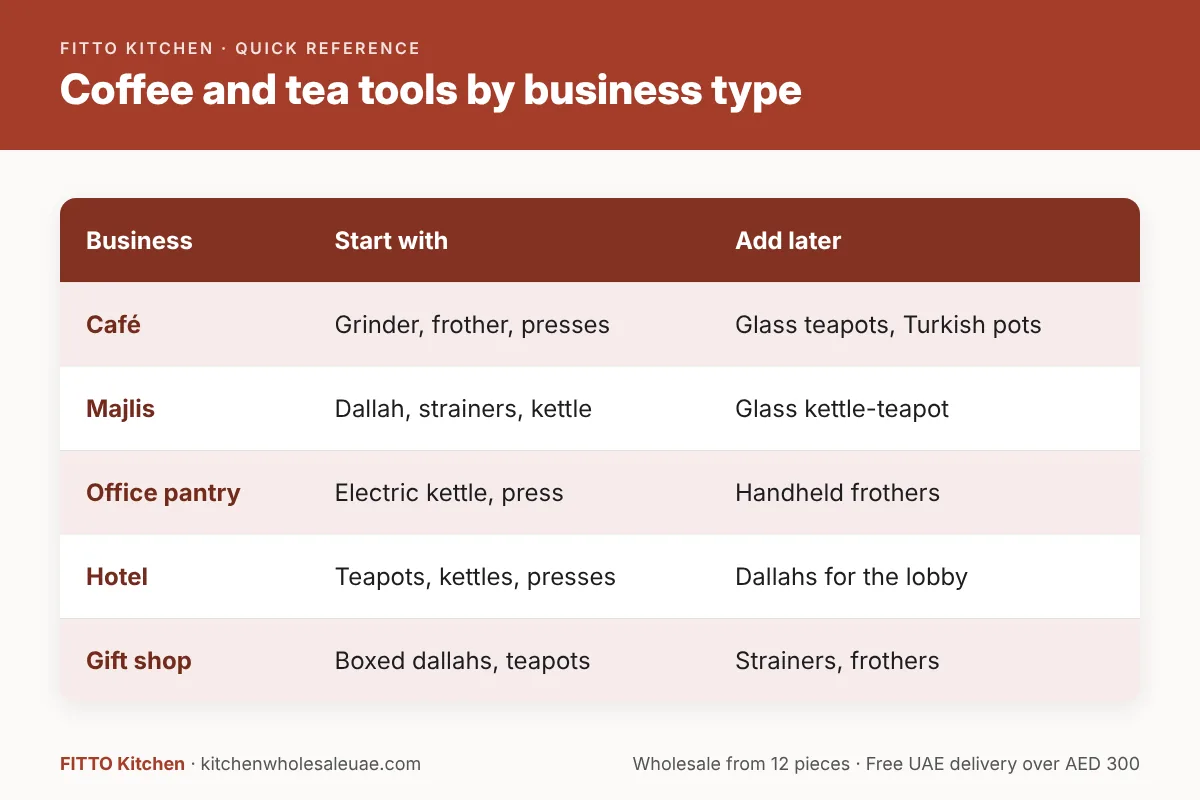
Gift shops should plan stock well ahead of Ramadan, Eid and National Day, because shoppers buy hosting gifts in the weeks before. For timing seasonal kitchenware orders, see our White Friday kitchenware stock guide.
How do you care for coffee and tea equipment in UAE water and heat?
Descale kettles and teapots regularly, dry stainless steel after washing and keep glass away from sudden temperature changes. These three habits prevent most complaints.
Limescale builds up quickly where water is hard. A soak in a citric acid or white vinegar solution keeps kettles, ibriks and glass teapots clear. As a rule of thumb, descale monthly at home and every two weeks in busy offices and hotels.
Dry stainless steel dallahs, teapots and strainers straight after washing to avoid water spots. Hand wash gold-tone and enamel finishes with mild soap and a soft brush; scouring pads wear decorative finishes.
Keep glass teapots and press makers out of hot cars and sunny shop windows in summer. Never pour boiling water into cold glass, and let hot glass cool before washing it.
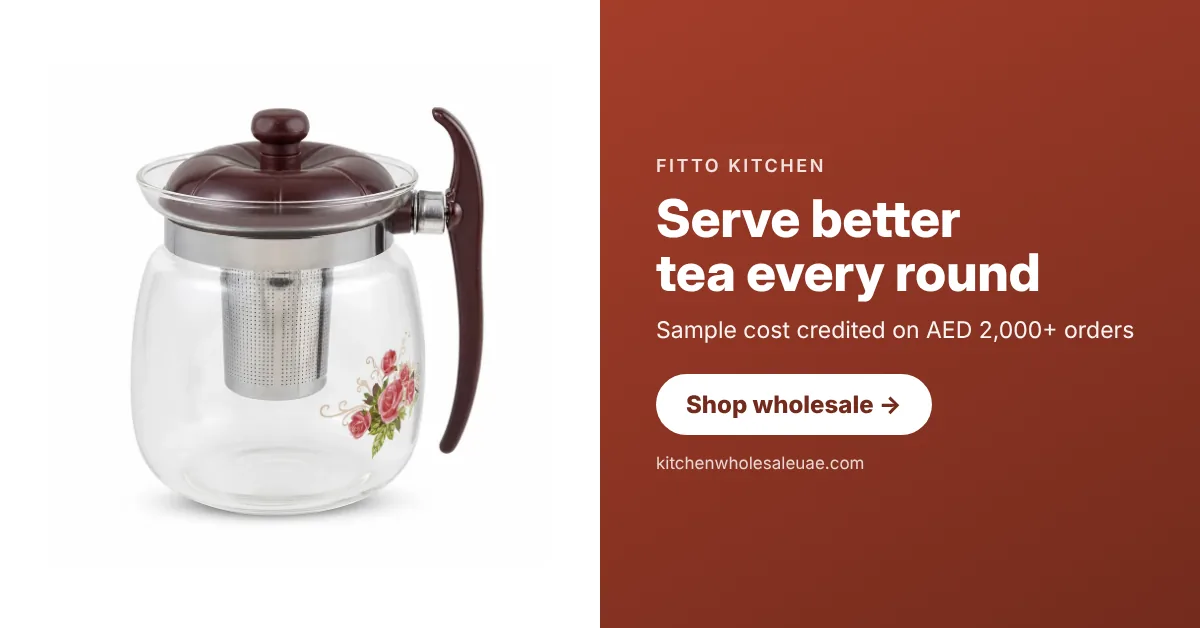
FITTO Trade Pick: Equip your coffee and tea station Pair the 2.4 litre glass teapot and the tall ribbed stainless steel dallah for service, with the 500 W milk frother and steamer and the 300 W coffee grinder for the counter. Not sure which suits your guests? Order a sample first, and we credit its cost on a bulk order of AED 2,000+ within 30 days.
The bottom line
Good coffee and tea service comes from matching each tool to a drink and a guest count. Stainless steel handles daily service, glass handles display, and grinders and frothers lift café menus. Start with the everyday tools, keep spares and descale often.
Browse our wholesale coffee and tea equipment, then request a quote for a mixed carton or order a sample to test a style. Wholesale prices start from 12 pieces, delivery is free over AED 300, and the Trade Desk is on WhatsApp at +971 55 672 6947. FITTO Kitchen: fit for the way you cook.
FAQ
What is the most important coffee tool for a new café besides the espresso machine?+
A coffee grinder comes first, because freshly ground beans change the taste of every cup. A milk frother comes a close second, since it opens up lattes, karak and cold foam drinks. Add two or three press makers for filter-style orders and loose-leaf tea, then glass teapots for display service once the core drinks run smoothly.
Is stainless steel or glass better for teapots?+
Stainless steel is better for rough daily use and busy kitchens, because it does not crack or chip. Glass is better when guests should see the tea, such as hotel breakfasts, cafés and family tables. Many buyers keep both: stainless steel teapots for the back of house and glass teapots for front-of-house service and retail display.
Can I use a decorative dallah on a gas flame?+
Only if the product page says it is made for stovetop use. Gold-tone, enamel and other decorative dallahs are mainly serving and gifting pieces. Most hosts brew gahwa in a stainless steel pot or an electric Turkish coffee maker, then pour it into the dallah through a fine strainer. This also keeps the finish looking new for longer.
How do I stop limescale in kettles and teapots?+
Empty kettles after use rather than leaving water standing overnight. Once a month, fill the kettle or teapot with water and a spoon of citric acid or a cup of white vinegar, heat gently, leave for 30 minutes and rinse well. In offices and hotels with heavy use, descale every two weeks to keep heating fast and drinks clear.
How many cups does a 2.4 litre teapot serve?+
As a rule of thumb, about 16 tea glasses of 150 ml, or around 10 mugs of 240 ml. In practice you fill a little below the lid line, so plan on 14 glasses per pot. For a majlis of 20 guests having two rounds each, two large teapots refilled once will cover service.
Should I buy a separate grinder for spices and coffee?+
Yes, if you grind both regularly. Cardamom, cloves and cumin leave oils in the chamber that carry into the next batch of coffee. A dedicated coffee grinder keeps coffee clean, while a multi-purpose spice grinder handles masala, cardamom for gahwa and dried herbs. Label each one so staff do not mix them up.