Which cookware works on induction hobs? A quick check before you buy
By FITTO Trade Desk · Last updated 29 October 2026
Induction compatible cookware has a magnetic base. Cast iron, carbon steel, black iron and magnetic stainless steel work; plain aluminium, copper, glass and ceramic do not, unless the base carries a bonded steel plate. To check, hold a fridge magnet to the underside: if it sticks firmly and the base is flat, the pan will work.
Key takeaways
- The magnet test is the quickest check: a firm hold on the base means the pan works.
- Aluminium pans work only when they have a steel induction plate in the base.
- Stainless steel varies by grade, so test each line rather than trusting the word "stainless".
- Shops can cut returns by testing every line and labelling only tested stock as induction-ready.
Many newer UAE apartments have induction hobs. A buyer who takes home the wrong pan finds it will not heat, and the shop gets the return.
This quick check is for home cooks with induction hobs and the shops that serve them. At FITTO Kitchen, a wholesale cookware supplier in the UAE, it is the question buyers ask most about pans.
How does the magnet test work?
Hold an ordinary fridge magnet against the centre of the pan's base; if it sticks firmly, the pan works on induction. If it slides off or barely holds, the pan will heat poorly or not at all.
Induction heats the pan itself through a magnetic field, so the base must be iron-based. Test the underside: some pans have a magnetic plate only there.
Which materials make induction compatible cookware?
Iron-based materials work; non-magnetic metals, glass and ceramic do not work on their own. The table sums up the common materials.
| Material | Works on induction? | What to check |
|---|---|---|
| Cast iron and enamelled cast iron | Yes | Lift rather than slide, to avoid scratching the glass top |
| Carbon steel and black iron | Yes | The base must be flat, not rounded |
| Magnetic stainless steel (18/0, grade 430) | Yes | Magnet test the base |
| 18/10 (304) stainless steel on its own | Usually not | Works when the base has a magnetic layer |
| Aluminium, including granite-coated pans | Only with a steel induction plate | Look for a bonded steel disc on the base |
| Copper and copper-bottom pans | Only with a magnetic layer | Copper itself is not magnetic |
| Glass, ceramic and clay | No | Needs an induction interface disc |
See our stainless steel, non-stick and granite comparison and cast iron vs aluminium guide for how each cooks.
What is an induction base?
An induction base is a magnetic steel plate bonded to the bottom of a non-magnetic pan, usually aluminium. It lets a light aluminium pan work on induction while keeping aluminium's even heat spread.
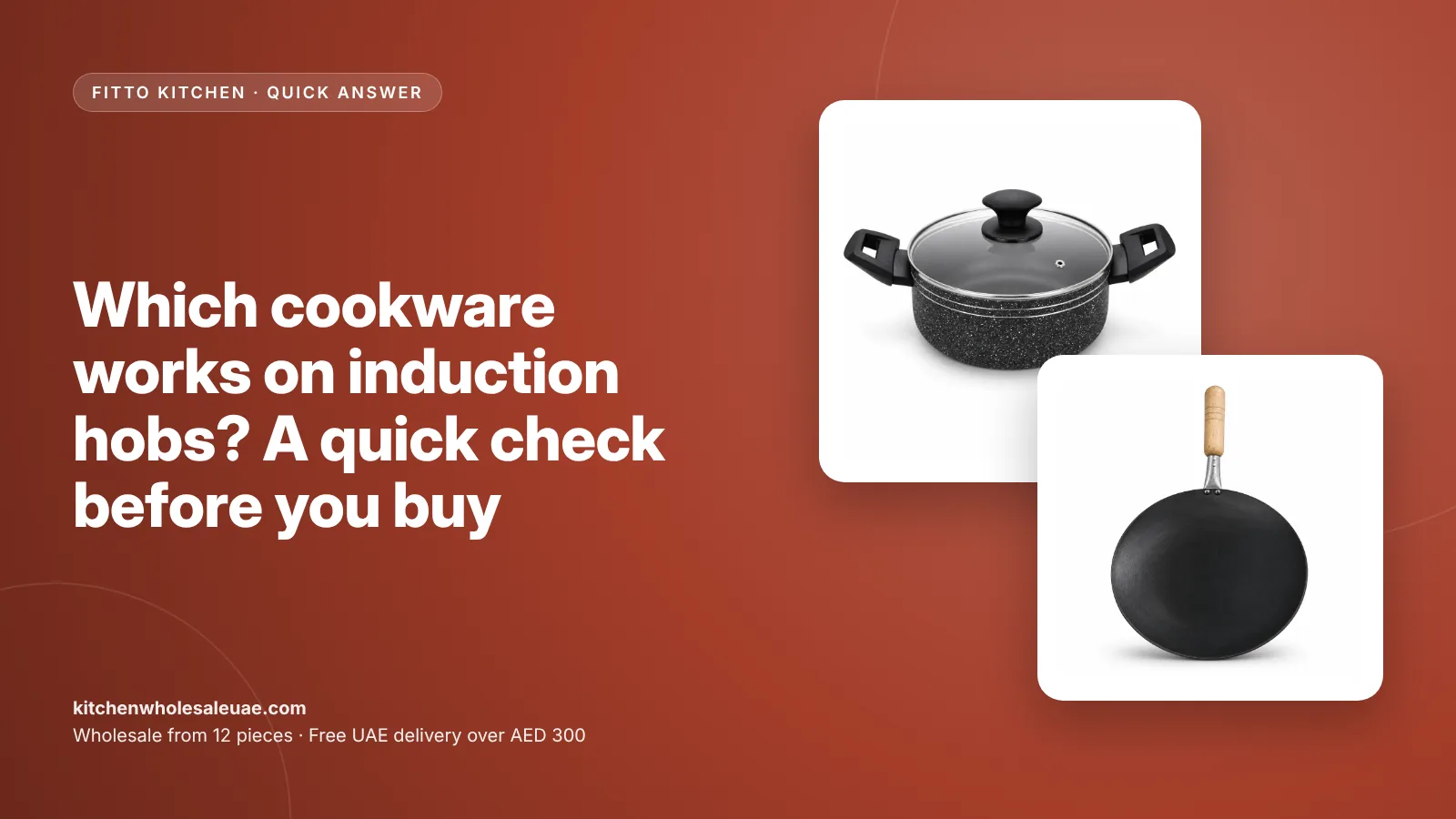
It usually shows as a flat steel disc on the underside. FITTO's 28 x 12 cm pressed aluminium induction casserole is made for induction; magnet-test other aluminium and granite-coated pans before buying in quantity.
Does the size and shape of the base matter?
Yes: the base should be flat and roughly the size of the cooking zone. A warped or rounded base makes poor contact, and many hobs ignore pans whose base is too small for the zone.
Choose flat-bottomed woks, not round-bottomed ones. A 14-inch tawa heats mainly over the zone, so its edges stay cooler.
Never use a gas-style heat diffuser ring on induction; FITTO's metal heat diffuser ring is listed for gas and electric hobs, not induction.
How should shops label induction cookware?
Label a line as induction-ready only after you have magnet-tested it. This one habit prevents most wrong-pan returns.
Use separate shelf tags for "Works on induction" and "Gas and ceramic hobs only", and keep a magnet on the shelf so customers can test.
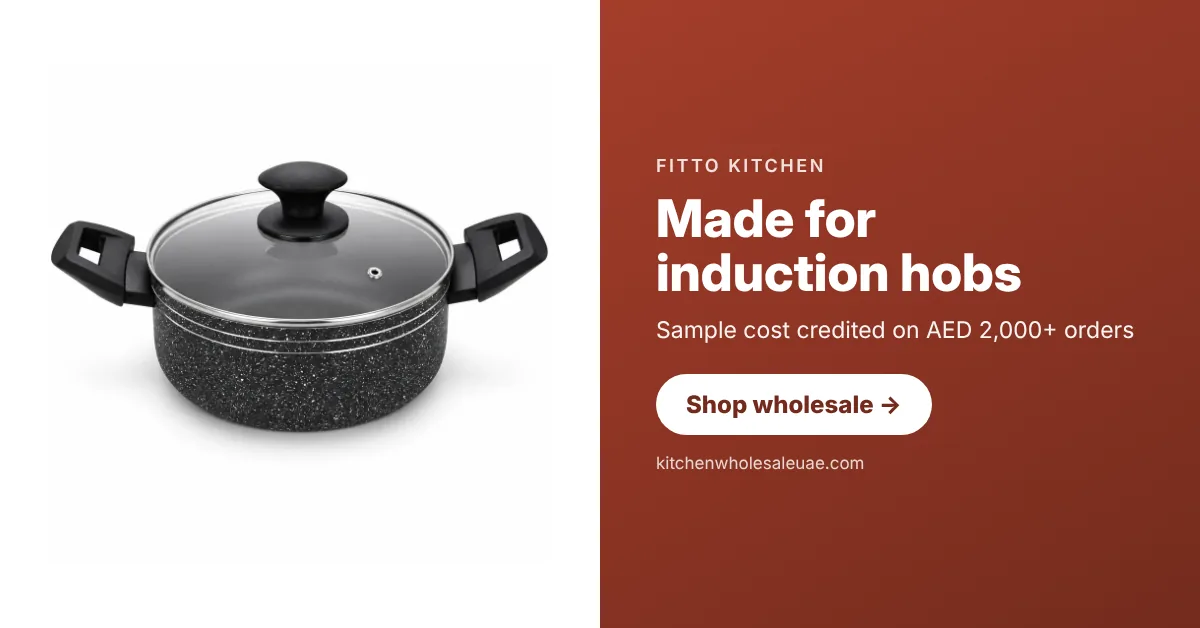
FITTO Trade Pick: Stock pans made for induction The 28 x 12 cm and 32 x 15 cm pressed aluminium induction casseroles are made for induction cooking, and the 14-inch black iron tawa is iron-based. Order samples to test on your own hob; we credit the sample cost on a bulk order of AED 2,000+ within 30 days.
The bottom line
If a magnet sticks firmly to the base and the base is flat, the pan works on induction. Plain aluminium, copper, glass and ceramic need a steel plate or an interface disc.
Browse our wholesale cookware and pans, request a quote for mixed sizes, or order samples to magnet-test first. Delivery is free across the seven emirates over AED 300, and the Trade Desk answers on WhatsApp at +971 55 672 6947. FITTO Kitchen: fit for the way you cook.
FAQ
Does aluminium work on induction?+
Not on its own. Aluminium is not magnetic, so an induction hob cannot heat it. Aluminium pans work when the base has a bonded steel induction plate, usually visible on the underside. If you are unsure, a fridge magnet gives the answer in seconds.
Is all stainless steel induction compatible?+
No. Magnetic grades such as 18/0 (grade 430) work, while 18/10 (grade 304) on its own is usually weakly magnetic or not magnetic. Many stainless pans add a magnetic layer to the base for induction. Test each line with a magnet rather than trusting the label.
Can I use an induction pan on a gas hob?+
Yes. Induction-ready pans also work on gas, electric and ceramic hobs, which is why many shops prefer to stock them. On gas, keep the flame within the base so it does not heat the sides and handle.
What is an induction interface disc?+
It is a flat steel plate that sits between the hob and a non-magnetic pan. The hob heats the disc, and the disc heats the pan. It lets you use glass, clay or aluminium pans, but it heats more slowly and gets very hot, so handle it with care.