How to sharpen a kitchen knife: whetstone, rod and pull-through methods
By FITTO Trade Desk · Last updated 29 October 2026
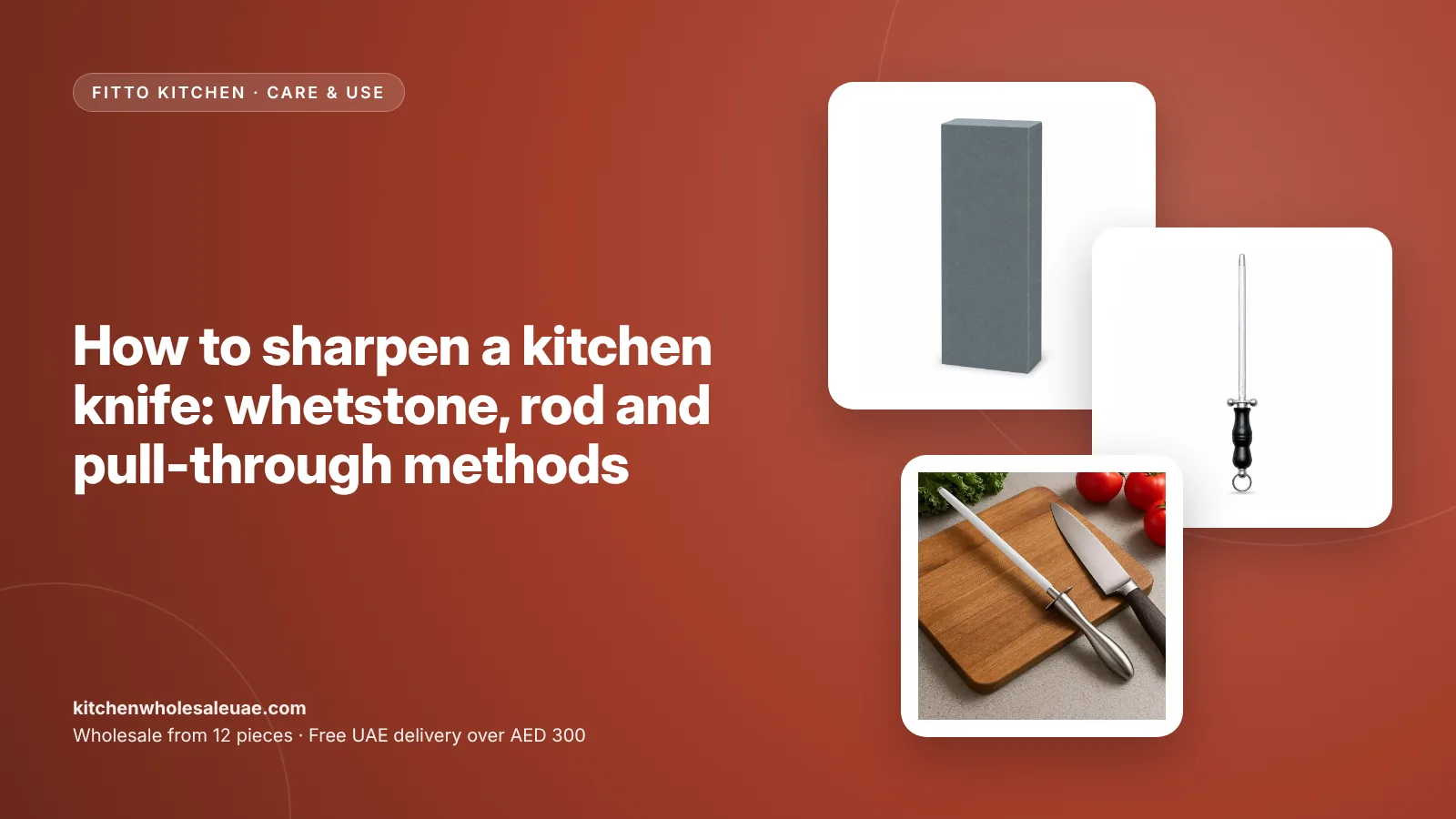
To sharpen a kitchen knife, hold a steady angle of about 15-20° per side and work the whole edge until a fine burr forms, then refine and remove it. A whetstone gives the best edge, a honing rod keeps it aligned between sharpenings, and a pull-through sharpener is the quick option for everyday knives.
Key takeaways
- A steady angle matters more than pressure: about 20° per side for most Western knives, about 15° for many Japanese knives.
- Sharpening removes metal to form a new edge; honing on a rod only straightens the existing one.
- Hone often, sharpen rarely: daily or each shift on a rod, every few weeks or months on a stone.
- Pull-through sharpeners are fast but remove more metal, so use the fine slot most of the time.
A dull knife skids off onion skins, and that slip is how many kitchen cuts happen. Proper sharpening keeps prep fast and knives working for years.
It is for home cooks, junior chefs and butchers. At FITTO Kitchen, a wholesale knives and cutting boards supplier in the UAE, we supply tools for knife sharpening (سن السكاكين) to homes and professional kitchens across the emirates.
Which sharpening method should you use?
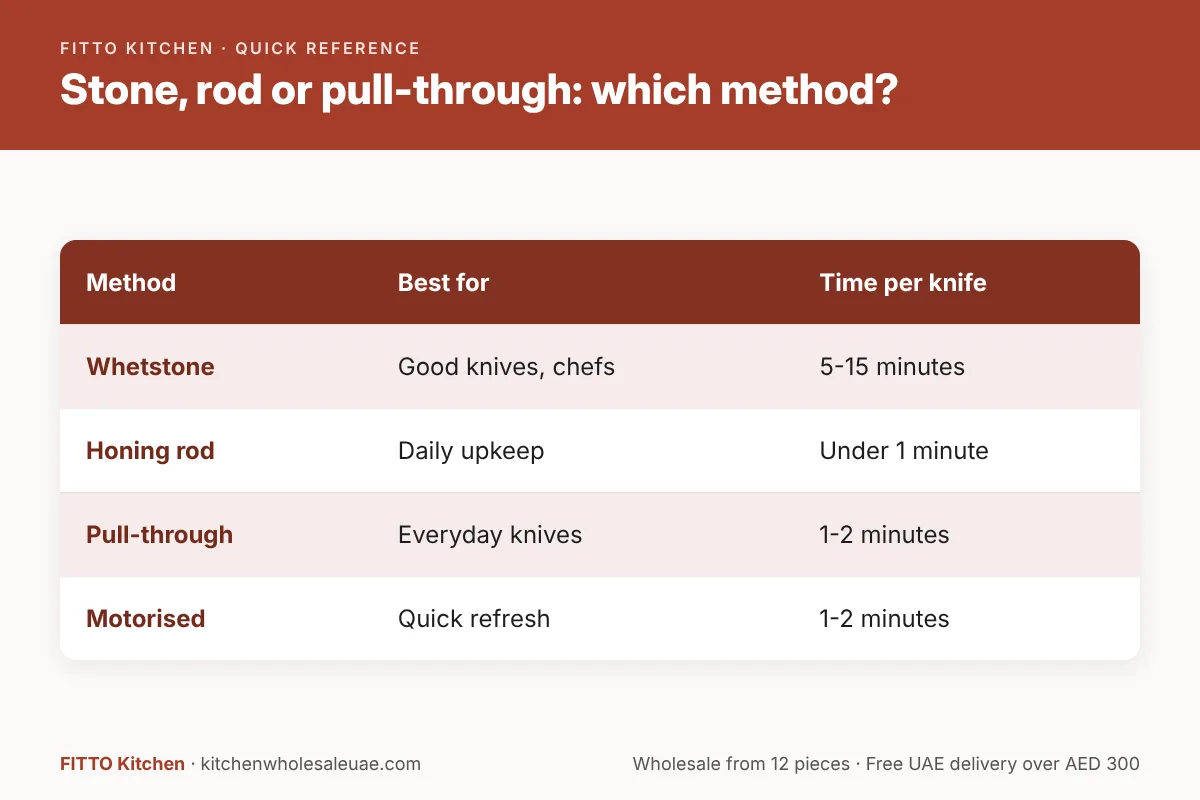
Use a whetstone for the best edge, a rod for daily upkeep and a pull-through when speed matters more than finesse.
| Method | Best for | Angle control | Time per knife | Metal removed |
|---|---|---|---|---|
| Whetstone | Good knives, chefs, butchers | Full (by hand) | 5-15 minutes | Low to medium |
| Honing rod | Daily upkeep between sharpenings | By hand | Under 1 minute | Very little |
| Pull-through (2-3 stage) | Everyday knives, busy homes, staff kitchens | Fixed by the slots | 1-2 minutes | Medium to high |
| Motorised | Quick refresh of knives and scissors | Fixed by the guide | 1-2 minutes | High if overused |
How do you find and hold the right sharpening angle?
Start from 90°, halve it twice to about 22°, then lower the spine slightly to reach 15-20°. Use about 20° for Western chef knives, 15° for many Japanese knives and 25° for cleavers.
To check, colour the bevel with a marker. After a few strokes, if ink remains at the very edge, raise the spine slightly; if it remains at the shoulder, lower it.
How to sharpen a knife on a whetstone
Work the coarse side until a burr forms along the whole edge, then refine on a finer side and remove the burr.
- Prepare the stone. Soak or wet it as its instructions say, then set it on a damp cloth so it cannot slide. The FITTO rectangular sharpening stone gives a broad, steady surface.
- Set the angle. Raise the spine to your chosen angle.
- Sharpen the first side. Push the blade across the stone heel to tip with light, even pressure, about 10-15 strokes.
- Feel for the burr. Stroke a fingertip gently off the opposite side of the edge, never along it. A rough lip along the full length means that side is done.
- Repeat on the second side with the same number of strokes until the burr flips back.
- Refine and deburr. On a finer stone, do a few lighter alternating strokes per side to polish the edge and remove the burr.
- Clean up. Rinse and dry the knife; let the stone dry fully before storing.
As a general guide, under 1,000 grit repairs dull or chipped edges, around 1,000 sharpens, and 3,000 and above polishes.
How to use a honing rod
A honing rod realigns a rolled edge in under a minute; it does not replace sharpening.
- Stand the rod upright with its tip on a damp cloth.
- Hold the knife at your sharpening angle against the top of the rod.
- Draw the blade down and towards you, heel to tip, in one smooth stroke.
- Alternate sides for 5-8 light strokes each, then wipe the blade clean.
Choose a rod longer than your longest blade: the 10-inch FITTO sharpening steel covers most chef knives, and butchers do better with a 12-inch sharpening rod.
How to use a pull-through sharpener
Pull the blade through the slots in one direction only, with light pressure, and use the coarse slot only when the knife is truly dull.
- Set the sharpener on a dry, flat surface and hold the handle firmly.
- For a dull knife, make 3-5 slow pulls from heel to tip in the coarse slot.
- Finish with 3-5 pulls in the fine slot; for touch-ups, use only this slot.
- Wash and dry the knife to remove filings.
The FITTO 3-stage white knife sharpener is designed for straight and serrated blades. Never saw back and forth or press hard.
How often should you sharpen a kitchen knife?
Hone little and often; sharpen when honing no longer brings the edge back, or when the knife tears a ripe tomato. As a rule of thumb:
- Home cooks: hone weekly or before big cooking sessions; sharpen every two to three months.
- Restaurant cooks: hone before every shift; sharpen every one to two weeks.
- Butchers: hone many times a day; sharpen weekly, and more often during Eid al-Adha weeks.
Glass and marble boards dull edges fast; our guide to wooden vs plastic cutting boards explains which boards are kinder to edges.
When is a knife past saving?
Replace a knife when sharpening cannot fix the damage or it is no longer safe to hold. Signs include:
- A cracked blade, or a chip too deep to grind out.
- A loose or split handle, which traps food and can slip in a wet hand.
- An edge worn so far that the heel or bolster hits the board first.
- Deep rust pitting along the edge, common when knives are left wet in humid kitchens.
When buying new, see our chef knife vs santoku vs cleaver comparison and the kitchen knives and cutting boards guide.
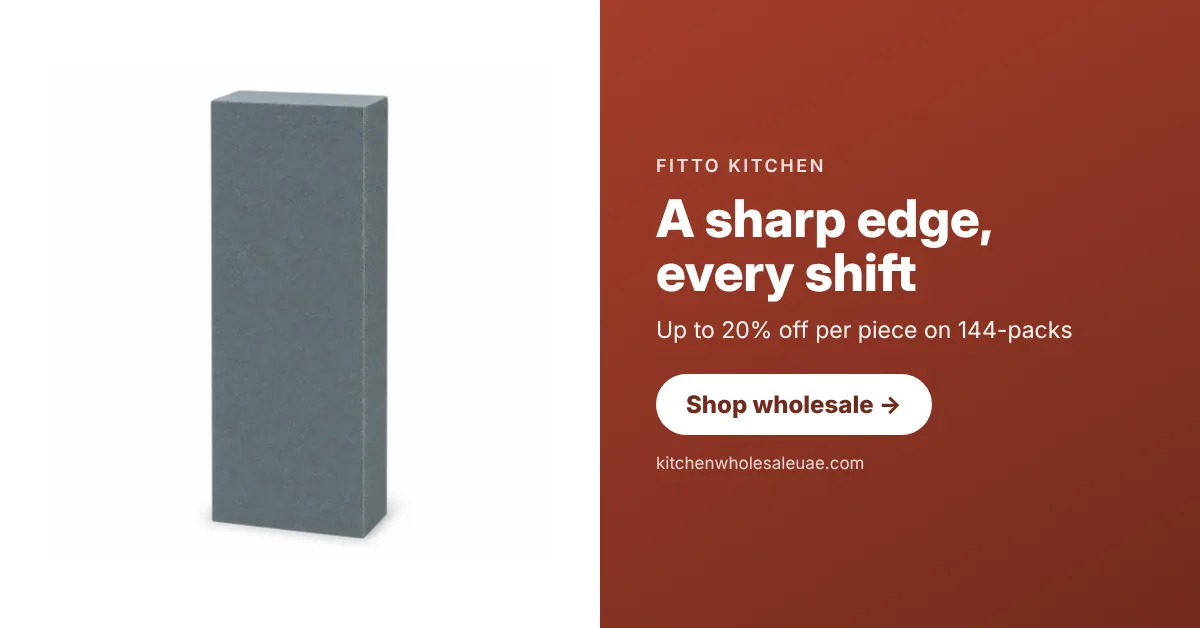
FITTO Trade Pick: A sharp edge for every kitchen Pair the rectangular sharpening stone with a 10-inch sharpening steel for kitchens that care for their knives. Wholesale prices start from 12 pieces, with up to 20% off per piece in packs of 144.
The bottom line
Sharpening comes down to a steady angle, a burr along the full edge and light finishing strokes. Hone often, sharpen when honing stops working, and retire unsafe knives.
Browse our knives and cutting boards range, request a quote for stones and steels, or order a sample to try one first. Delivery is free over AED 300, and the Trade Desk answers on WhatsApp at +971 55 672 6947. FITTO Kitchen: fit for the way you cook.
FAQ
What angle should I sharpen a kitchen knife at?+
About 20° per side suits most Western and German-style knives. Many Japanese knives use about 15° for a finer edge, and cleavers around 25° for toughness. Check the maker's guidance if you have it.
Do I need to soak a whetstone before use?+
It depends on the stone. Soaking water stones stay in water until bubbles stop rising, usually 10-15 minutes. Splash-and-go stones only need wetting, and oil stones use honing oil. Follow your stone's instructions.
Can I sharpen a serrated knife?+
Yes, with a tapered rod worked into each scallop, or a pull-through with a slot made for serrated blades. Never grind a serrated knife flat on a whetstone, because that removes the teeth.
Is it bad to use a pull-through sharpener on good knives?+
Not for everyday stainless knives, if you use light pressure and mostly the fine slot. Fixed slots remove more metal than a stone and may not match thin Japanese blades, so expensive knives last longer on a whetstone and rod.