Kitchen knives and cutting boards: a complete guide for UAE kitchens and buyers
By FITTO Trade Desk · Last updated 29 October 2026
Buying kitchen knives wholesale in the UAE starts with matching each knife to its job: a 20 cm chef knife for most cutting, a paring knife for detail, a serrated bread knife and a cleaver for bone. Pair them with colour-coded plastic or wooden boards, a honing rod and safe storage, and both kitchens and shoppers stay happy.
Key takeaways
- Four knives cover most kitchens: chef or santoku, paring, bread and a cleaver or boning knife.
- Stainless steel blades resist rust in humid UAE kitchens; harder steel holds an edge longer but is tougher to sharpen.
- Colour-coded boards separate raw meat, fish, vegetables and bakery to cut cross-contamination risk.
- A honing rod keeps edges straight between sharpenings and costs far less than replacing dull knives.
- Store knives on a magnetic strip or in a block, never loose in a drawer or left in the sink.
Dull knives slow every prep shift, and a worn or wrong board can fail a hygiene check. Both cost time, stock and customer trust. This guide settles which knives and boards to buy, how to keep them sharp and safe, and what a kitchen or shop should stock.
At FITTO Kitchen, a wholesale knives and cutting boards supplier in the UAE, we supply kitchen knives (سكاكين المطبخ) and cutting boards (لوح تقطيع) to restaurants, butchers, hotel kitchens and kitchenware retailers. This guide is for chefs, purchasing teams, shop owners and serious home cooks.
Which kitchen knives does a kitchen actually need?
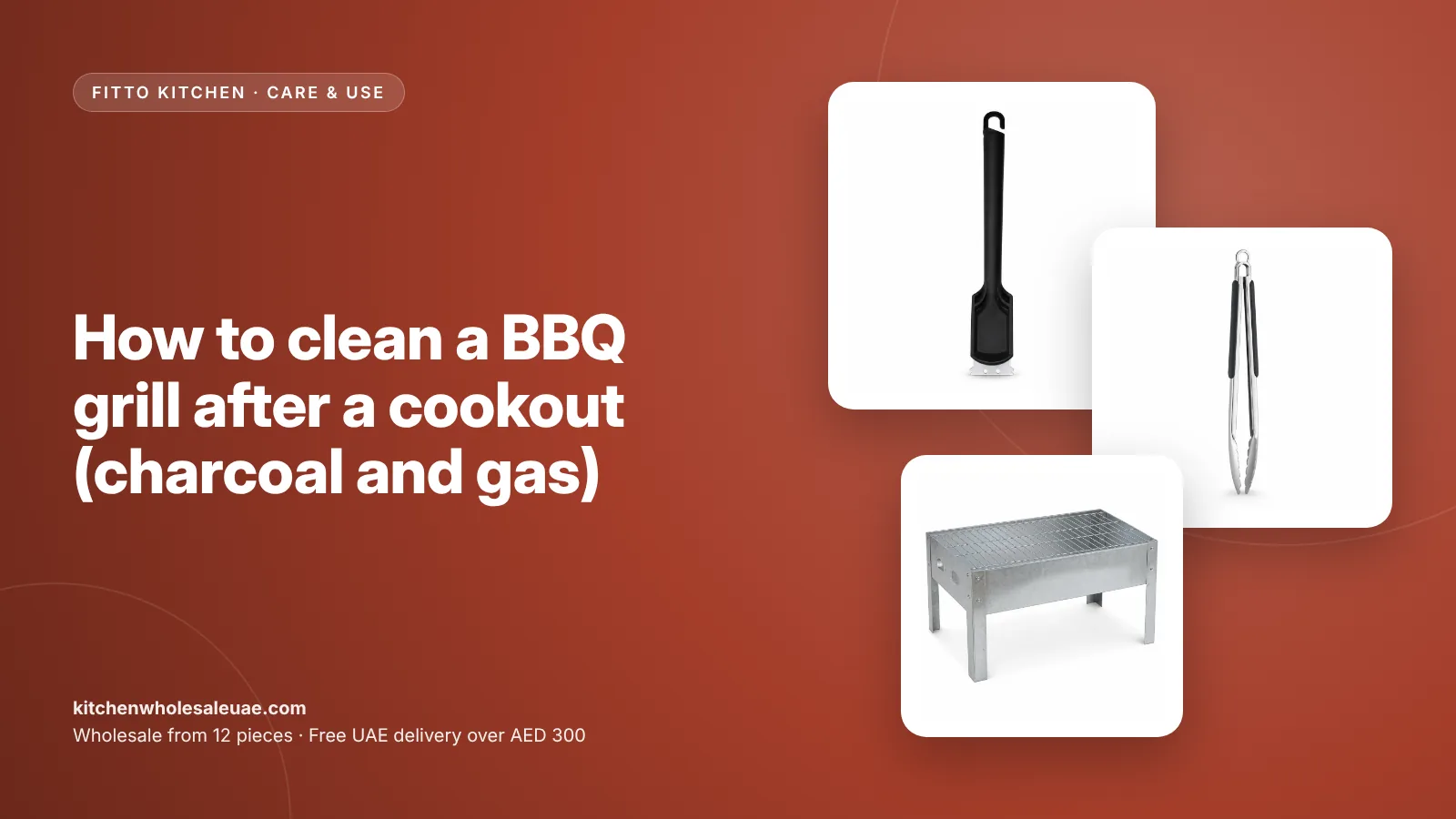
Most kitchens need four knife types: a chef knife or santoku for general cutting, a paring knife for small work, a serrated bread knife, and a cleaver or boning knife for meat. Everything else is a specialist addition.
| Knife | Typical blade length | Main jobs | Who needs it |
|---|---|---|---|
| Chef knife | 15 to 25 cm (6 to 10 inch) | Chopping, slicing, dicing almost anything | Every kitchen |
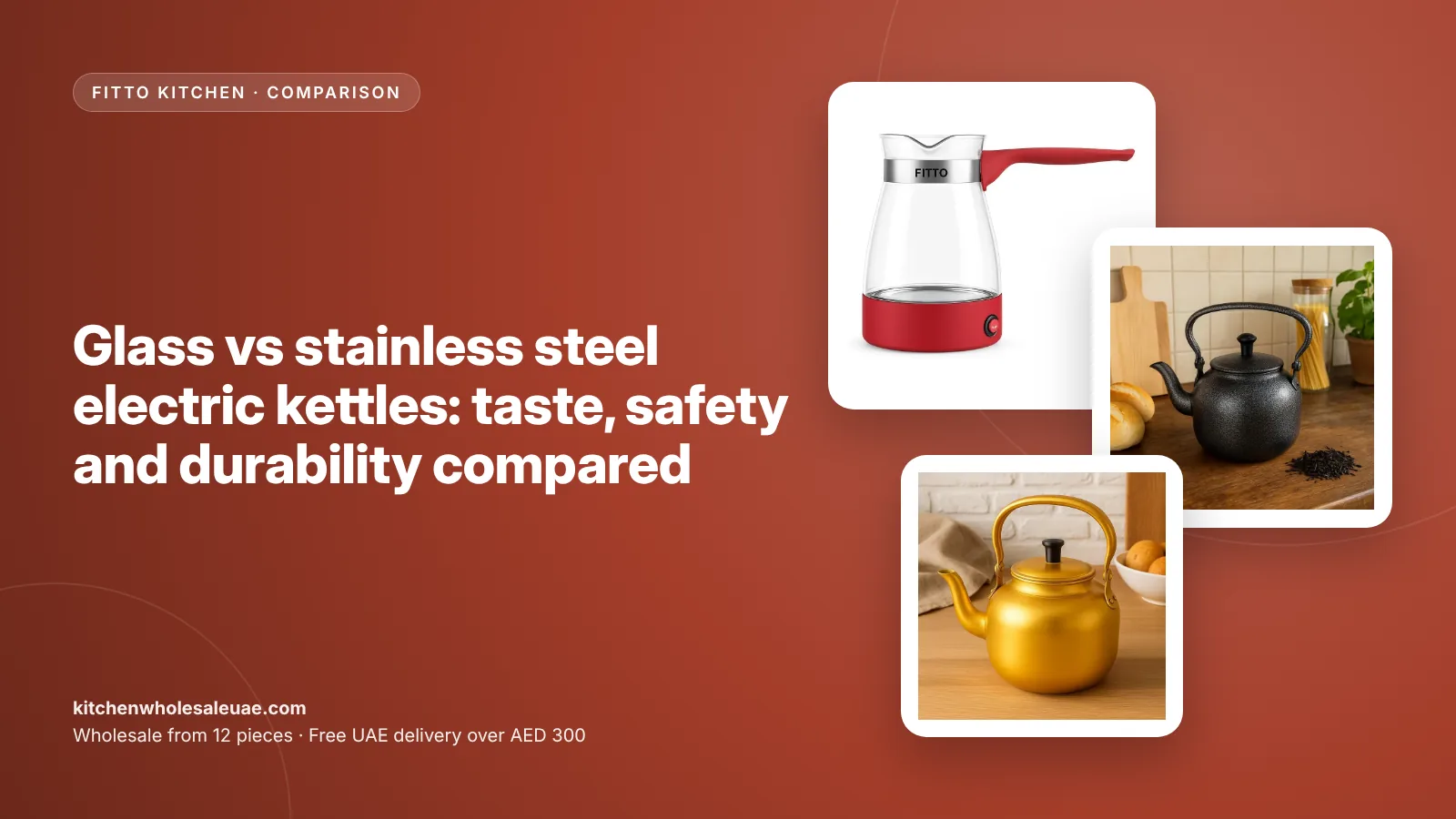
| Santoku | 15 to 18 cm (6 to 7 inch) | Thin slicing of vegetables, fish and boneless meat | Home cooks, Asian menus, prep cooks |
| Paring knife | 7.5 to 10 cm (3 to 4 inch) | Peeling, trimming, fruit, garnish | Every kitchen |
| Utility knife | 12 to 15 cm (5 to 6 inch) | Sandwiches, small produce, cheese | Cafés, home cooks |
| Bread knife | 20 to 25 cm (8 to 10 inch), serrated | Bread, cakes, tomatoes | Cafés, bakeries, homes |
| Carving knife | About 20 cm (8 inch), narrow | Slicing roasts, shawarma and cooked meat | Hotels, buffets, grills |
| Cleaver or meat chopper | Wide, heavy blade | Chopping through bone and joints | Butchers, grill and Asian restaurants |
| Boning knife | Slim, narrow blade | Separating meat from bone | Butchers, hotel kitchens |
A 20 cm (8-inch) chef knife is the safest single choice for a professional cook. A 15 cm (6-inch) version suits smaller hands, home cooks and tight prep spaces.
Our guide to chef knives for restaurants covers blade length, steel and handle choice for each station.
What blade steel should you look for?
For most UAE kitchens, choose stainless steel blades. They resist rust in humid kitchens and survive daily washing. Harder steel keeps a sharp edge longer, while softer steel is easier to resharpen and less likely to chip.
Knife hardness is measured on the Rockwell C scale (HRC). Many everyday Western-style kitchen knives sit in the mid-50s, while harder Japanese-style blades go higher. Few product titles state hardness, so judge a knife by these signs instead:
- Edge retention: how long it slices a tomato cleanly before needing a hone.
- Ease of sharpening: softer blades respond quickly to a rod or stone.
- Rust resistance: stainless blades should not spot if dried after washing.
- Balance: the knife should feel steady when you pinch it where the blade meets the handle.
For a busy restaurant with many users, a mid-range stainless blade that sharpens easily is often the better buy. Staff turnover, dishwashers and drops are hard on expensive knives.
Which handle material is best?
Plastic handles are the most practical for commercial kitchens because they are easy to sanitise and come in colours for food-safety coding. Wooden handles feel warm and grippy but need drying. One-piece steel handles are hygienic but can be slippery when wet.
| Handle | Grip | Hygiene and care | Best for |
|---|---|---|---|
| Plastic, PP or PVC | Good, often textured | Easy to wash; colours allow coding | Restaurants, hotels, butchers |
| Wood or wood-effect | Warm, comfortable | Hand wash and dry; avoid soaking | Home cooks, gift sets |
| Stainless steel (one-piece) | Can slip when wet | Very hygienic, no joints | Hotels, hygiene-focused kitchens |
Coloured handles help kitchens match knives to boards. FITTO lists 8 and 10-inch kitchen knives with red, blue and white PVC handles, so a red-handled knife can stay with the red raw-meat board.
Which cutting board material should you choose?
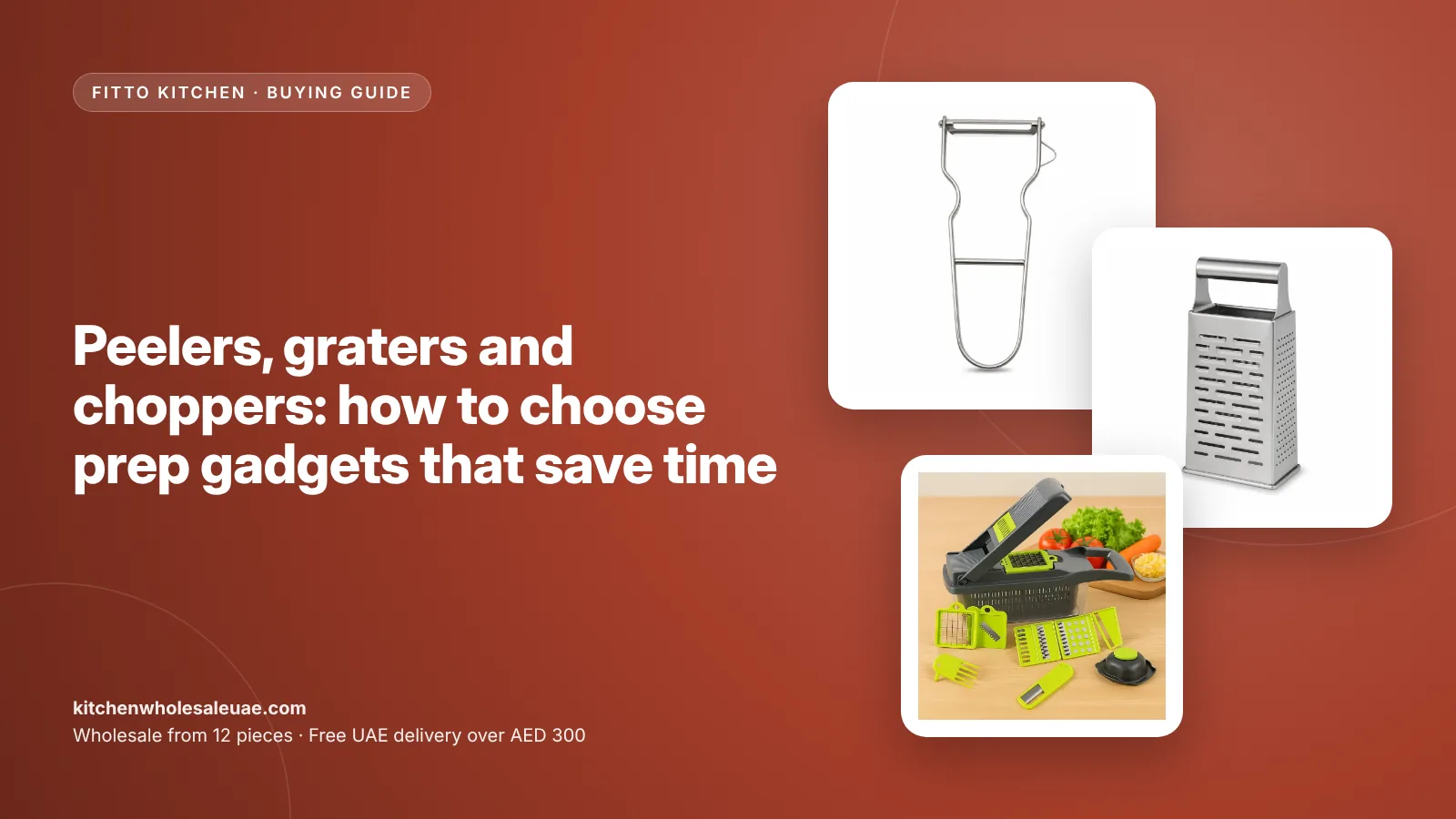
Choose plastic boards for raw meat, fish and colour-coded commercial prep, because they tolerate hot washing. Choose wooden boards for bread, vegetables and serving, because they are gentle on knife edges and look good at the pass.
| Board material | Knife-edge wear | Cleaning | Lifespan | Best for |
|---|---|---|---|---|
| Plastic (PP or HDPE) | Gentle | Hot wash; check the label for dishwasher use | Replace when deeply scored | Raw meat, fish, colour coding |
| Wood | Very gentle | Hand wash, dry upright, oil regularly | Long if oiled and kept dry | Bread, vegetables, serving |
| TPU (flexible) | Gentle | Easy wash; bends for pouring | Medium | Home kitchens, quick prep |
| Bamboo | Harder on edges | Hand wash, oil occasionally | Medium to long | Serving, light prep |
Plastic boards of around 35 x 20 cm suit home and café prep. Commercial stations need larger boards that give room to work without food spilling onto the counter. A thicker board, such as a 10 mm plastic board, stays flatter and steadier under heavy chopping than a thin flexible one.
We compare the two main materials in detail in wooden vs plastic cutting boards.
How does the colour code for cutting boards work?
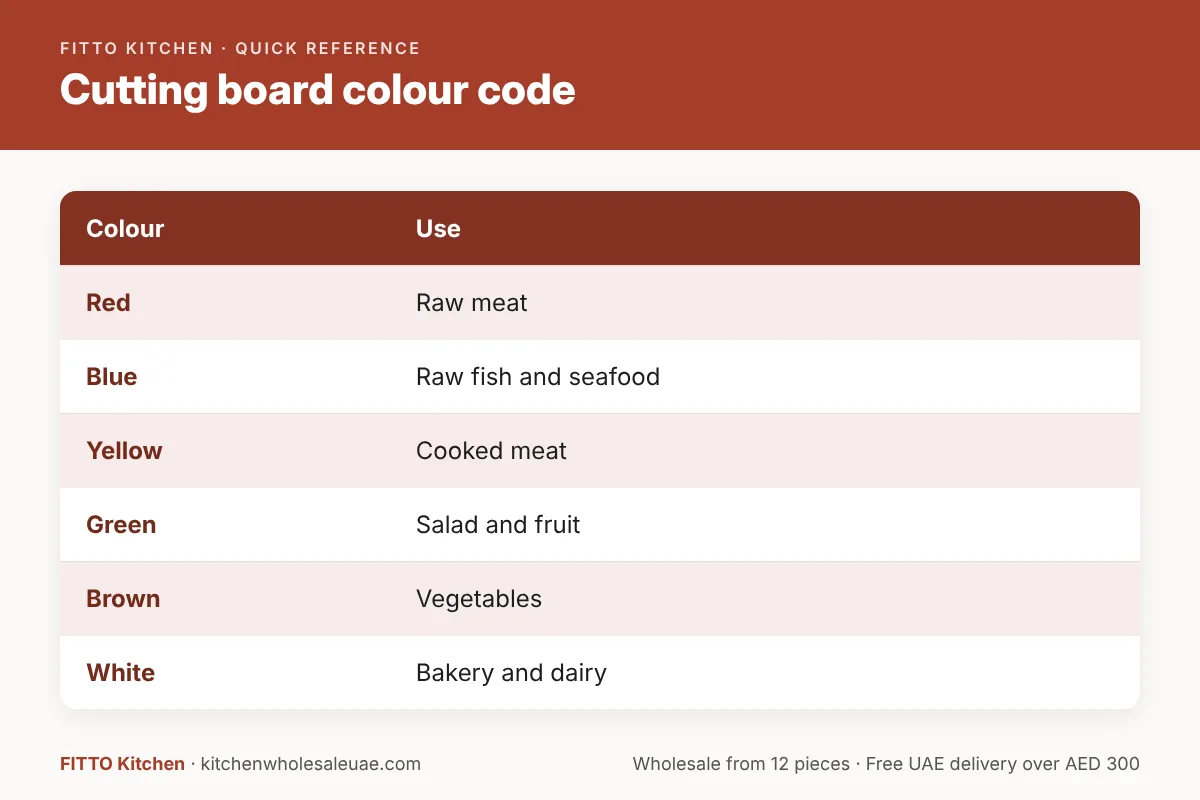
Colour-coded boards and knife handles separate foods that should never touch the same surface. The scheme below is widely used in commercial kitchens; follow the food-safety guidance of your local authority, such as Dubai Municipality or Abu Dhabi's food-safety regulator, where it differs.
| Colour | Use |
|---|---|
| Red | Raw meat |
| Blue | Raw fish and seafood |
| Yellow | Cooked meat |
| Green | Salad and fruit |
| Brown | Vegetables |
| White | Bakery and dairy |
Post the chart above the prep area and buy boards in matching sets. A colour system only works when every station has every colour it needs.
How do you keep kitchen knives sharp?
Hone often and sharpen when honing stops working. A honing rod realigns the edge in seconds, while a whetstone or sharpener removes metal to build a new edge.
- Hone with a steel rod before each shift or each heavy prep session. Hold the blade at roughly 15 to 20 degrees to the rod and make 5 or 6 light strokes per side.
- Test by slicing a tomato or a sheet of paper. If the knife skids, hone again.
- Sharpen on a whetstone when honing no longer restores the edge. Start on a medium grit, finish on a fine grit and keep the same angle throughout.
- Use a pull-through sharpener for speed if staff are not trained on stones. It is quick but removes more metal.
- Replace knives with chipped tips, loose handles or blades worn too narrow to control safely.
| Tool | What it does | How often | Skill needed |
|---|---|---|---|
| Honing rod (8 to 12 inch) | Straightens the edge | Daily or each shift | Low |
| Whetstone | Grinds a new edge | Every few weeks to months | Medium to high |
| Pull-through sharpener | Quick new edge | When dull | Low |
| Electric or battery sharpener | Fast, consistent edge | When dull | Low |
How should knives and boards be stored and cleaned?
Store knives on a magnetic strip or in a block, never loose in a drawer. Wash knives by hand straight after use and dry them before storing. Wash boards hot, stand them upright to dry and replace them when grooves get deep.
- Magnetic strips keep blades visible, dry and off the counter, which suits small UAE apartment kitchens and busy commercial lines. A 33 cm strip holds a basic home set.
- Knife blocks protect edges on a home counter.
- Never leave knives in a sink of water; it is a cutting hazard and dulls the edge.
- Steady every board on a damp cloth or non-slip mat so it does not slide while cutting.
- Oil wooden boards when they look dry, especially in air-conditioned rooms where wood can crack.
Our kitchen organisation and racks range includes magnetic knife holders, knife blocks and board racks.
What should a kitchen or shop stock?
A restaurant should stock knives per cook and boards per colour per station. A shop should stock a tight range: one or two chef knife sizes, sets, paring and bread knives, sharpeners and boards in two or three sizes.
Restaurant or hotel kitchen
- One chef knife and one paring knife per cook, plus spares for new staff
- A bread knife for the pastry or breakfast station
- Cleavers and boning knives where meat is broken down on site
- A full set of colour-coded boards per prep station
- Honing rods at each station and a shared whetstone or sharpener
Butcher or meat counter
- Cleavers, boning knives and butcher knives
- Large, thick plastic boards for raw meat
- Sharpening steels within arm's reach
Kitchenware shop or online seller
- Knife sets of 3 to 12 pieces, which make clear gifts and value bundles
- Chef knives in 15 and 20 cm with coloured handles
- Paring and bread knives as add-on sales
- Sharpening rods, whetstones and 3-stage sharpeners
- Plastic and wooden boards in two or three sizes
Ramadan, Eid al-Adha and the cooler BBQ months bring heavier meat prep at home, so cleavers, large boards and sharpeners deserve shelf space ahead of those dates.
How should you plan a kitchen knives wholesale order in the UAE?
Plan by headcount and station, test one knife before committing, and count sets correctly. That keeps every cook equipped without paying for knives nobody uses.
- Count cooks per shift and prep stations, then list one chef knife and one paring knife per cook plus one board per colour per station.
- Add 10 to 20% spares as a rule of thumb, to cover new staff, losses and knives away for sharpening.
- Test one knife from each line for a week of real prep to check balance, grip and edge.
- Read the piece count in each set title. Twelve sets of a 3-piece knife set give 36 knives, and twelve of a 12-piece set give 144 knives.
- Schedule sharpening and replacement, so worn knives are swapped before they become a safety risk.
For pack sizes, pricing and delivery, see how ordering, pack sizes and delivery work.
FITTO Trade Pick: Knives and boards for safer, faster prep Start with the 8-inch chef knife with blue handle, the 7-inch santoku knife with dimpled blade, the large wooden cutting board with handle and the 10-inch knife sharpener steel rod. Feel the balance first: order a sample at the single-piece price, credited on a bulk order of AED 2,000+ within 30 days.
The bottom line
A small set of well-chosen knives, colour-coded boards and a honing rod does more for speed and hygiene than a drawer full of blades. Match each knife to its job, store it safely, and keep it sharp.
Browse our wholesale knives and cutting boards, request a quote for a full kitchen or shop range, or order a sample first. Wholesale prices start from 12 pieces, with up to 20% off per piece on 144-piece packs, and the trade team is on WhatsApp at +971 55 672 6947. FITTO Kitchen: fit for the way you cook.
FAQ
What size chef knife is best for a professional kitchen?+
A 20 cm (8-inch) chef knife suits most professional cooks because it handles chopping, slicing and dicing with good control. A 15 cm (6-inch) chef knife suits smaller hands and tight stations. Larger 25 cm blades help with big vegetables and volume prep but take more skill. Many kitchens give each cook a 20 cm knife plus a paring knife.
Are plastic or wooden cutting boards more hygienic?+
Both can be hygienic when cleaned and replaced properly. Plastic boards tolerate hot washing and come in colours for food-safety coding, so most commercial kitchens use them for raw meat and fish. Wooden boards suit bread and vegetables but need hand washing, drying and oiling. Replace either type once deep grooves appear.
How often should kitchen knives be sharpened?+
Hone knives with a steel rod daily or before each shift, which keeps the edge straight. Sharpen on a whetstone or sharpener when honing no longer restores a clean cut, often every few weeks in a busy kitchen and every few months at home. The tomato test is a quick check: a sharp knife slices the skin without pressure.
What do coloured chopping boards mean?+
In the widely used scheme, red is for raw meat and blue is for raw fish. Yellow is for cooked meat, green for salad and fruit, brown for vegetables and white for bakery and dairy. Colour coding keeps raw and ready-to-eat foods apart. Always follow your local food-safety authority's guidance where it differs from this scheme.
What is the difference between a chef knife and a santoku?+
A chef knife has a curved edge and pointed tip, so it rocks through herbs and handles almost any task. A santoku is shorter, with a flatter edge and a rounded tip, and suits straight up-and-down slicing of vegetables, fish and boneless meat. Dimples on some santoku blades help thin slices release.
When should a cutting board be replaced?+
Replace a plastic board once knife grooves are deep enough to catch a fingernail, because they trap food and resist cleaning. Replace a wooden board if it cracks, warps or stays stained and smelly after oiling. Boards that rock on the counter should also go, since an unstable board is a cutting hazard.