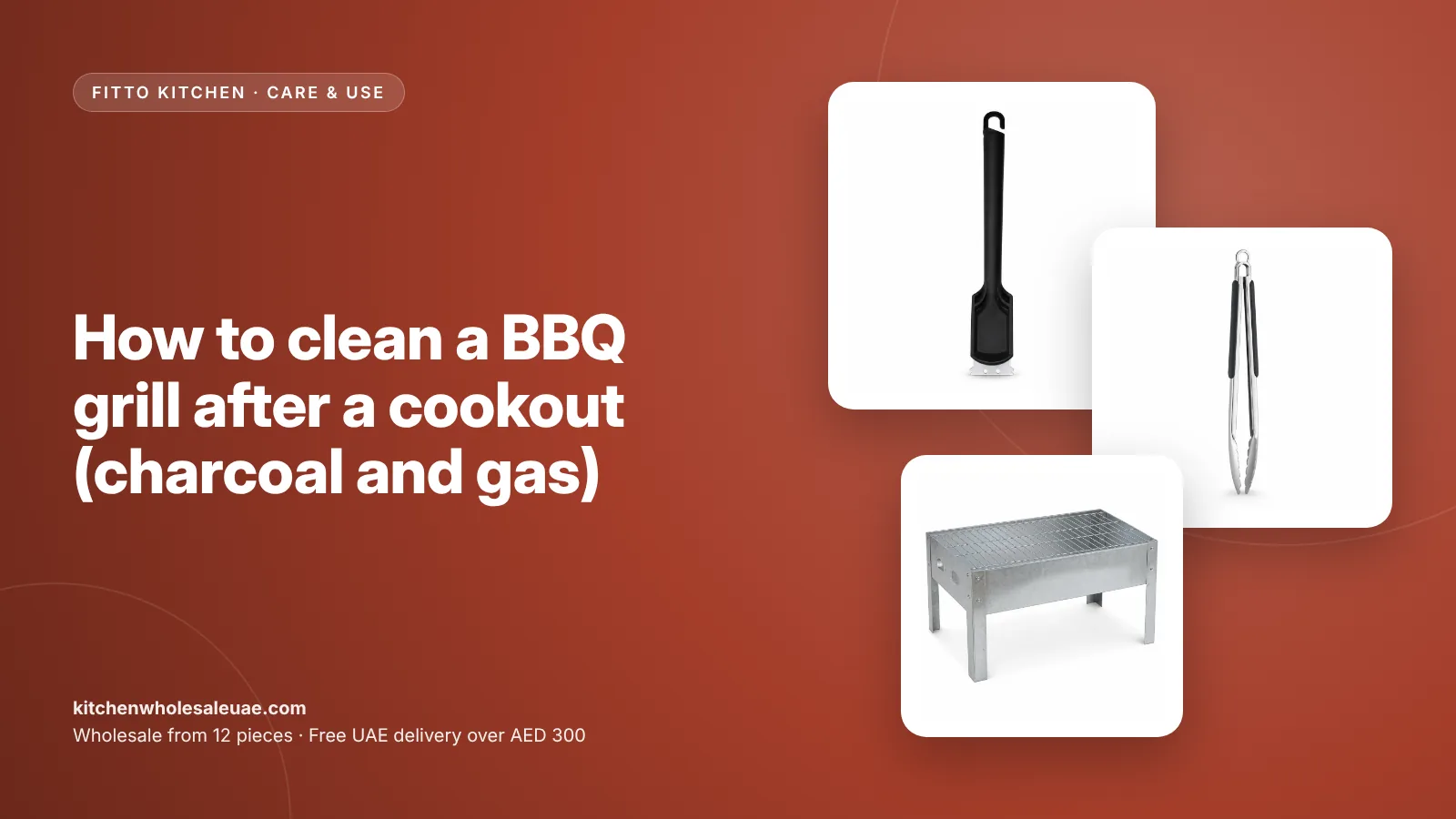
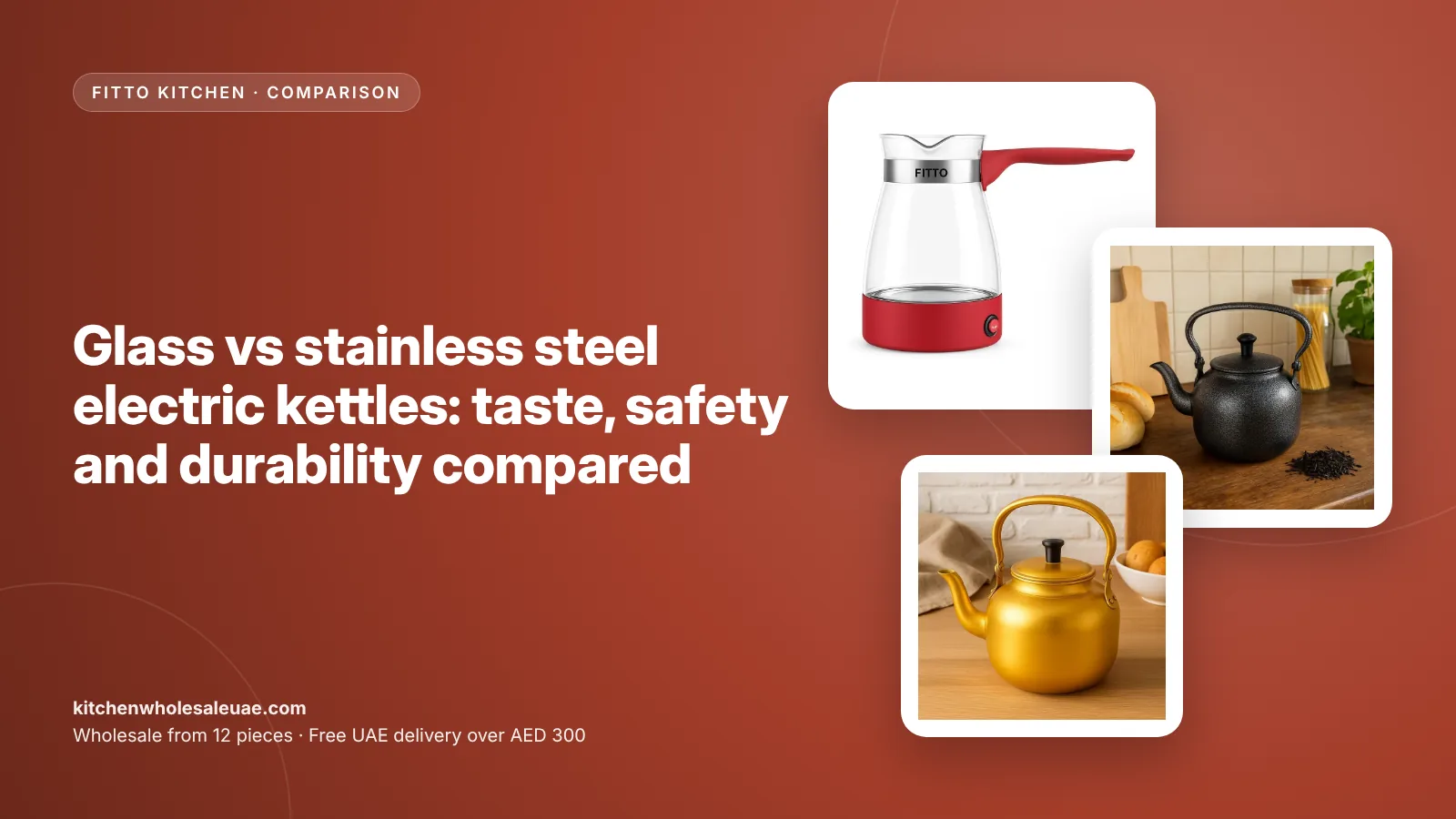
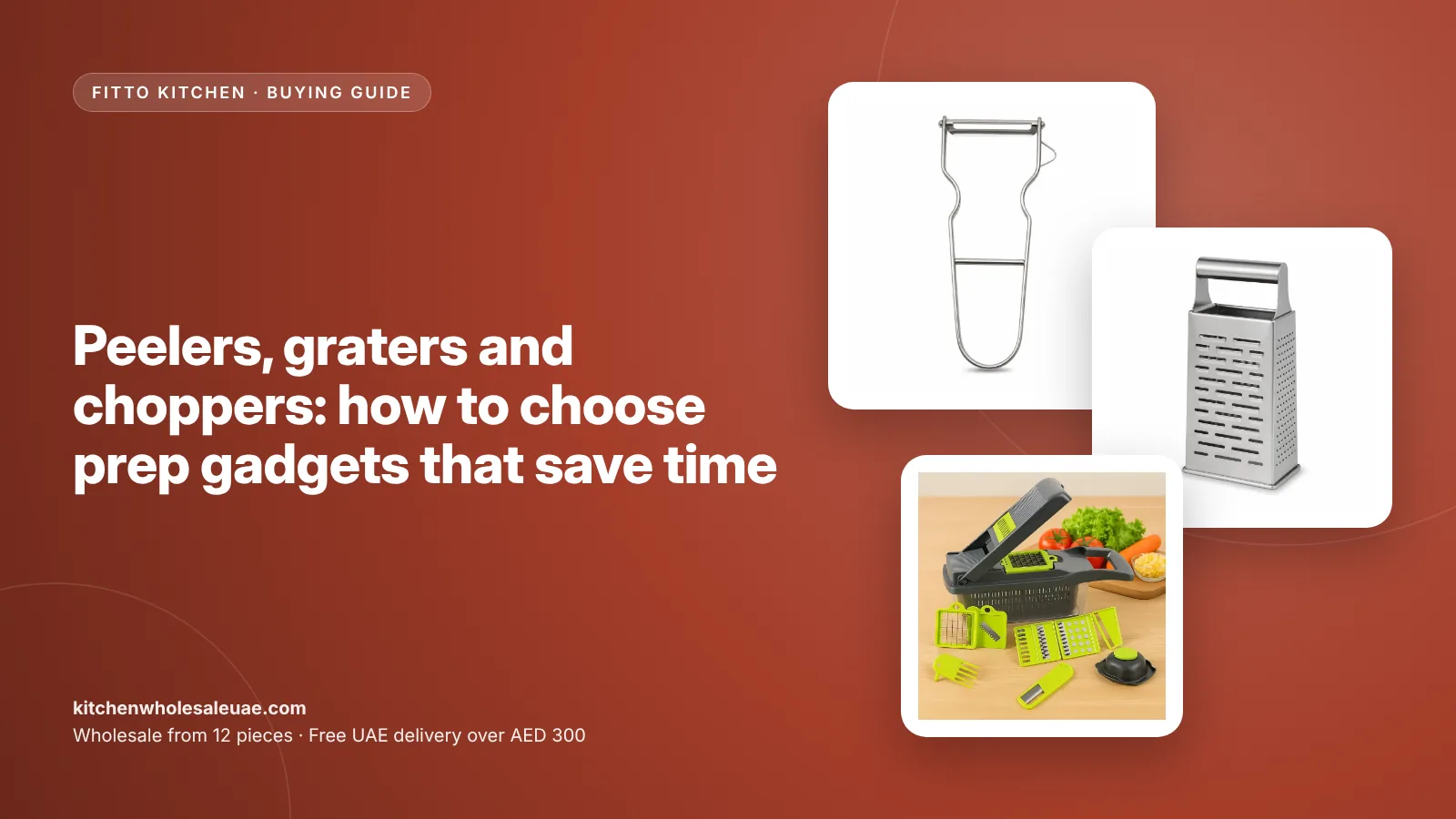
Chef knives for restaurants: how to choose blade, steel and handle that last
By FITTO Trade Desk · Last updated 29 October 2026
The best chef knife for restaurants has a 20–25 cm (8–10-inch) stainless steel blade, a handle that stays secure when wet, and a weight that suits long shifts. Give every cook a 20 cm chef knife, use colour-coded handles to keep raw meat, fish and vegetables apart, and keep a honing steel at each station.
Key takeaways
- A 20 cm (8-inch) chef knife suits most cooks; add 25 cm blades for volume prep and 15 cm blades for tight stations.
- Stainless steel is the practical choice in humid UAE kitchens; carbon steel rusts too easily for a busy line.
- Plastic, colour-coded handles are easier to keep clean and help separate raw and ready-to-eat food.
- Plan one knife per cook, colour-coded knives per raw food group and about 20–25% spares.
A dull or slippery knife slows prep, crushes herbs and causes more cuts, because cooks press harder. In a busy kitchen that means slower tickets, wasted produce and staff off the line. This guide settles which chef knife for restaurants to buy and how many each station needs.
At FITTO Kitchen, a wholesale knives and cutting boards supplier in the UAE, we supply knives to restaurants, cafés, hotel kitchens and caterers across the seven emirates. This guide is for head chefs and purchasing managers kitting out a line.
What blade length should a chef knife for restaurants have?
A 20 cm (8-inch) blade is the standard chef knife (سكين الشيف) for restaurant work. It is long enough to slice onions and portion chicken in one stroke, yet short enough to control on a crowded board.
| Blade length | Best for | Who should use it |
|---|---|---|
| 15 cm (6-inch) | Herbs, garlic, small veg, tight stations | Café kitchens, cooks with smaller hands |
| 20 cm (8-inch) | All-round chopping, slicing, dicing | Every line cook and prep cook |
| 25 cm (10-inch) | Large volumes, cabbages, melons, big cuts | Prep teams, catering, banqueting |
An 8-inch knife is about 33 cm overall, so check it fits your racks.
Which steel is best for a commercial chef knife?
Stainless steel is the best everyday choice for a commercial chef knife in the UAE. It resists rust from steam, humidity and constant washing, which matters in coastal kitchens in Dubai, Abu Dhabi and Sharjah.
Blade hardness is measured on the Rockwell scale (HRC). As a general guide:
- Softer stainless (roughly 54–58 HRC): easy to hone, tolerant of knocks, needs more frequent touch-ups. Good for high-turnover lines.
- Harder stainless (roughly 58–61 HRC): holds an edge longer but can chip if twisted in bones or dropped. Better for experienced chefs.
- Carbon steel: takes a very sharp edge but rusts and stains quickly. Rarely practical for a shared restaurant line.
If hardness is not printed, test a sample through a full prep shift and note how soon it needs honing.
Chef knife or santoku: which should cooks use?
Use a chef knife as the main tool and a santoku as a second option for fine vegetable work.
| Knife | Typical blade | Strength | Weak point |
|---|---|---|---|
| Chef knife | 20 cm, curved edge | Rocking cuts, all-round prep, meat | Tip can feel long on small boards |
| Santoku | 18 cm (7-inch), flatter edge, often dimpled | Thin, even vegetable slices; food sticks less | Less suited to rocking cuts |
| Cleaver | 15–20 cm, wide heavy blade | Chopping through small bones, crushing garlic | Heavy for long slicing tasks |
For a full knife line-up beyond chef knives, see our kitchen knives and cutting boards guide.
What makes a good chef knife handle in a commercial kitchen?
A good commercial handle is non-slip when wet, sealed against water and comfortable for a full shift.
- Moulded plastic handles: sealed, easy to sanitise and available in colours. The practical choice for most lines.
- Riveted wooden or wood-effect handles: comfortable and good-looking, but natural wood needs hand washing and can crack if soaked.
- Steel ferrule or bolster: the metal collar between blade and handle adds balance and protects fingers.
Test a sample with wet hands: if it twists or slips, it will cause cuts in a rush.
Why do restaurants use colour-coded chef knives?
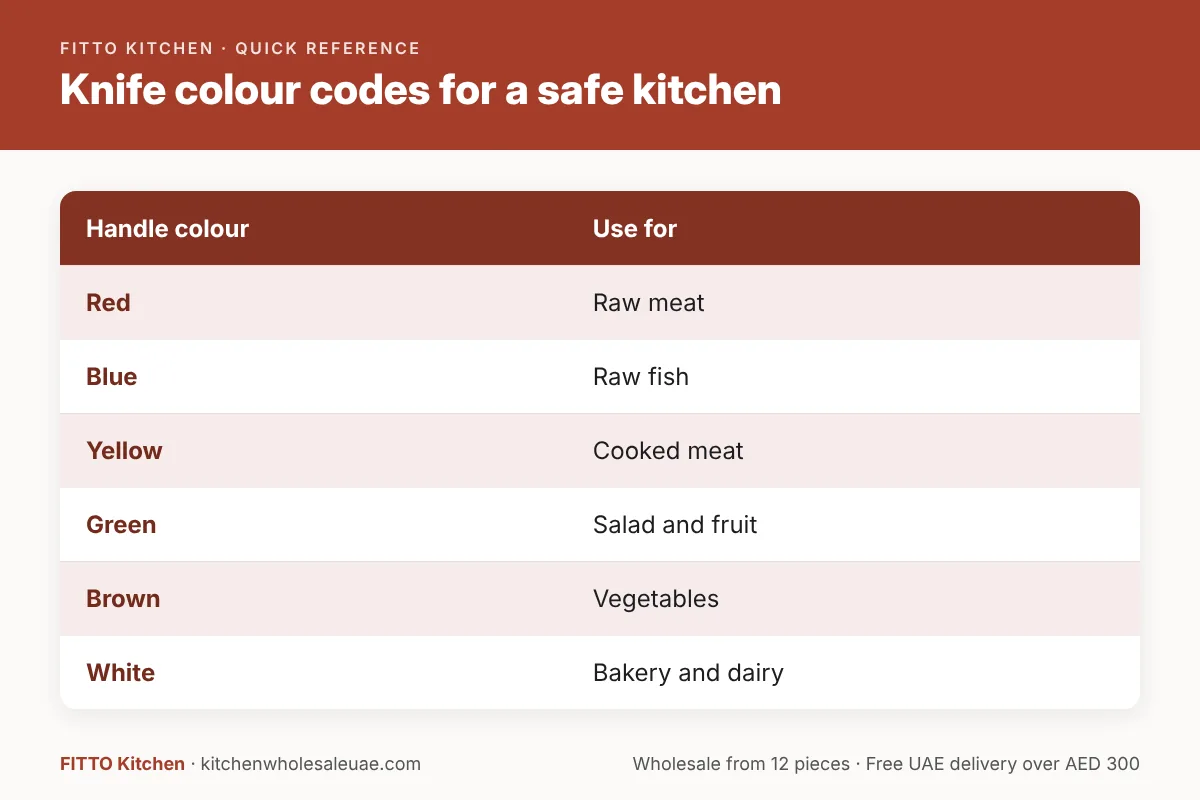
Colour-coded handles help stop cross-contamination by keeping one knife for each food group. Many kitchens follow a widely used scheme: red for raw meat, blue for raw fish, yellow for cooked meat, green for salad and fruit, brown for vegetables and white for bakery and dairy.
Match the knife colour to the board colour, and post the chart at each station. Check that your scheme matches your own food safety plan and what local inspectors expect. Our wooden vs plastic cutting boards comparison covers the board side.
How many chef knives does each station need?
Plan for one personal chef knife per cook, plus spares and colour-coded knives for each raw food group. Knives go missing and go out for sharpening, so exactly one per cook runs short within weeks.
Follow these steps to size your order:
- Count your cooks per shift. Give each one a 20 cm chef knife.
- Add colour-coded knives. One per raw food group per prep station: usually red, blue, green and yellow.
- Add specialist blades. One 25 cm knife and one cleaver per prep section; a santoku where cooks prefer one.
- Add 20–25% spares. Cover losses, sharpening days and new staff.
- Add a honing steel per station. A 25 cm (10-inch) rod suits most chef knives, because the rod should be longer than the blade.
Worked example for 6 cooks per shift and 2 prep stations:
| Item | Calculation | Quantity |
|---|---|---|
| 20 cm chef knives | 1 per cook | 6 |
| Colour-coded knives | 4 colours × 2 prep stations | 8 |
| 25 cm knives and cleavers | 1 of each × 2 prep stations | 4 |
| Spares | About 20–25% of 18 | 4 |
| Honing steels | 1 per station (2 prep + 2 line) | 4 |
That is 22 knives and 4 steels. The restaurant kitchen equipment checklist lists knives alongside every other station item.
When is a mid-price chef knife good enough?
A mid-price stainless chef knife is good enough for most line cooks, as long as it is honed daily. Knives are lost, dropped and swapped between shifts, so expensive blades rarely pay back.
Spend more where it counts: the head chef, the carving station and anyone doing fine, repetitive cuts. For everyone else, a 20 cm stainless knife with a plastic handle gives clean cuts at a lower cost per cook. Hone it with 5–6 light strokes per side at the start of each shift, sharpen it on a whetstone when honing stops working, and always hand wash it.
FITTO Trade Pick: Line-ready chef knives, colour-coded by station Stock the 8-inch chef's knife for every cook, 8-inch red-handle and blue-handle stainless chef knives for raw meat and fish, and a 10-inch sharpening steel per station. Order one sample first; we credit it on a bulk order of AED 2,000+ within 30 days.
The bottom line
Buy a 20 cm stainless chef knife for every cook, add colour-coded knives for raw food, and keep a honing steel at each station. A mid-price knife that is honed daily beats an expensive one that is left dull.
Browse our wholesale knives and cutting boards, request a quote for a full line, order a sample or WhatsApp +971 55 672 6947. Wholesale prices start from 12 pieces, and delivery is free across the UAE over AED 300. FITTO Kitchen: fit for the way you cook.
FAQ
What size chef knife do most restaurants use?+
Most restaurants use a 20 cm (8-inch) chef knife as the main tool for every cook, because it balances reach and control. Prep teams handling large volumes often add 25 cm (10-inch) blades, while café kitchens and cooks with smaller hands may prefer a lighter 15 cm (6-inch) knife.
Can chef knives go in the dishwasher?+
Chef knives should be washed by hand and dried straight away. Dishwasher heat, detergent and contact with other items dull the edge and can loosen or crack handles, especially wooden ones. A quick wash-and-dry routine at each station keeps knives sharp and in their colour zone.
How often should restaurant knives be sharpened?+
Hone restaurant knives at the start of every shift with a steel rod to keep the edge aligned. Sharpen them on a whetstone or through a sharpening service when honing no longer restores a clean cut. In a busy kitchen that is often every few weeks; a simple check is whether the knife bites into tomato skin without pressing.
What is the difference between honing and sharpening a knife?+
Honing straightens the thin edge of the blade, which bends sideways with daily use; it removes almost no metal and takes seconds on a steel rod. Sharpening grinds new metal to create a fresh edge, using a whetstone or sharpener. Hone daily; sharpen only when honing stops working.