Spice and condiment tools: a complete guide to grinders, racks and oil dispensers
By FITTO Trade Desk · Last updated 29 October 2026
Spice and condiment tools fall into four jobs: grinding (salt and pepper mills, electric grinders, mortars), storing (jars and racks), pouring (oil bottles and dispensers) and serving (squeeze bottles, honey and syrup pots). Choose ceramic mechanisms for salt, glass or steel for oil, airtight jars for spices, and buy sizes that empty within weeks.
Key takeaways
- Use ceramic grinding mechanisms for salt; steel burrs can corrode when salt and humidity meet.
- Light, heat and air are what dull spices and oil, so keep both away from the hob and sunny windows.
- A stone mortar makes garlic and chilli pastes; an electric blade grinder is faster for dry whole spices.
- Restaurants need volume and speed (squeeze bottles, large dispensers); homes and gift shops buy sets and display pieces.
- Buy oil bottles and spice jars sized to empty within a few weeks, then refill from bulk stock.
A kitchen can buy good saffron and fresh olive oil and still serve flat food. Spices go stale in open jars beside the stove, oil turns bitter in a sunny window, and a cheap pepper mill jams within a month. Each mistake wastes stock and money.
This guide covers every tool in the spice, oil and condiment family: what it does, which material lasts, and what to buy first. It is for restaurant and café kitchens, home cooks, kitchenware shops and gift retailers. At FITTO Kitchen, a wholesale spice and condiment tools supplier in the UAE, we stock mills, mortars, jars, racks and dispensers for all of these buyers.
What spice and condiment tools does a kitchen actually need?
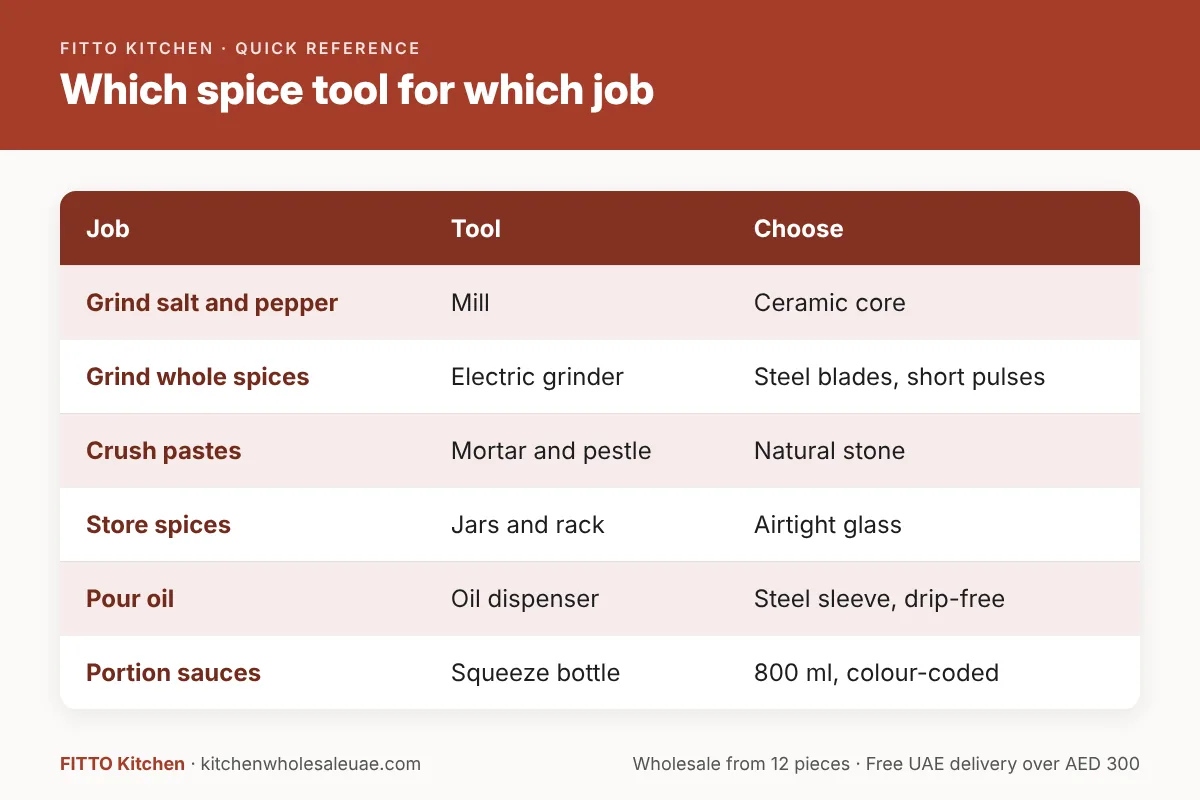
Most kitchens need one tool from each of four jobs: grind, store, pour and serve. A home might need six pieces; a busy grill restaurant might need forty, mostly bottles and dispensers.
Start with the jobs your menu actually does every day. A kitchen that cooks machboos and grills needs whole-spice grinding and a garlic paste routine. A café needs syrup and honey dispensers more than a mortar.
| Tool | Main job | Best for | Material to look for |
|---|---|---|---|
| Salt and pepper mill | Grind at the table or pass | Restaurants, homes, gifting | Ceramic core, wood or steel body |
| Electric spice grinder | Grind whole spices fast | Home cooks, small kitchens | Stainless steel blades and bowl |
| Mortar and pestle | Crush pastes and small batches | Arabic, Indian and Thai cooking | Stone for pastes, steel for easy cleaning |
| Spice jars and racks | Keep spices fresh and findable | Every kitchen | Glass jars with airtight lids |
| Oil dispenser | Pour measured oil | Cooking and table service | Glass with a sleeve, or stainless steel |
| Squeeze bottle | Portion sauces fast | Grill, shawarma and burger lines | Food-grade soft plastic |
| Honey and syrup dispenser | Serve without drips | Cafés, breakfast buffets | Glass or clear acrylic with a lever or dipper |
How do you choose a salt and pepper mill that lasts?
Choose a mill by its grinding core first and its looks second. A ceramic core handles both salt and pepper; a steel core grinds pepper well but can corrode with salt.
Salt draws moisture from the air, and humid coastal months in the UAE make that worse. A steel mechanism used for salt can corrode and jam, so ceramic is the safer default for any mill sold as a pair. An adjustable core matters too: coarse for steaks and salads, fine for soups and eggs.
Size follows use. An 8-inch (about 20 cm) mill suits dining tables and gift sets, while a 25 cm mill holds more and suits a pass or buffet. Clear bodies show the fill level, which saves a waiter checking every mill before service.
Manual or electric? Manual mills are cheaper, have no batteries to fail and suit most tables. Electric mills grind one-handed, which helps a cook holding a pan or a guest with weak wrists. USB-rechargeable models avoid the cost of disposable batteries; check the charging cable is included when you buy for resale.
When is an electric spice grinder worth it?
An electric grinder is worth it when you grind whole spices more than a few times a week. It turns cumin, coriander seed or cardamom into powder in seconds, where a mortar takes minutes.
Blade grinders chop rather than crush, so the texture is slightly uneven. That is fine for curry and rice spice mixes, less ideal when you want a perfectly even powder. Grind in short pulses of a few seconds so the spices do not heat up and lose aroma.
Keep coffee and spices apart. Spice oils linger in the bowl and flavour the next batch, so many kitchens keep one grinder for coffee and one for spices. If you must share, a rule of thumb is to grind a spoon of dry rice or stale bread between uses, then wipe the bowl. Our coffee and tea equipment guide covers coffee grinders in more depth.
Mortar and pestle: which material suits which job?
Stone suits wet pastes, wood suits dry herbs, and stainless steel suits kitchens that value easy cleaning. The heavier and rougher the mortar, the faster it breaks down garlic, ginger and chilli.
A mortar (هاون) is still the best tool for small batches where texture matters: garlic for toum, green chilli paste, crushed cardamom for gahwa. It releases oils without the heat a motor adds.
| Material | Strengths | Trade-offs | Best use |
|---|---|---|---|
| Natural stone | Heavy, grips food, makes pastes quickly | Heavy to move, needs drying after washing | Garlic, ginger, chilli pastes |
| Wood | Light, quiet, warm look | Can absorb odours and oils; hand wash only | Dry herbs, salt blends, serving |
| Stainless steel | Easy to clean, does not absorb odours | Smooth bowl grips pastes less | Seeds, peppercorns, small daily jobs |
| Aluminium | Very light, low cost | Softer metal marks over time | Light home use |
For size, a 13 cm stainless mortar handles a few spoonfuls of seeds. A stone set of about 24 x 20 x 14 cm suits family-size paste batches.
Spice jars and racks: how do you keep spices fresh and findable?
Store spices in airtight glass jars, away from heat and light, in a rack that shows every label. Freshness depends on storage; speed depends on the rack layout.
As a rule of thumb, ground spices keep their best flavour for around six months to a year, and whole spices for longer. In a UAE kitchen where the room warms up when the AC is off, keep jars away from the hob, oven vents and sunny windows. Buy small, refill often, and date the jar when you fill it.
Rack choice depends on space and the number of spices you use:
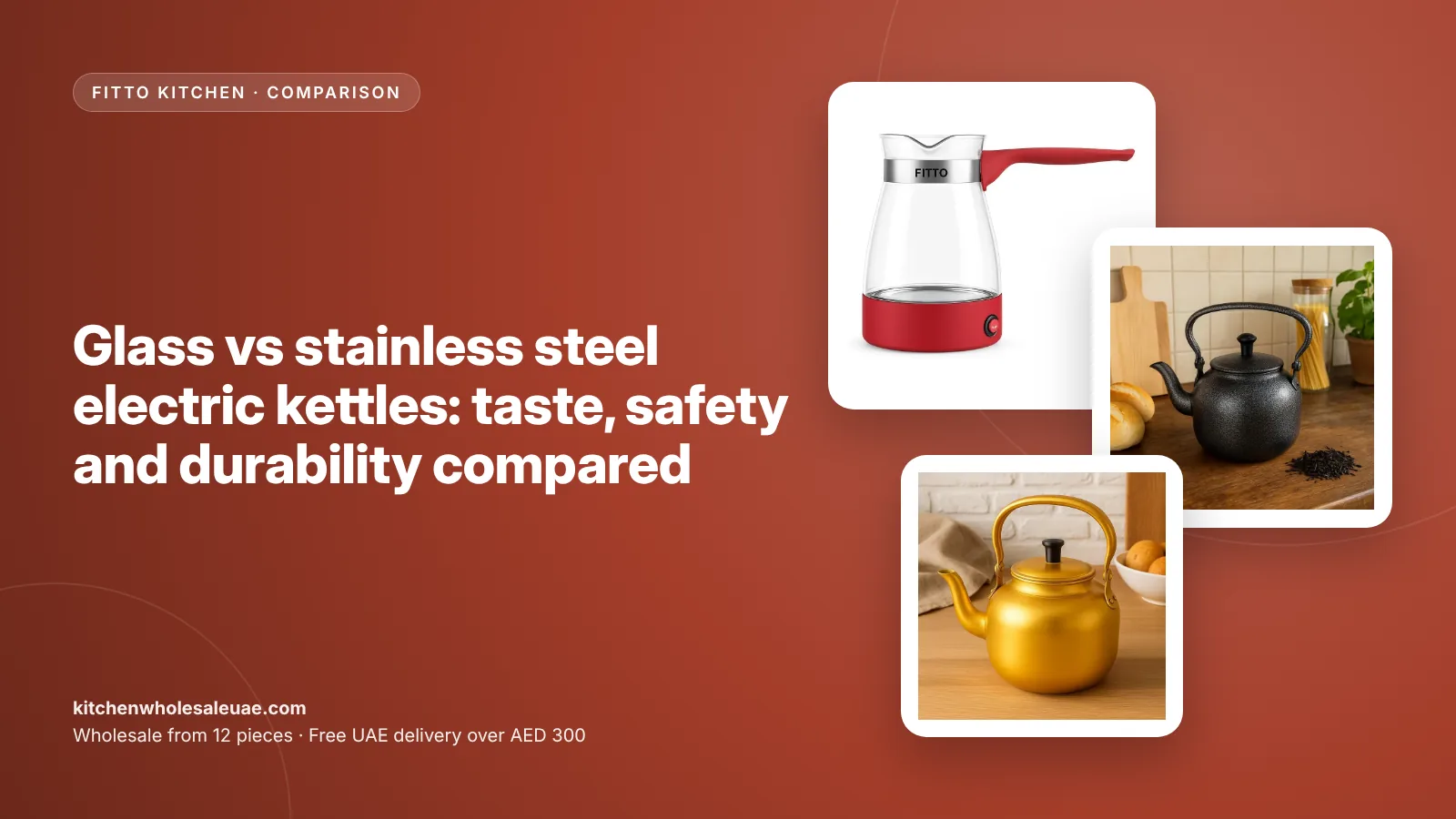
- Rotating carousel: holds many jars on a small footprint; an 18-jar carousel suits a home cook with a wide spice range.
- Two-tier turntable: a 28 x 28 x 31 cm organiser takes your own jars and suits corners and pantry shelves.
- Jar set with rack: a matched 9-jar set looks tidy on open shelves and suits gift buyers.
- Glass shakers: a 6 x 6 x 11 cm shaker with a perforated steel lid suits sumac, chilli flakes and za'atar on a pass or table.
For wall rails, fridge-door clips and wider storage ideas, see our wholesale kitchen organisation and racks range.
Oil dispensers and bottles: glass, steel or plastic?
Glass shows the level and is easy to clean; a steel sleeve or steel body adds light protection; plastic suits busy lines where breakage is a risk. Pick the spout as carefully as the bottle.
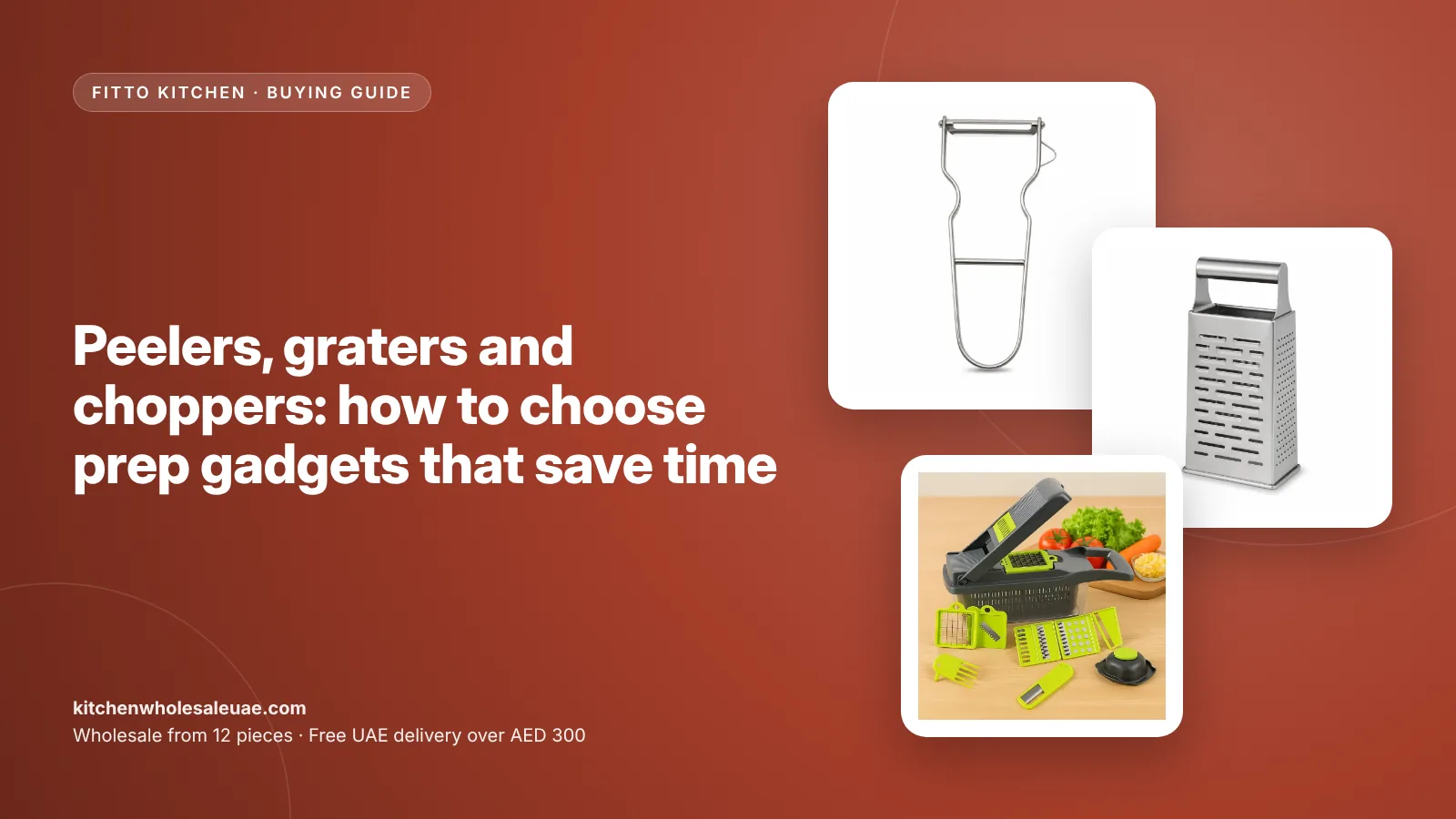
Olive oil and other cooking oils lose flavour faster with light, heat and air. A clear glass bottle on a sunny counter is the worst case. A stainless steel sleeve around the glass, or a steel bottle, shades the oil while keeping a clean look.
Capacity should match use. A 10 oz (about 300 ml) glass decanter suits a dining table or a home cook who uses olive oil cold. A 500 ml bottle suits a cooking station. Refill weekly from a larger tin rather than storing a big bottle beside the stove.
Look for a dripless spout and a seal at the neck. Drips on a table or shelf turn sticky in warm kitchens and attract ants. Stainless pourer spouts can also be fitted to existing oil bottles when you want to standardise a station quickly.
Squeeze bottles, honey and syrup dispensers: what works for service?
Squeeze bottles win on speed for sauces; lever-top glass dispensers suit syrup; a pot with a dipper suits honey at a breakfast table. Choose by how fast the item must be portioned.
Grill, shawarma and burger lines portion garlic sauce, tahini, ketchup and mayonnaise hundreds of times a shift. Large 800 ml squeeze bottles mean fewer refills during a rush; use colours to separate sauces, and label each bottle with contents and date.
Cafés serve syrup and honey differently. A 1000 ml glass syrup dispenser with a thumb-lever top pours cleanly into drinks. A clear honey pot with a wooden dipper looks good on a breakfast buffet or in a gift basket. Honey crystallises naturally over time; stand the jar in warm water to soften it rather than heating an acrylic pot in a microwave.
What should restaurants, homes and shops stock?
Restaurants buy for volume and hygiene, homes buy sets that look good, and shops need a mix of low-price impulse items and gift pieces. The table below is a starting point, not a rule.
| Buyer | Start with | Add next |
|---|---|---|
| Grill or shawarma restaurant | 800 ml squeeze bottles, glass shakers, steel oil bottles | Stone mortar for garlic paste |
| Café | Syrup dispenser, honey pots, 300 ml oil decanters | Table salt and pepper mills |
| Home cook | Ceramic-core mill pair, spice carousel, 500 ml oil bottle | Electric spice grinder, mortar |
| Kitchenware shop | Mills, jar sets, oil bottles in two sizes | Electric mills, carousels for gifting |
| Gift retailer | Acacia mill sets, 9-jar sets, honey pots | Oil and vinegar bottles |
Ramadan and Eid hosting puts extra pressure on spice storage and table sets, so shops should have racks and mill sets on shelf a few weeks before. For a full list of what a new kitchen needs beyond condiments, see our restaurant kitchen equipment checklist.
How do you clean and care for spice and condiment tools?
Wash bottles and jars often, keep grinding mechanisms dry, and never soak wood. Most failures come from moisture, not wear.
- Empty and wash squeeze bottles and oil bottles in hot soapy water before refilling; never top up old sauce or oil with new.
- Dry jars and bottles completely, upside down on a rack, before refilling, because water spoils dry spices.
- Clean mill mechanisms with a dry brush; do not run water through a grinding core.
- Wipe an electric grinder bowl with a dry cloth after unplugging it, and keep the motor base away from water.
- Hand wash wooden mortars and mill bodies, dry them straight away, and rub in a little food-safe oil now and then.
- Scrub stone mortars with water and a brush, then let them dry fully before storing.
For more on choosing the wider range of everyday utensils, see our kitchen utensils wholesale guide.
FITTO Trade Pick: Grind, store and pour in three pieces Cover grinding, storing and pouring with three pieces: the 8-inch acacia wood salt and pepper grinder set with adjustable ceramic cores, the 360-degree rotating spice rack with 18 glass jars and the 500 ml glass oil dispenser with stainless steel sleeve. Order one of each as a sample first; we credit the sample cost on a bulk order of AED 2,000+ within 30 days.

The bottom line
Choose spice and condiment tools by job: ceramic cores for salt, airtight glass for spices, shaded bottles for oil and squeeze bottles for speed. Store everything away from heat and light, and size containers to empty within weeks. That keeps food tasting the way it should.
Browse our wholesale spice, oil and condiment tools, then request a quote for a mixed carton of mills, jars and bottles, or order a sample to check the finish first. Wholesale prices start from 12 pieces, delivery is free across the UAE over AED 300, and the Trade Desk answers on WhatsApp at +971 55 672 6947. FITTO Kitchen: fit for the way you cook.
FAQ
Can I use a pepper mill for salt?+
Only if it has a ceramic grinding core. Salt attracts moisture, and in humid weather it can corrode a steel mechanism and make it stiff or jam. Ceramic cores handle both salt and pepper. If a mill only says steel or carbon steel, keep it for pepper and label it so staff do not fill it with salt.
How long do ground spices stay fresh?+
As a rule of thumb, ground spices keep their best flavour for around six months to a year, and whole spices last longer. They do not usually become unsafe, but they lose aroma and colour. Smell a pinch: if the scent is faint, replace it. Airtight jars away from heat and light slow the loss.
Is a glass or stainless steel oil dispenser better?+
Glass is easy to clean and shows the level; stainless steel or a steel sleeve shades the oil from light, which helps it keep flavour longer. For a sunny counter or a table near a window, choose a sleeve or steel bottle. For a dark cupboard or a quick-use station, clear glass works well.
Should I buy a mortar and pestle or an electric grinder?+
Buy a mortar for pastes and small batches where texture matters, such as garlic, ginger, chilli and crushed cardamom. Buy an electric grinder for dry whole spices you grind often, such as cumin, coriander or black pepper. Many cooks keep both, because each does a different job well.
How do I stop squeeze bottles from clogging?+
Clogs come from dried sauce in the nozzle. Wipe the tip after each service, rinse nozzles in hot water daily, and wash the whole bottle before refilling. Thick sauces such as tahini flow better at room temperature, so take them out of the fridge a little before service.
What is the best spice rack for a small kitchen?+
A rotating carousel or a two-tier turntable gives the most jars per square centimetre of counter. If the counter is full, use wall rails or fridge-door clip racks instead. Choose clear jars with labels facing out, so you can find each spice without lifting every jar.