Kitchen utensils wholesale: what to stock, which materials last and how much to order
By FITTO Trade Desk · Last updated 29 October 2026
Kitchen utensils wholesale buying comes down to three decisions: match the material to the job, keep a tight core range of fast sellers, and order in quantities your shelf can clear. Stainless steel suits heat and scraping, silicone and nylon protect non-stick pans, and wood suits stirring. Start with turners, spoons, tongs, whisks, strainers and peelers.
Key takeaways
- Stock by job, not by look: cooking, prep, draining, measuring and opening tools each need a different material.
- Silicone and nylon heads protect non-stick pans; stainless steel is for cast iron, stainless pans, draining and the grill.
- A core range of roughly 15–20 everyday lines covers most requests; gadgets and novelty items are the slow movers.
- Order by sell-through: test new lines small, give bigger quantities only to tools that sell every week.
- In a busy kitchen, plan one tool in use, one in the wash and one spare for each station.
Melted nylon spatulas, scratched non-stick pans and handles that wobble loose after a month are the classic utensil complaints. Each one costs a refund, a wasted shelf slot and a customer who shops elsewhere next time. This guide settles which materials to stock, which tools sell, and how much to order so stock moves and returns stay low.
At FITTO Kitchen, a wholesale kitchen utensils and gadgets supplier in the UAE, we pack cooking tools for kitchenware shops, resellers, online sellers, restaurants and café kitchens across all seven emirates. This guide is for buyers who want a utensil range that sells steadily and survives real cooking.
What counts as kitchen utensils and gadgets?
Kitchen utensils (أدوات المطبخ) are the hand tools used to cook, prep, drain, measure and open food; gadgets are single-job tools that make one task faster. A good wholesale range covers five groups before it adds anything novel.
| Group | Typical tools | Who buys most |
|---|---|---|
| Cooking tools | Turners, solid and slotted spoons, ladles, tongs, rice spoons | Every household, restaurants, cafés |
| Prep tools | Whisks, peelers, graters, garlic presses, kitchen scissors | Home cooks, café prep stations |
| Draining tools | Spider strainers, colanders, mesh sieves, rice strainers | Restaurants, family kitchens |
| Measuring tools | Measuring cups and spoons, jugs, kitchen scales | Bakers, cafés, home cooks |
| Openers and cutters | Can openers, jar openers, pizza cutters, bottle openers | Shops, offices, hotel rooms |
Gadgets sit on top of this base. Think rotary cheese graters, peelers with built-in containers, push whisks or garlic crushers. They can sell well as impulse buys, but they rarely replace the core tools a buyer comes in for.
Which kitchen utensil materials last longest?
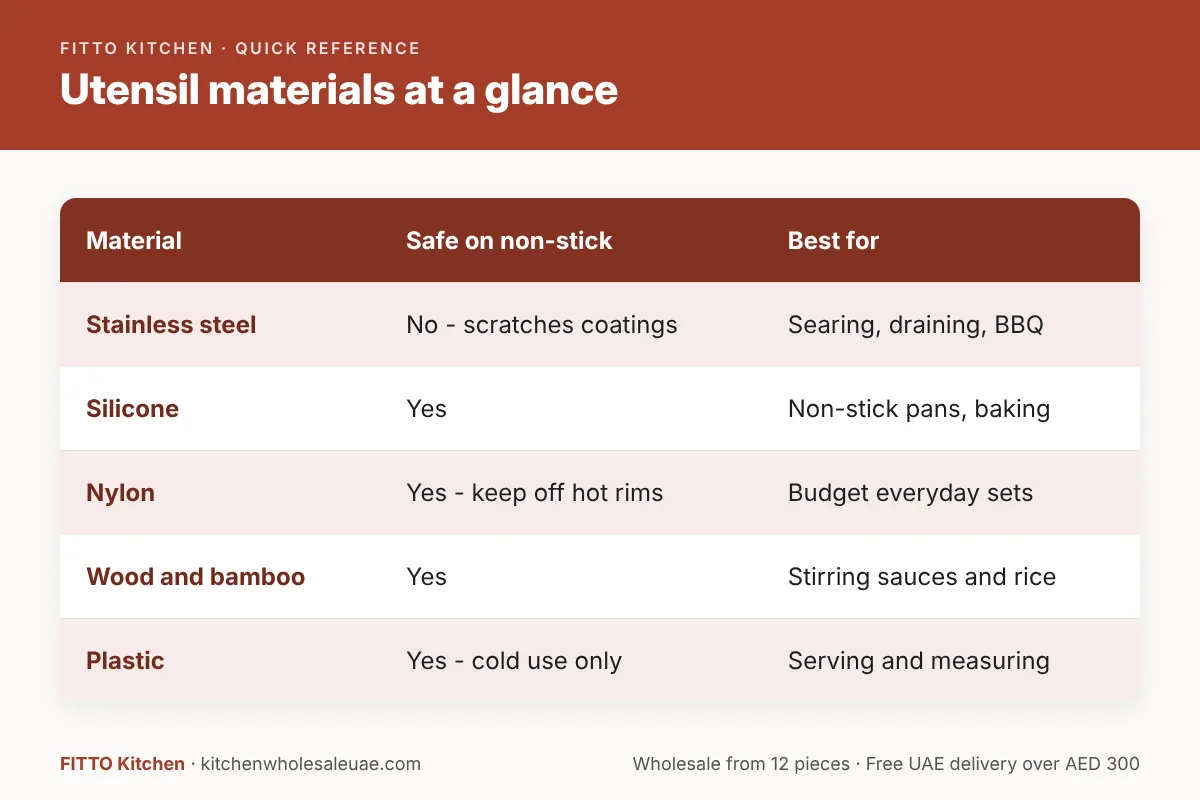
Stainless steel lasts longest overall, but the right material depends on the pan and the job. A stainless turner will outlive a nylon one, yet it will also scratch a non-stick pan with daily use. Match the head material to the cookware your customer owns.
| Material | Safe on non-stick? | Heat guide (typical) | Best for | Weak point |
|---|---|---|---|---|
| Stainless steel | No – scratches coatings | Very high | Searing, flipping on steel or cast iron, draining, BBQ | Heavier; metal handles can get hot |
| Silicone | Yes | Often rated around 200–230 °C – check the pack | Non-stick pans, scraping bowls, baking | Cheap silicone can tear or stain |
| Nylon | Yes | Usually lower than silicone, around 200 °C | Budget everyday sets | Melts if left resting on a hot pan |
| Wood and bamboo | Yes | Will not melt, but can scorch | Stirring sauces, rice, curries | Cracks if soaked or left wet |
| Plastic (PP/ABS) | Yes | Low | Serving tongs, measuring, cold prep | Not for frying or the hob |
Handles matter as much as heads. Wooden or acacia handles feel good and sell well in gift ranges, but they need hand washing. Stainless or silicone-wrapped handles cope better with the dishwasher. On metal tools, check whether the handle is long enough to keep fingers away from a hot rim.
A simple rule to give customers: silicone or nylon for non-stick, stainless for everything else, wood for stirring. Stock all three and every customer finds the right tool for their pans.
What heat limits should UAE kitchens watch?
The main heat risk for utensils is contact with a hot pan, not the air temperature. Nylon heads are typically rated to about 200 °C and silicone heads are often rated a little higher. A heavy pan on a high flame can pass those limits within minutes, so a nylon spoon left resting on the rim can melt.
Here is what that means in practice:
- Frying and searing: use stainless steel or high-rated silicone. Do not leave nylon resting in a hot pan.
- Stirring sauces and rice: wood, bamboo or silicone all work well.
- Deep frying: use a stainless spider strainer or skimmer with a long handle to keep hands away from hot oil.
- Storage in summer: wooden handles dry out in heavily air-conditioned kitchens and swell in humid coastal air. Oil them occasionally and store them dry.
Check the heat rating printed on each pack and repeat it on your shelf label or online listing.
Which kitchen utensils sell fastest?
The fastest sellers are everyday replacement tools: turners, slotted spoons, tongs, whisks, peelers and silicone utensil sets. These wear out, get lost or melt, so households and kitchens buy them again and again.
As a rule of thumb, a utensil range splits into three tiers:
- Steady replacement lines: stainless and silicone turners, slotted spoons, ladles, tongs of 23–32 cm, balloon whisks, Y-peelers and can openers. Keep these in stock at all times.
- Set and gift lines: silicone utensil sets, wooden spoon sets and measuring cup and spoon sets. These are popular gift buys around Ramadan and Eid, White Friday and the Dubai Shopping Festival.
- Gadgets and novelties: rotary graters, peelers with containers, push whisks and garlic presses. Order these in small quantities until you know they move.
Local cooking shapes demand too. Rice strainers, atta (flour) sieves, dosa ladles and deep curry ladles suit areas with large South Asian households and the restaurants that serve them. Long tongs, skimmers and spider strainers suit villa families who fry and grill at home.
How should a restaurant or café kitchen kit out its utensils?
Kit each station separately so cooks never borrow tools from another section. Borrowing spreads allergens, slows service and means tools go missing. Use the table below as a starting point, then adjust for your menu and cover count.
| Station | Core utensils | Starting quantity per station |
|---|---|---|
| Hot line (sauté, grill) | Stainless turners, slotted turners, tongs, ladles | 2 of each per cook |
| Fryer | Spider strainer, long tongs, oil skimmer | 2 spider strainers, 2 tongs |
| Prep | Whisks, peelers, graters, kitchen scissors, garlic press | 1–2 of each per prep cook |
| Pastry and café | Silicone spatulas, balloon whisks, measuring cups and spoons | 2 spatulas, 1 measuring set |
| Pass and service | Serving tongs, ladles, slotted spoons | 2–3 of each per service point |
Add spares for the dishwasher cycle. In a busy kitchen some tools are always in the wash, so plan for one in use, one in the wash and one spare. Hang tools on a rail or in a holder near each station; our kitchen organisation and racks range has utensil holders, caddies and drainers for this.
Should a shop stock utensil sets or single pieces?
Stock both: single pieces for replacement buyers, sets for first homes, gifts and sale seasons. Single pieces turn over steadily all year. Sets carry a higher ticket and suit customers furnishing a new villa or apartment.
In FITTO pricing a set counts as one piece, and the product title shows how many tools are inside. That makes sets an easy way to fill a promotion table with boxed gifts without tying up money in dozens of separate lines.
For sale periods, see our guide to White Friday kitchenware stock, which covers what to order for the November sales and when.
How much of each utensil should you order?
Order by sell-through: start small on new lines and give bigger quantities only to proven sellers. The aim is a shelf that never runs out of turners and tongs, without boxes of slow gadgets in the stockroom.
Follow these steps for a first utensil order:
- List your core lines. Pick 15–20 everyday tools across the five groups above, plus two or three sets.
- Check one sample of anything new. Hold it, wash it and use it on a hot pan before you commit to a carton.
- Start new lines small. Order the smallest pack and track sales for 4–6 weeks.
- Move proven sellers to bigger packs. Tools that sell every week, such as turners, ladles and tongs, earn the larger quantities and the lower price per piece.
- Set a reorder point. Reorder when stock falls to about two weeks of sales. For example, a shop selling 6 slotted turners a week reorders at around 12.
- Review every quarter. Drop lines that have not sold in 8–12 weeks and test one new gadget in their place.
Our kitchenware wholesale supplier guide explains FITTO pack sizes, mixed cartons and delivery step by step.
How do you check utensil quality before a bulk order?
Check the joints, the head material and the weight of a sample before you commit to a full pack. Most utensil failures start where the head meets the handle.
Use this checklist on every sample:
- Joint: the head should not twist or flex at the handle. Rivets should sit flush, and welds should be smooth with no gaps.
- Silicone quality: a common rule of thumb is the pinch test. Pinch and twist the head; if white streaks appear, the silicone may contain filler.
- Edges: run a finger along the turner edge. It should be thin enough to slide under food but not sharp.
- Stainless finish: look for an even polish with no rust spots, especially around rivets and welds.
- Handle grip: hold it with wet hands. A smooth plastic handle that slips is a complaint waiting to happen.
- Length: turners and spoons of 30–37 cm suit restaurant pans; 25–30 cm suits home kitchens.
If a sample fails any check, ask about an alternative before ordering. Our quality guarantee is set out on the returns page.
How should utensils be cleaned and stored?
Wash stainless and silicone tools in the dishwasher or by hand, wash wooden tools by hand only, and dry everything fully before storing. Many early failures come from care, not manufacture.
| Material | Dishwasher? | Care tip |
|---|---|---|
| Stainless steel | Yes | Dry straight away to avoid water spots |
| Silicone | Usually yes – check the pack | Wash off oil quickly to stop staining |
| Nylon | Usually yes – check the pack | Replace once the edge goes rough |
| Wood and bamboo | No | Hand wash, dry upright, oil monthly |
| Wooden-handled tools | Hand wash preferred | Keep handles out of soaking water |
Store tools hanging or upright in a holder, not loose in a drawer where edges bend. In UAE summers, keep them away from the hob splash zone and out of direct sun. Retailers can print these care tips on shelf tags; a customer who cares for a tool properly comes back to buy the matching set.
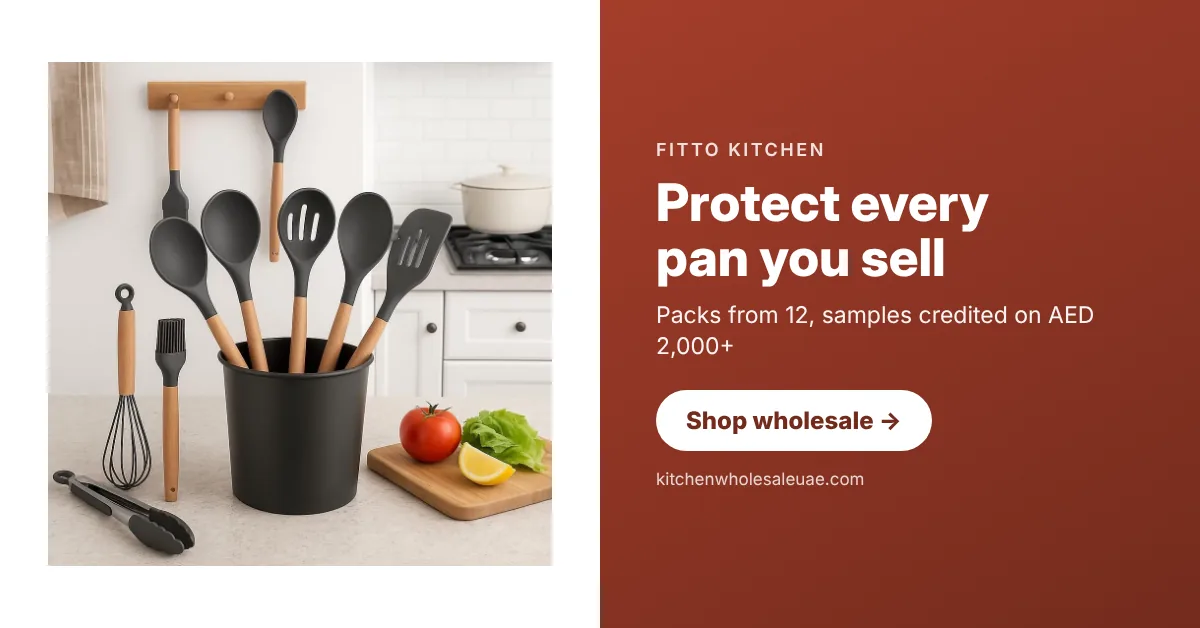
FITTO Trade Pick: Utensils that protect pans and stay intact The 12-piece silicone cooking utensils set and 32 cm silicone kitchen tongs are gentle on non-stick pans, while the stainless spider strainer and 36.5 cm slotted turner handle the hot work. Wholesale prices start from 12 pieces, and a sample is credited back on a bulk order of AED 2,000+ within 30 days.
Which cookware should utensils be matched with?
Utensils should be matched to the pans your customers cook in, so stock and display them side by side. A shop that sells non-stick frying pans should place silicone and nylon tools next to them. A restaurant buying stainless stock pots needs stainless ladles and spiders.
Cross-merchandising also lifts the basket. A customer buying a pan often needs a turner too, and a customer buying a turner may have a worn pan at home. Our wholesale cookware and pans range covers the materials, and our cookware wholesale buyer's guide explains which pans suit which kitchens. Knives and boards are the other half of prep; our kitchen knives and cutting boards guide covers them.
The bottom line
A utensil range that sells is built on a few dependable lines in the right materials: silicone and nylon for non-stick, stainless for heat and draining, wood for stirring. Test new lines small, give proven sellers the bigger quantities, and check a sample of anything new before a bulk run.
Browse our wholesale kitchen utensils and gadgets, request a quote for a mixed carton, order a sample or WhatsApp +971 55 672 6947. Packs run from 12 to 144 pieces, with up to 20% off per piece on the largest pack, and delivery is free over AED 300. FITTO Kitchen: fit for the way you cook.
FAQ
Are silicone utensils better than nylon?+
Silicone utensils usually tolerate more heat than nylon and are less likely to melt if left briefly on a hot pan. Both are gentle on non-stick coatings. Nylon is lighter and often cheaper, so it suits budget sets and light home use. For cafés and restaurants cooking on high heat all day, silicone or stainless steel is the safer choice, depending on the pan.
Can I use stainless steel utensils on non-stick pans?+
Stainless steel utensils can scratch non-stick and granite coatings, especially with daily use. Scratches shorten the life of the pan and lead to complaints. Use silicone, nylon or wooden tools on coated pans, and keep stainless turners, tongs and ladles for stainless steel, cast iron, the grill and draining.
Which kitchen utensils should a new kitchenware shop stock first?+
Start with the replacement tools households buy most often: turners, slotted spoons, ladles, tongs, whisks, peelers, can openers and a silicone utensil set. Add a measuring set and a spider strainer. Order small quantities of each new line, track sales for 4–6 weeks, and move the steady sellers to bigger packs for a lower price per piece.
Are wooden utensils hygienic?+
Wooden spoons and spatulas are fine for everyday cooking when they are washed by hand in hot soapy water and dried fully before storing. Do not soak them or leave them in a wet sink, because trapped moisture causes cracks. Replace any wooden tool that has deep cracks, splits or a smell that will not wash out. Follow your food-safety plan in commercial kitchens.
When should kitchen utensils be replaced?+
Replace a utensil when it no longer does its job safely. Common signs are nylon edges that are rough or melted, silicone heads that are torn or sticky, wooden tools with deep cracks, and stainless heads that wobble at the joint. In restaurants, check tools weekly during cleaning, because a damaged edge can shed fragments into food or harbour dirt.
What length of tongs and turners should I buy?+
Match the length to the heat source. Tongs of around 23–25 cm suit serving and salads, 30–32 cm suits the hob and fryer, and longer BBQ tongs keep hands away from open coals. Turners of 30–37 cm suit restaurant pans and griddles, while 25–30 cm is comfortable in a home kitchen.