French press vs Turkish pot vs electric coffee maker: which suits you?
By FITTO Trade Desk · Last updated 29 October 2026
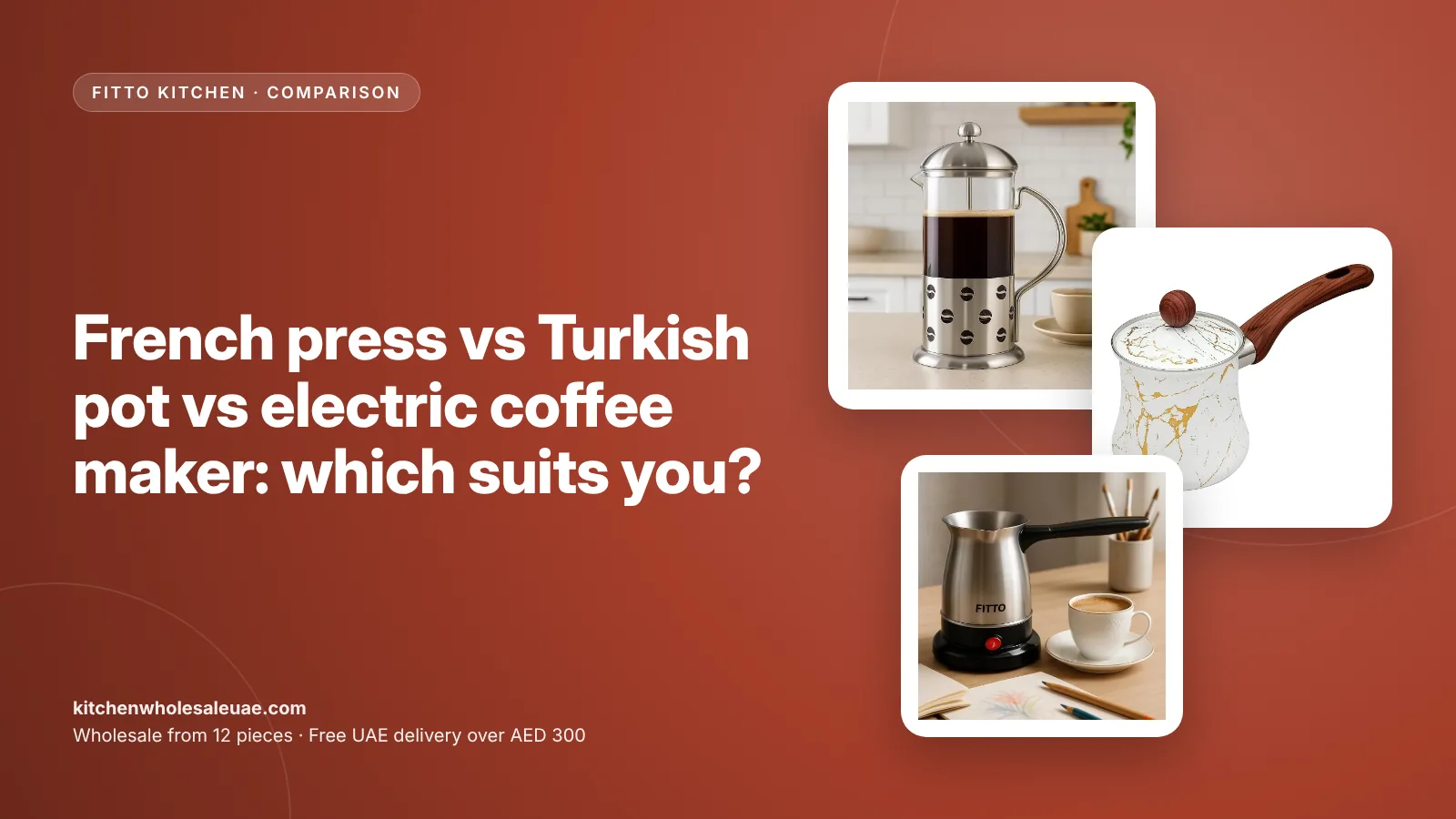
In the French press vs coffee maker choice, pick by setting. A French press gives full-bodied coffee for two to four people with no power needed. A Turkish pot makes strong, foamy coffee one or two cups at a time. An electric coffee maker wins where several people want coffee without anyone watching the stove.
Key takeaways
- French press: about four minutes of brewing, full body, easy to scale up to 1 litre, but needs coarse ground coffee and careful cleaning.
- Turkish pot (cezve or ibrik): fastest for one or two cups, richest texture, but needs a hob and someone watching the foam.
- Electric Turkish coffee maker: same style of coffee with one button and no flame, ideal for offices and staff rooms.
- For travel, a 300 ml portable machine or a small press beats carrying a stovetop pot.
Buy the wrong brewer and it sits in a cupboard, or ties up a barista for every order. This comparison settles which brewer suits home, office and travel, so the money goes on equipment people actually use.
It is for home coffee drinkers, office managers and small cafés. At FITTO Kitchen, a wholesale coffee and tea supplier in the UAE, we stock presses, Turkish pots and electric coffee makers for homes, pantries and cafés.
French press vs coffee maker vs Turkish pot: how do they compare?
The French press suits groups, the Turkish pot suits one or two strong cups, and the electric maker suits busy, unattended spaces.
| Factor | French press (cafetière) | Turkish pot (cezve / ibrik) | Electric coffee maker |
|---|---|---|---|
| Taste | Full body, natural oils, light sediment | Thick, strong, foamy, grounds settle in cup | Depends on type; electric Turkish makers mirror the pot |
| Brew time | About 4 min steep, plus boiling water | 3-4 min on a low flame | 2-5 min, mostly hands-off |
| Typical FITTO capacity | 600 ml and 1,000 ml | 355 ml | 300 ml, 500 ml and 600 ml |
| Grind | Coarse | Extra fine, powder-like | Matches the method it copies |
| Cleaning | Strip the mesh filter after each brew | Rinse and dry | Wipe; never immerse the base; descale |
| Power needed | Kettle only | Hob or gas | Socket |
On running cost, the press and pot need only coffee and water. The electric maker uses a little power but saves staff time, usually the bigger cost.
What does French press coffee taste like, and how long does it take?
French press coffee is rich and full-bodied because the metal mesh lets natural oils through. It takes about four minutes once the water is hot.
A common starting ratio is 1:15, so about 60-65 g of coarse ground coffee per litre of water. Pour water just off the boil, stir, steep for four minutes and press slowly. Serve straight away, or decant into a flask, because coffee left on the grounds turns bitter.
The FITTO 1,000 ml cafetière press brews for a small group and doubles as a loose-leaf tea maker. The 600 ml insulated press in 304-grade stainless steel is insulated to keep coffee warm, with a 3-level filter and dishwasher-safe parts.
Why choose a Turkish pot (ركوة) instead?
Choose a Turkish pot for strong, foamy coffee in small cups, made in about three minutes. It is the traditional brewer for Turkish and many Levantine and Arabic-style coffees.
Use extra-fine powder coffee, about one heaped teaspoon (6-7 g) per small cup of 60-70 ml. Start with cold water, add sugar or cardamom if wanted, and heat gently. Lift the pot off just as the foam rises, before it boils over.
The 355 ml FITTO Turkish coffee pot is stainless steel with a lid and makes about four to five small cups. The trade-off is attention: someone must stand at the hob for every batch. For sizes and shapes, see our Turkish coffee pots guide.
When is an electric coffee maker the better buy?
An electric coffee maker is better wherever people make their own coffee and nobody can watch a flame. That means offices, staff rooms, hotel rooms and many homes with induction-only hobs.
FITTO's electric options copy the Turkish method without a stove:
- The 800 W electric Turkish coffee maker holds 600 ml, about five cups, with a cool-touch handle and pouring spout.
- The 500 ml, 600 W black Turkish coffee maker has a foldable handle for compact storage.
- The 300 ml, 600 W portable coffee maker makes a single cup at a desk or on a trip.
Check the plug and voltage on each appliance's documentation before installing it in a pantry. The trade-off is one more appliance to descale, which matters in the UAE because tap water can leave scale; descaling monthly is a sensible routine for busy units.
Which is easiest to clean?
The Turkish pot is the easiest; the French press takes the most care.
A Turkish pot only needs rinsing and drying. A press needs its mesh filter unscrewed now and then, because fine grounds collect between the layers and turn stale. Tip used grounds into the bin or compost, never the sink, to avoid blocked drains.
For electric makers, wipe the inside after use, keep water away from the base and descale with a citric acid or vinegar solution as the manual directs.
Which should you buy for office, home and travel?
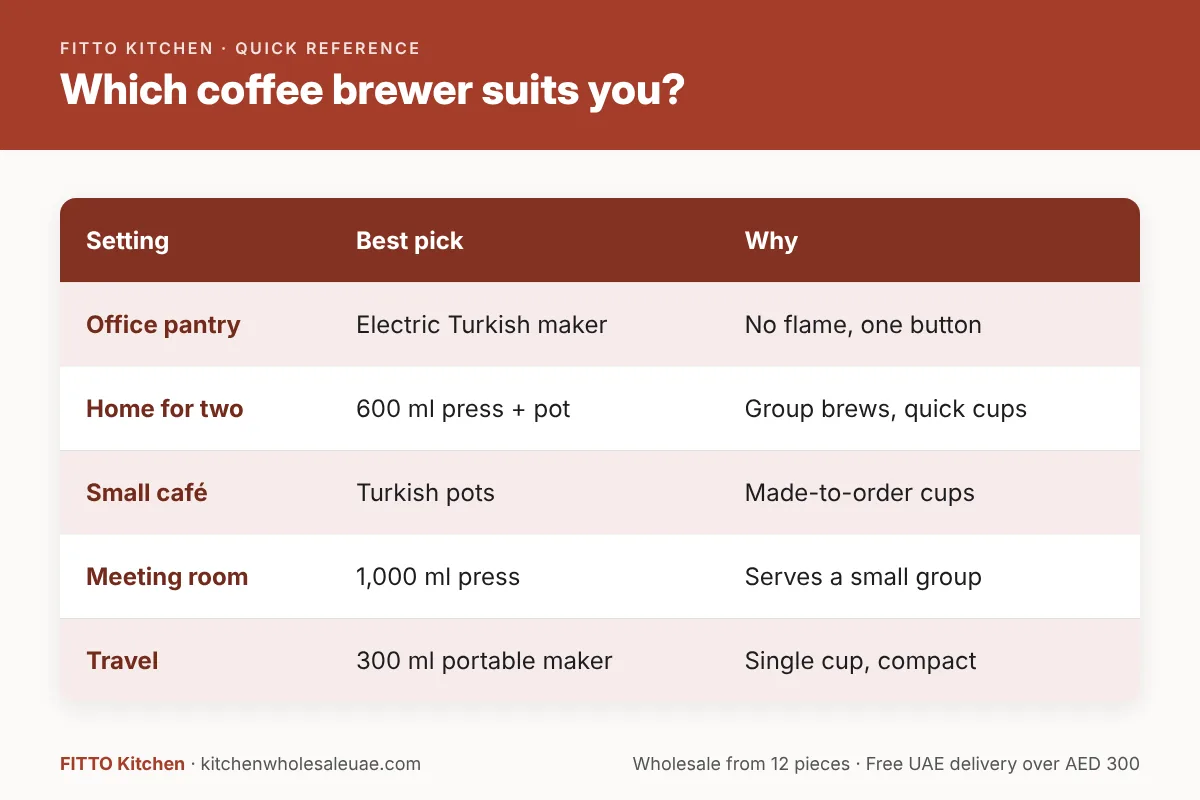
Our verdict: electric for offices, French press or Turkish pot for homes, and a compact press or portable machine for travel.
- Office pantry: as a rule of thumb, one electric Turkish coffee maker per 10-15 coffee drinkers, plus a 1,000 ml press for meetings.
- Home, two people: a 600 ml press for weekend mornings and a Turkish pot for quick strong cups.
- Home, majlis guests: pair a large press with your dallah for Arabic coffee.
- Small café: Turkish pots for made-to-order cups, with a press for tea and specials.
- Travel and staycations: the 300 ml portable machine where there is a socket, or a press packed with pre-ground coarse coffee.
Setting up a café menu? Our café coffee and tea tools list and coffee and tea equipment guide cover grinders, kettles and serving pieces.
FITTO Trade Pick: Coffee for every setting Stock the 1,000 ml cafetière press for homes and meeting rooms and the 800 W electric Turkish coffee maker for pantries. Wholesale prices start from 12 pieces, with up to 20% off per piece in packs of 144.

The bottom line
No brewer is best everywhere. Choose a French press for full-bodied coffee for a group, a Turkish pot for strong single cups, and an electric coffee maker wherever people serve themselves.
Browse our coffee and tea range, request a quote for a mixed brewer order, or order a sample to taste-test first. Delivery is free over AED 300, and the Trade Desk answers on WhatsApp at +971 55 672 6947. FITTO Kitchen: fit for the way you cook.
FAQ
Can you make Turkish coffee in a French press?+
Not properly. Turkish coffee relies on extra-fine powder heated slowly with the water to build foam, and the fine grounds would pass through a press filter. A French press needs a coarse grind and steeped, not heated, coffee. Use a stovetop pot or an electric Turkish coffee maker for Turkish coffee, and keep the press for coarse-ground blends and tea.
Is French press coffee stronger than Turkish coffee?+
Usually not. Turkish coffee uses more coffee per millilitre and is served in small, unfiltered cups, so it tastes far stronger. French press coffee is full-bodied but brewed at a lower ratio, around 1:15, and drunk in larger mugs. Strength in both cases depends mainly on how much coffee you use, so adjust the dose rather than the brew time.
Can you use a French press for tea?+
Yes. A press works well for loose-leaf tea: steep, then press to separate the leaves. Keep a separate press for tea if you can, because coffee oils flavour delicate teas. Let water cool a few minutes for green tea; steep black tea in just-boiled water for three to five minutes.
How many cups does a 600 ml electric Turkish coffee maker make?+
Around five small Turkish cups of 60-70 ml each, leaving space for the foam to rise. Filling to the maximum line risks boil-over, so most users brew a little under capacity. For an office of 10 to 15 coffee drinkers, one unit works if people brew in turns, while larger teams may need two.
Do electric coffee makers need descaling in the UAE?+
Yes. Hard or mineral-rich water leaves scale on heating plates, which slows heating and affects taste. Descale once a month in busy pantries, or whenever you see white deposits, using a citric acid or diluted vinegar solution and following the maker's manual. Using filtered or bottled water stretches the time between descaling.