Knife sharpeners: how to choose one that keeps blades kitchen-ready
By FITTO Trade Desk · Last updated 29 October 2026
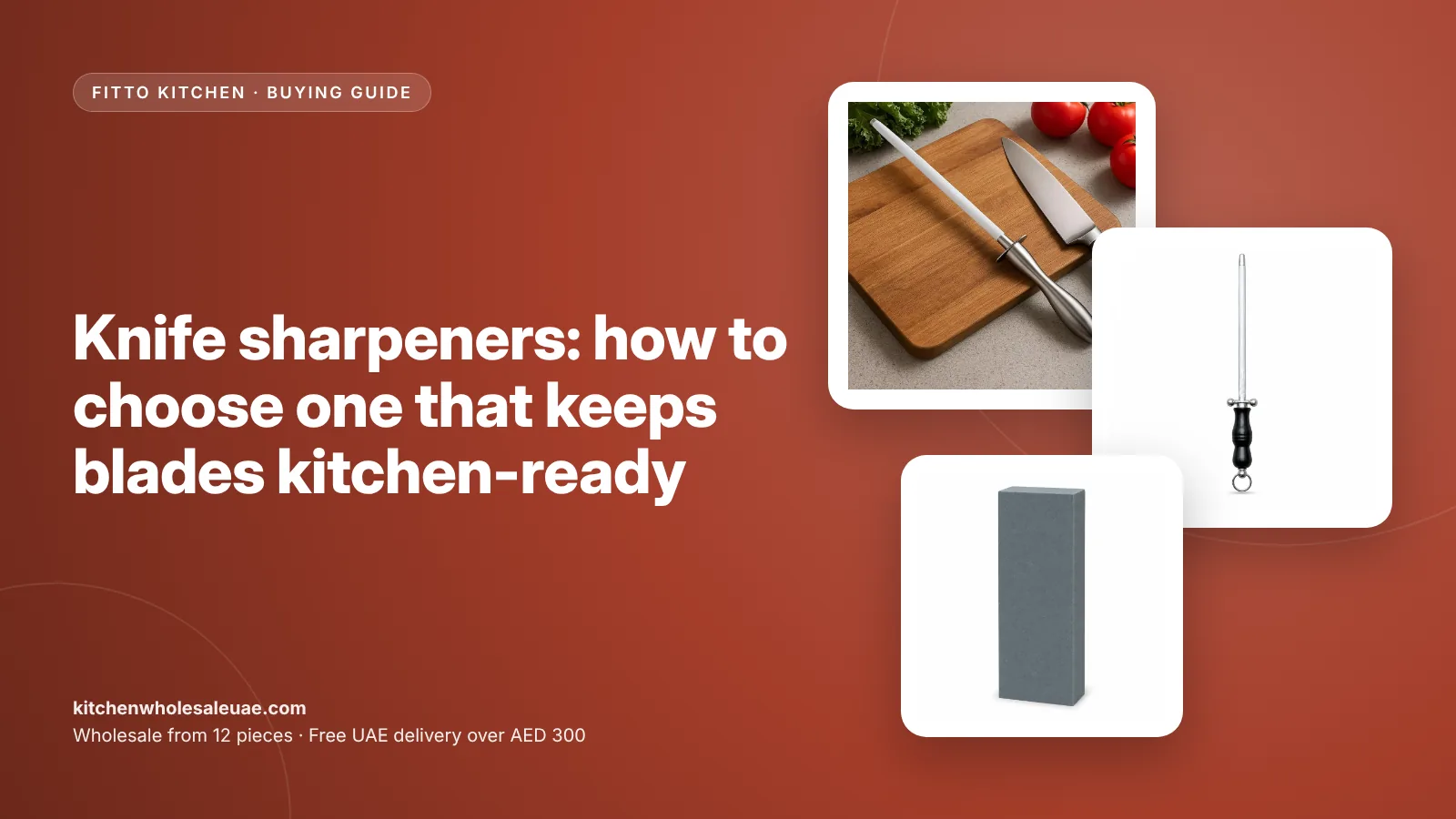
The right knife sharpener depends on who uses it and how often. A pull-through sharpener suits busy home cooks and staff who need speed. A honing steel keeps a sharp edge aligned between sharpenings. A whetstone gives chefs and butchers full control over the angle. Most kitchens do best with two tools: a steel plus one sharpener.
Key takeaways
- Honing and sharpening are different jobs: a steel realigns the edge, while a stone or pull-through removes metal to make a new one.
- Choose your rod at least as long as your longest blade: 10 inch (25 cm) covers most chef knives.
- Western knives are usually sharpened at about 20° per side, many Japanese knives at about 15°. Fixed-angle sharpeners suit the first group best.
- Pull-through and motorised sharpeners are fast but remove more metal, so save good knives for a stone or steel.
- Safety comes from a stable base, slow strokes and wiping off metal filings before the knife touches food.
A dull knife slips off tomato skins, crushes herbs and drags prep time out across a whole shift. Replacing knives early because nobody kept the edge is money gone. This guide settles which knife sharpener fits which knife and which user.
It is for chefs, butchers, home cooks and retailers. At FITTO Kitchen, a wholesale knives and cutting boards supplier in the UAE, we supply steels, stones and pull-through sharpeners to restaurants, butcher shops and kitchenware stores across the emirates.
What is the difference between honing and sharpening?
Honing straightens a rolled edge; sharpening grinds away metal to create a new edge. You hone often and sharpen rarely.
With daily use, the thin edge bends sideways, so the knife feels dull. A few strokes on a sharpening steel (a honing rod) push that edge back into line.
Once the edge is rounded or chipped, honing cannot bring it back. Then a whetstone, pull-through or motorised sharpener must remove metal and form a fresh bevel.
As a rule of thumb, a busy restaurant hones before each shift and sharpens every week or two; a home cook sharpens every two to three months.
Which type of knife sharpener should you choose?
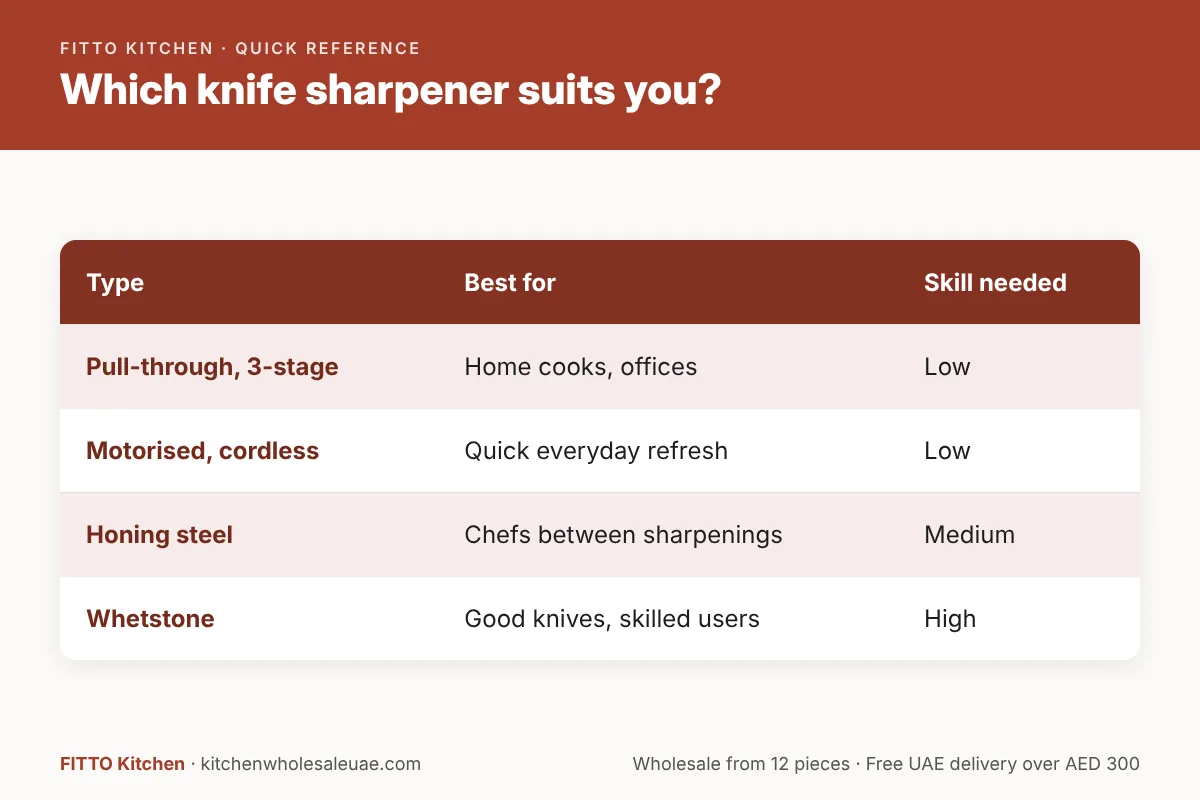
Pick by user skill and knife value: pull-through for speed, a steel for upkeep, a stone for control. The table compares the four main types.
| Sharpener type | How it works | Best for | Skill needed | Trade-off |
|---|---|---|---|---|
| Pull-through (2-3 stage) | Blade drawn through fixed-angle slots | Home cooks, staff kitchens, offices | Low | Fixed angle; removes more metal than a stone |
| Motorised / cordless | Spinning abrasive in a guided slot | Quick refresh of everyday knives and scissors | Low | Fast metal removal; easy to over-grind |
| Honing steel (rod) | Realigns the edge with light strokes | Chefs and butchers between sharpenings | Medium | Cannot fix a rounded or chipped edge |
| Whetstone | Flat abrasive stone, angle held by hand | Chefs, butchers, enthusiasts with good knives | High | Slower to learn; needs a flat surface and water |
Retailers sell the pull-through to the widest crowd because it needs no training. In professional kitchens, the steel is the daily tool and the stone the weekly one.
How do pull-through sharpeners work, and are they safe for good knives?
They are safe for everyday stainless knives, but use the fine slot most of the time and the coarse slot only when the edge is truly dull.
A three-stage pull-through usually runs from coarse (to reshape) through medium to fine (to polish). The FITTO 3-stage white knife sharpener is designed for straight and serrated blades and sits on a non-slip base. The red 3-in-1 knife and scissor sharpener adds a scissor slot, useful in kitchens that cut herbs and packaging.
The fixed angle suits most Western knives. For thin Japanese blades or expensive knives, a stone or steel removes less metal.
When does a manual knife sharpener rod make sense?
A sharpening steel is the daily tool in most professional kitchens, and the right length matters more than the brand. The rod should be longer than the blade so you can hone the full edge in one stroke.
| Your longest blade | Rod length | FITTO example |
|---|---|---|
| Paring and utility knives, up to 15 cm | 8 inch (20 cm) | 8-inch sharpening steel |
| Chef knife, 20-23 cm | 10 inch (25 cm) | 10-inch sharpening steel |
| Butcher, slicing and bread knives, 25 cm and over | 12 inch (30 cm) | 12-inch sharpening steel |
Butchers benefit from a finger guard, as on the 25 cm stainless steel rod with finger guard, which also hangs on a knife rail.
To hone, stand the rod upright with its tip on a damp cloth. Draw the blade down and towards you at the sharpening angle, five to eight light strokes per side. A steady angle matters more than pressure.
Is a whetstone worth it in the UAE kitchen?
Yes, for chefs and butchers who own good knives and will practise. A whetstone (حجر سن السكاكين) gives the best edge and removes the least metal, because you control angle and pressure.
Grit numbers show how coarse a stone is. As a general guide, 200-600 grit repairs chips, 800-2,000 grit does regular sharpening and 3,000 and above polishes.
The FITTO rectangular sharpening stone offers a broad surface for controlled strokes. Follow its instructions on soaking or wetting.
Our step-by-step knife sharpening guide walks through the stone technique, angle by angle.
Which sharpener suits which knife and user?
Match the tool to the person holding it, not only to the knife.
- Home cook with a mixed knife block: a 3-stage pull-through plus an 8 or 10 inch steel.
- Restaurant line cook: a 10 inch steel at every station; the head chef sharpens on a stone weekly.
- Butcher shop: 12 inch steels for long blades, with spares for Eid al-Adha weeks when knives work all day.
- Office pantry or staff accommodation: a pull-through with a non-slip base, because nobody needs training.
- Gift shops and resellers: a knife set with sharpening rod makes a complete, giftable package.
Still choosing the knives themselves? See our guide to chef knives for restaurants.
How do you sharpen safely and keep sharpeners working?
Stabilise the sharpener, move slowly, and clean both blade and tool after every session.
- Use pull-throughs on a dry, flat counter, hold the handle firmly and draw the blade one way only.
- Keep the rod tip planted on a damp cloth instead of honing in the air.
- Wipe off metal filings, then wash and dry the blade before food prep.
- Brush out slots and rinse stones as directed, then dry fully; humid coastal summers slow drying, so store them in a ventilated drawer.
- Test the edge on paper or a ripe tomato; a sharp knife slices without tearing.
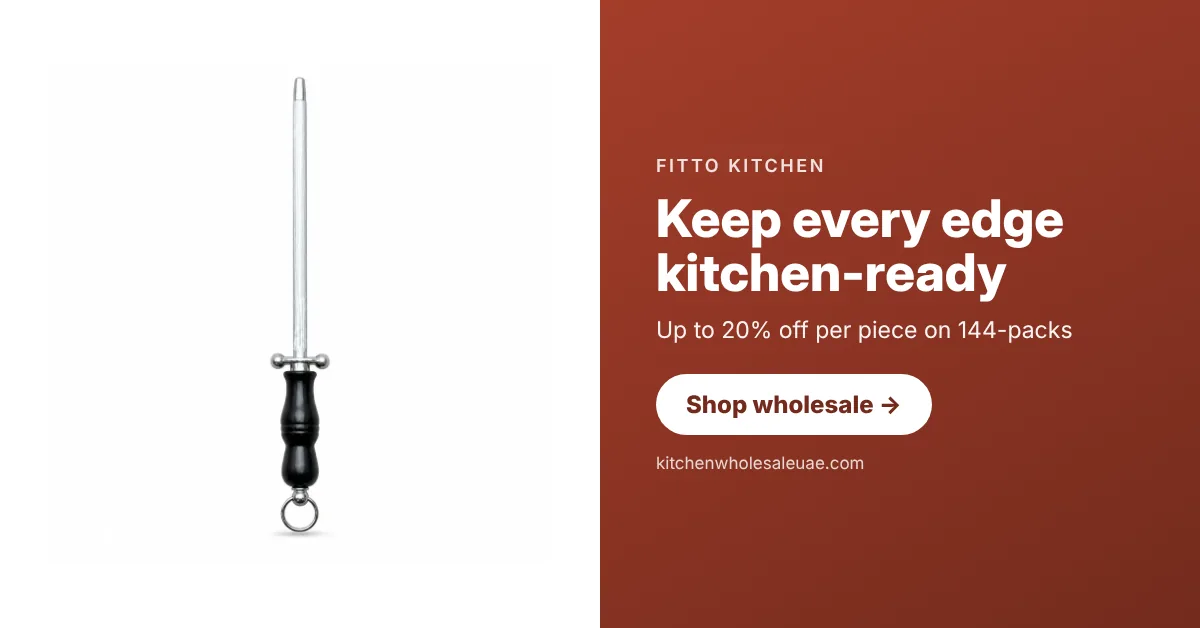
FITTO Trade Pick: One sharpener for every station Pair the 10-inch sharpening steel for daily honing with the 3-stage white knife sharpener for quick resets. Wholesale prices start from 12 pieces, with up to 20% off per piece in packs of 144.
The bottom line
A knife sharpener only pays off when it matches the user. Give every station a steel of the right length, add a pull-through where speed matters and a whetstone where skill and good knives meet.
Browse our knives and cutting boards range, request a quote for a mixed sharpener order, or order a sample to test a steel in your kitchen first. Delivery is free over AED 300, and the Trade Desk answers on WhatsApp at +971 55 672 6947. FITTO Kitchen: fit for the way you cook.
FAQ
What angle should I sharpen my kitchen knife at?+
Most Western and German-style knives are sharpened at about 20° per side for a durable edge. Many Japanese knives use about 15° per side for a finer edge that needs more care. If unsure, check the maker's guidance, or colour the bevel with a marker and watch where the stone removes ink.
Does a sharpening steel actually sharpen a knife?+
A steel mainly realigns the edge, which is why it is called honing. Ridged steels remove a little metal, but none can rebuild a rounded or chipped edge. Hone little and often, and sharpen on a stone or pull-through when honing no longer brings the bite back.
Can I use a pull-through sharpener on a serrated knife?+
Only if it has a slot designed for serrated blades, like a 3-stage sharpener built for straight and serrated knives. Otherwise use a thin tapered rod on each scallop. Never grind a serrated knife flat on a whetstone, because that removes the teeth.
Is a motorised knife sharpener better than a manual one?+
A motorised sharpener is faster and easier for beginners, and cordless models such as the FITTO cordless motorised sharpener store in any drawer. The trade-off is fast metal removal, so extra passes waste blade. It suits everyday knives and scissors; expensive knives last longer on a steel and whetstone.