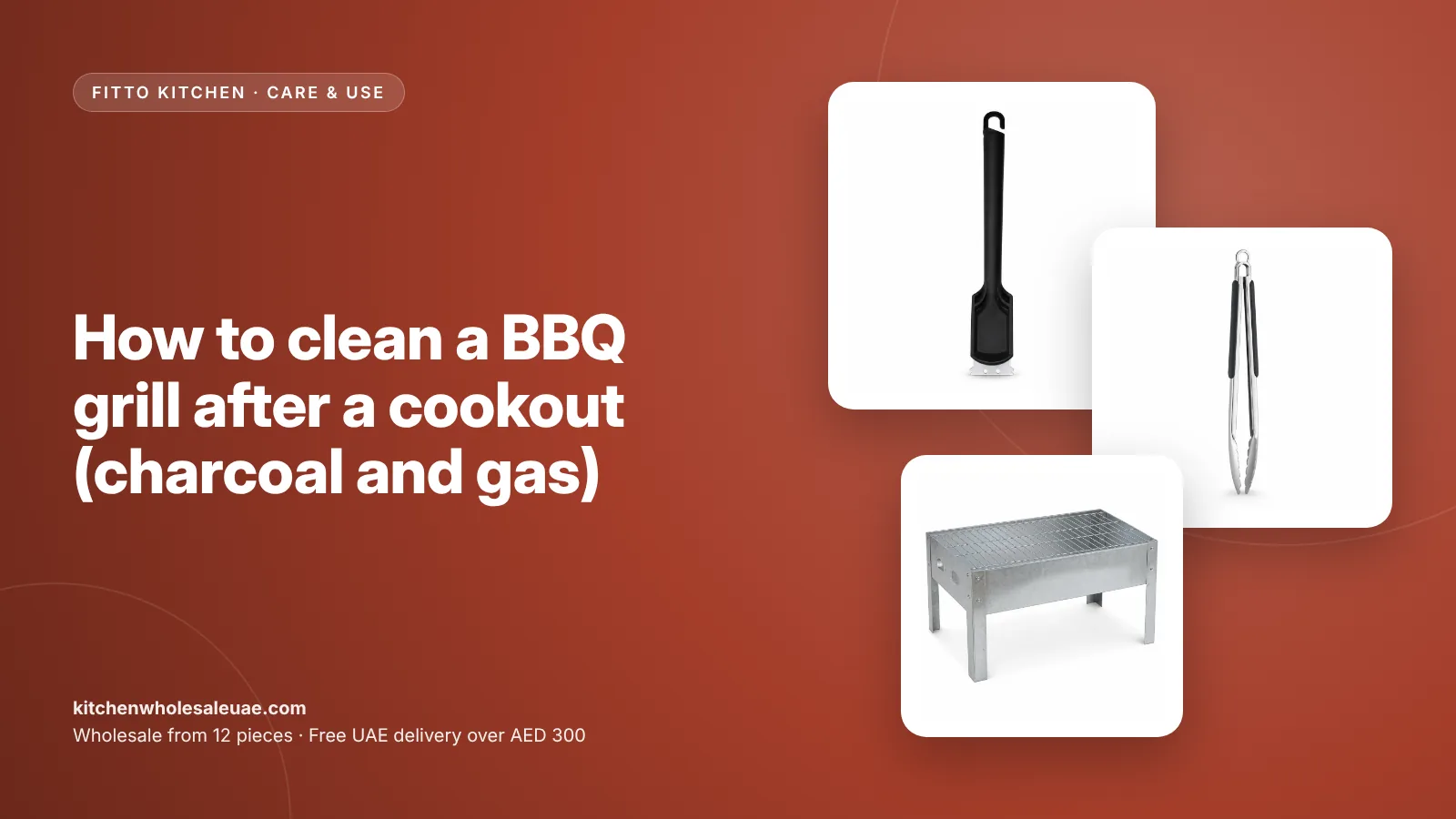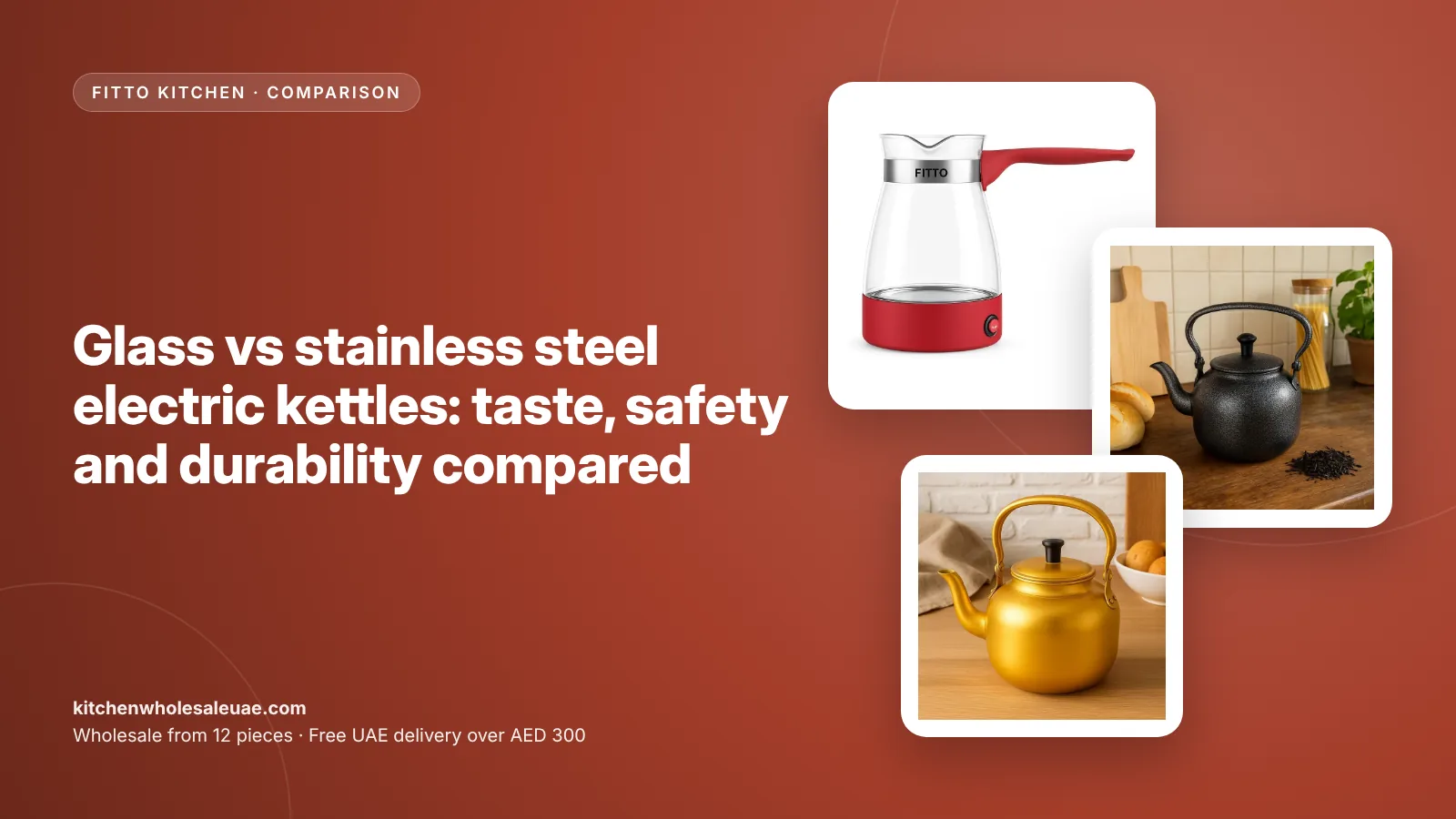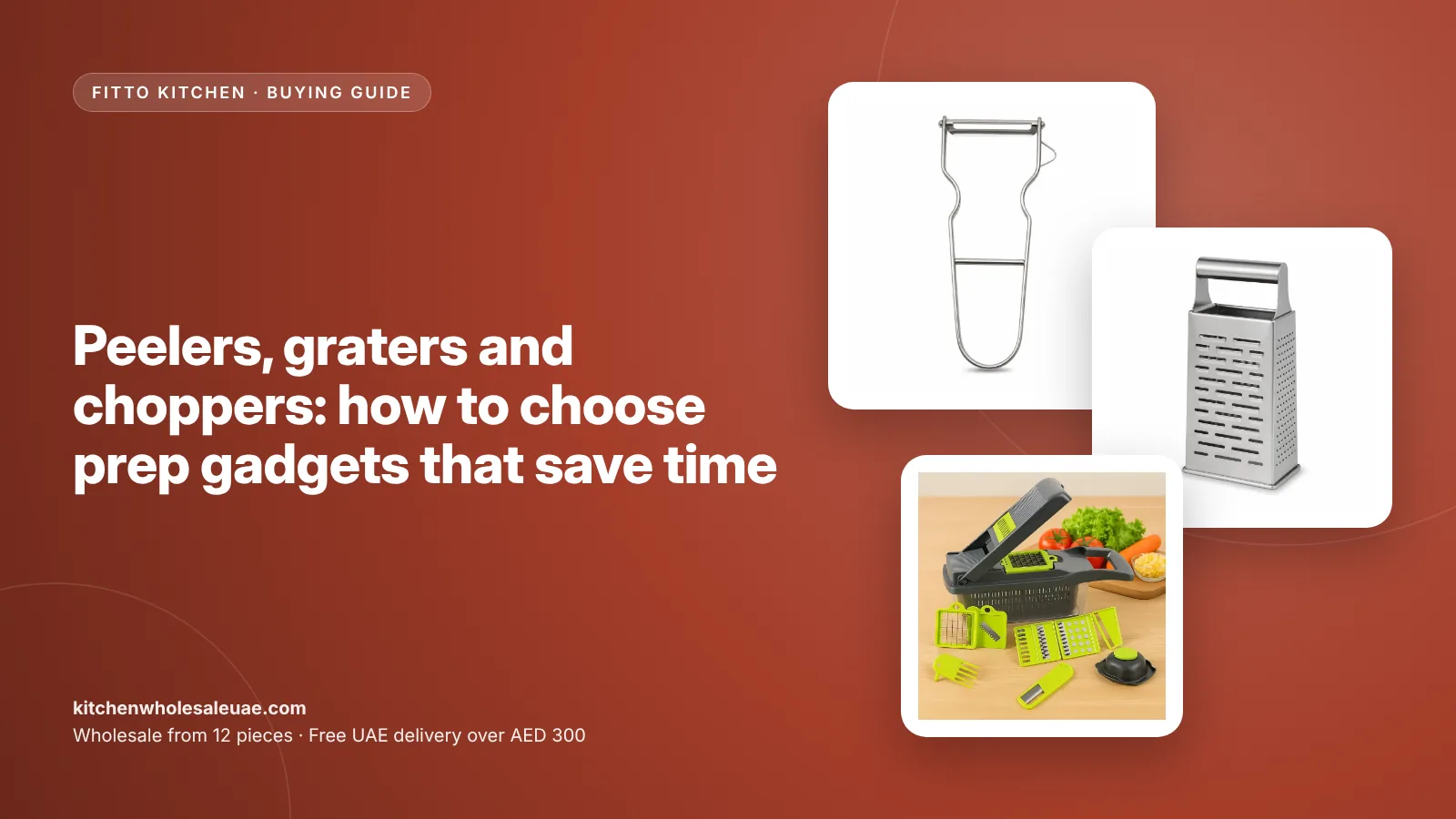
What do coloured chopping boards mean? The colour code explained
By FITTO Trade Desk · Last updated 29 October 2026
Colour coded chopping boards give each food group its own board so raw juices never reach ready-to-eat food. The most widely used code is red for raw meat, blue for raw fish, yellow for cooked meat or raw poultry, green for salad and fruit, brown for root vegetables and white for bakery and dairy.
Key takeaways
- Red, blue, yellow, green, brown and white is the common six-colour code; many kitchens add purple for allergen-free prep.
- Yellow is the colour that varies: some kitchens use it for cooked meat, others for raw poultry. Write your choice down.
- The code is a convention, so follow your food-safety plan and your municipality's guidance.
- Colour only works with a wall chart, separate storage and boards replaced once deeply scored.
One board for everything is how raw chicken juice ends up in a salad, and how a restaurant fails an inspection. This quick answer settles what each colour means.
At FITTO Kitchen, a wholesale knives and cutting boards supplier in the UAE, we supply coloured plastic boards to restaurants, cafés, caterers and school canteens.
What does each chopping board colour mean?
Each colour is reserved for one food group, and the board never crosses over. This is the common code used in many UAE and UK-trained kitchens.
| Colour | Food group | Typical examples |
|---|---|---|
| Red | Raw meat | Lamb, beef, kofta mix |
| Yellow | Cooked meat, or raw poultry in some kitchens | Roast chicken, or raw chicken |
| Blue | Raw fish and seafood | Hammour, shrimp |
| Green | Salad, fruit and washed herbs | Fattoush, cut fruit |
| Brown | Unwashed root vegetables | Potatoes, onions from the sack |
| White | Bakery and dairy | Bread, cheese, sandwiches |
| Purple (optional) | Allergen-free prep | Gluten-free or nut-free orders |
Brown is for vegetables that still carry soil. Once washed and peeled, they move to green.
Why does yellow mean different things in different kitchens?
Because the code grew from training schemes, not one global standard. UK-trained kitchens usually keep yellow for cooked meat, while many others give raw poultry its own yellow board.
Either choice works if the whole team knows it. Print the chart above the prep area in English and your staff's main language.
Is colour coding required in the UAE?
Separating raw and ready-to-eat food is a basic food-safety expectation; colours are the easiest way to prove it. Check current guidance from your emirate's authority, such as Dubai Municipality or ADAFSA in Abu Dhabi.
As a rule of thumb, inspectors look for separate boards for raw and cooked food, boards in good condition and staff who can explain the system. A colour chart answers all three.
How do you set up a colour-coded board system?
Buy one board per colour per station, store them apart and brief the team.
- Count stations and the colours each one really uses. A shawarma counter may only need red, yellow, green and white.
- Store boards upright and apart. A vertical cutting board rack gives each board its own slot.
- Wash and sanitise knives between colours.
- Use plastic for raw proteins so boards can go through a hot dishwasher where the label allows; our wooden vs plastic cutting boards comparison explains why.
- Keep boards away from hobs so they do not warp, and replace any board with grooves that stay stained.
For sizes and thickness by station, see our commercial cutting boards guide.
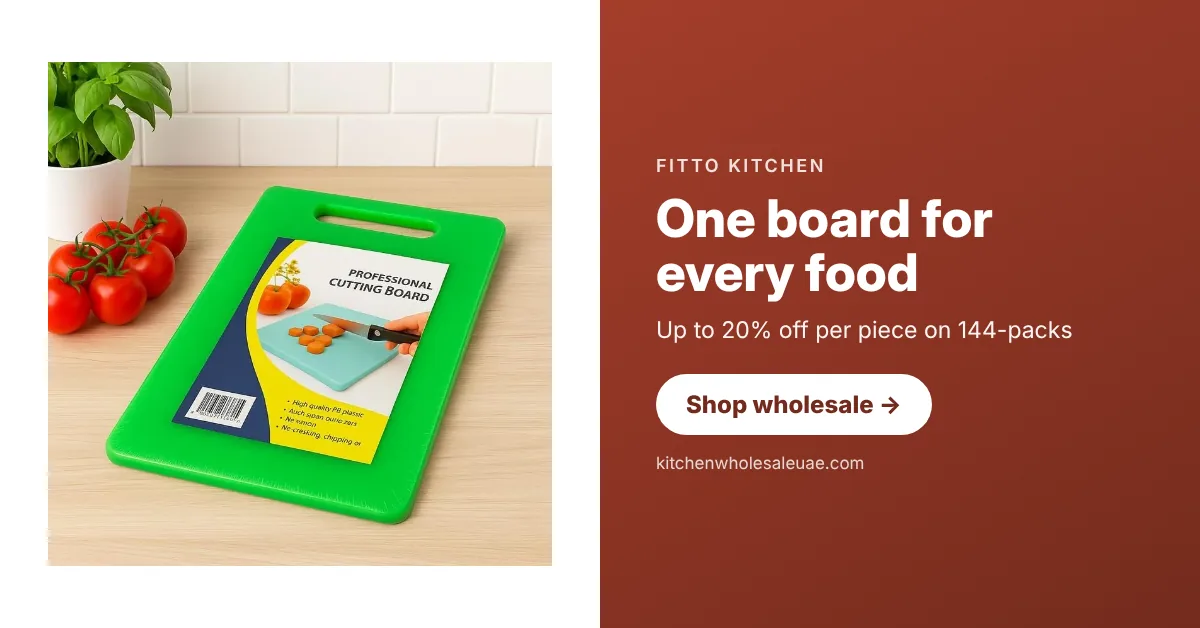
FITTO Trade Pick: Build your colour set in one order Start with the white non-slip board for bakery and dairy, the green BPA-free board for salad, the blue 36 x 22 cm board for fish and the brown 35 x 20 cm board for root vegetables. Packs run from 12 to 144 pieces, with up to 20% off per piece on the largest pack.
The bottom line
Colour coding is the simplest way to keep raw and ready-to-eat food apart. Use the common six-colour code, decide what yellow means in your kitchen, and post the chart where every cook can see it.
Browse our knives and cutting boards range, request a quote for a full colour split, or order a sample to check thickness first. Delivery is free over AED 300, and the Trade Desk answers on WhatsApp at +971 55 672 6947. FITTO Kitchen: fit for the way you cook.
FAQ
What colour chopping board is used for raw chicken?+
Many kitchens use yellow for raw poultry, while UK-trained kitchens often keep yellow for cooked meat and put raw chicken on red. Both systems work if everyone follows the same chart. Choose one, write it into your food-safety plan and label the storage rack so a new cook cannot guess wrong.
What does a red chopping board mean?+
A red chopping board (لوح تقطيع أحمر) is reserved for raw meat such as lamb, beef and mince. It never touches cooked food, salad or bread. Because raw meat carries the highest risk, red boards are usually plastic so they can go through a hot dishwasher, and they are replaced once grooves stay stained.
How many colour-coded boards does a small café need?+
A café serving sandwiches, salads and one hot dish usually needs four: white for bread and cheese, green for salad and fruit, red for raw meat and yellow for poultry or cooked meat. Add blue only if you prepare raw fish. Keep a spare of the colour you use most so a damaged board can be swapped the same day.
How often should colour-coded chopping boards be replaced?+
There is no fixed calendar; replace a board when its condition fails. Deep grooves that stay stained after washing, warping that makes the board rock, or cracks along the edge are all signs. As a rule of thumb, busy commercial kitchens check boards weekly, while a home may get a year or more from a well-kept plastic board.