Kitchen strainers and colanders: how to choose mesh, size and handle
By FITTO Trade Desk · Last updated 29 October 2026
For kitchen strainer wholesale buying, match the tool to the food. Use fine mesh for rice, tea, juice and flour; a perforated colander for pasta, vegetables and big rinses; and a spider for lifting food out of hot oil. Choose sizes by batch volume, and handles and hooks that let staff pour safely with both hands.
Key takeaways
- Fine mesh holds rice, seeds, tea leaves and pulp; perforated colanders drain pasta and vegetables faster and clog less.
- As a rule of thumb, a 24 cm colander drains about 500 g of dry pasta; busy kitchens need 28 cm and up.
- A rest hook or ear opposite the handle lets a strainer sit across a pot, which saves wrists and spills.
- Only stainless steel and wire spiders belong in hot oil; plastic strainers stay at the sink.
A strainer that is too small floods over the rim, holes that are too large send basmati down the drain, and plastic warps in fryer oil. Each mistake costs food, time and a reorder.
This guide is for restaurants, cafés, juice bars and kitchenware shops choosing strainers and colanders (مصفاة) for daily service or resale. At FITTO Kitchen, a wholesale kitchen utensils supplier in the UAE, we stock fine mesh sieves from 5 to 22 cm and colanders from 20 to 36 cm. The range also includes aluminium rice strainers and spider skimmers.
What is the difference between a strainer, a colander and a sieve?
A colander is a perforated bowl for draining large volumes; a strainer or sieve is a mesh basket on a handle for finer work. Judge each item by its holes and shape, not its name.
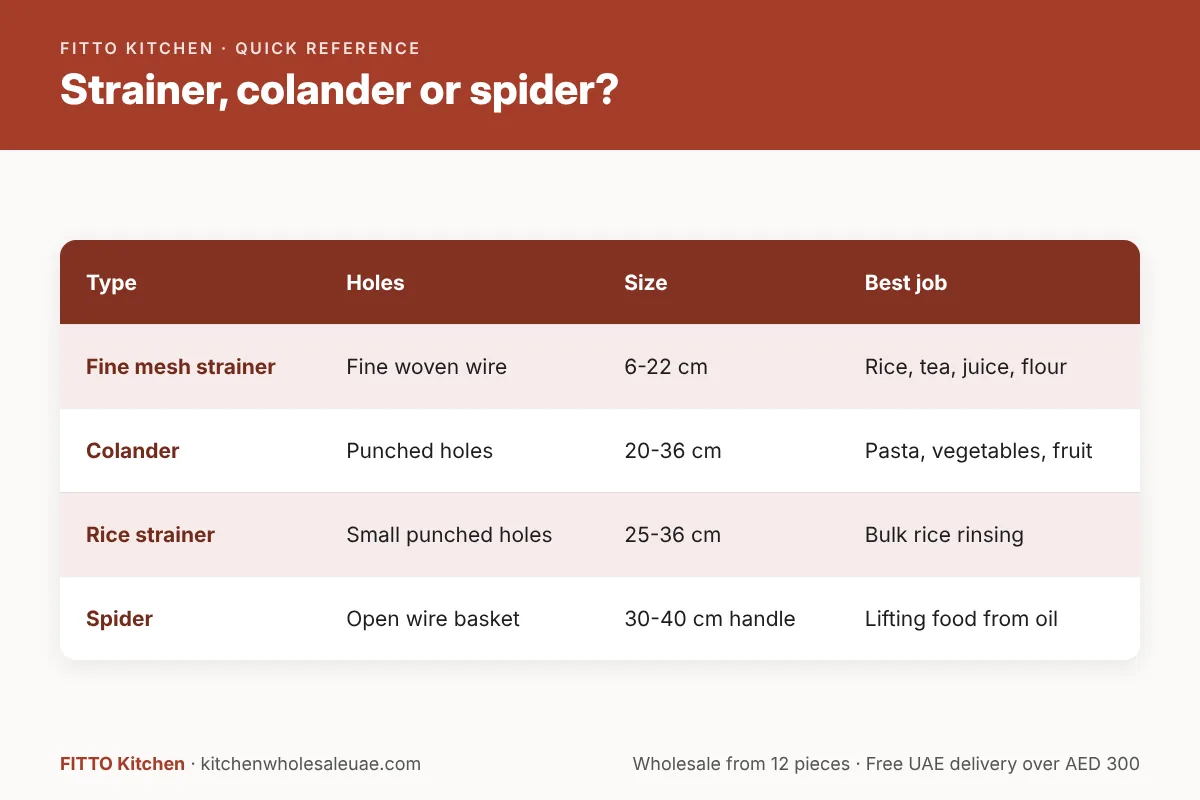
| Type | Holes | Typical sizes | Best jobs | Watch out for |
|---|---|---|---|---|
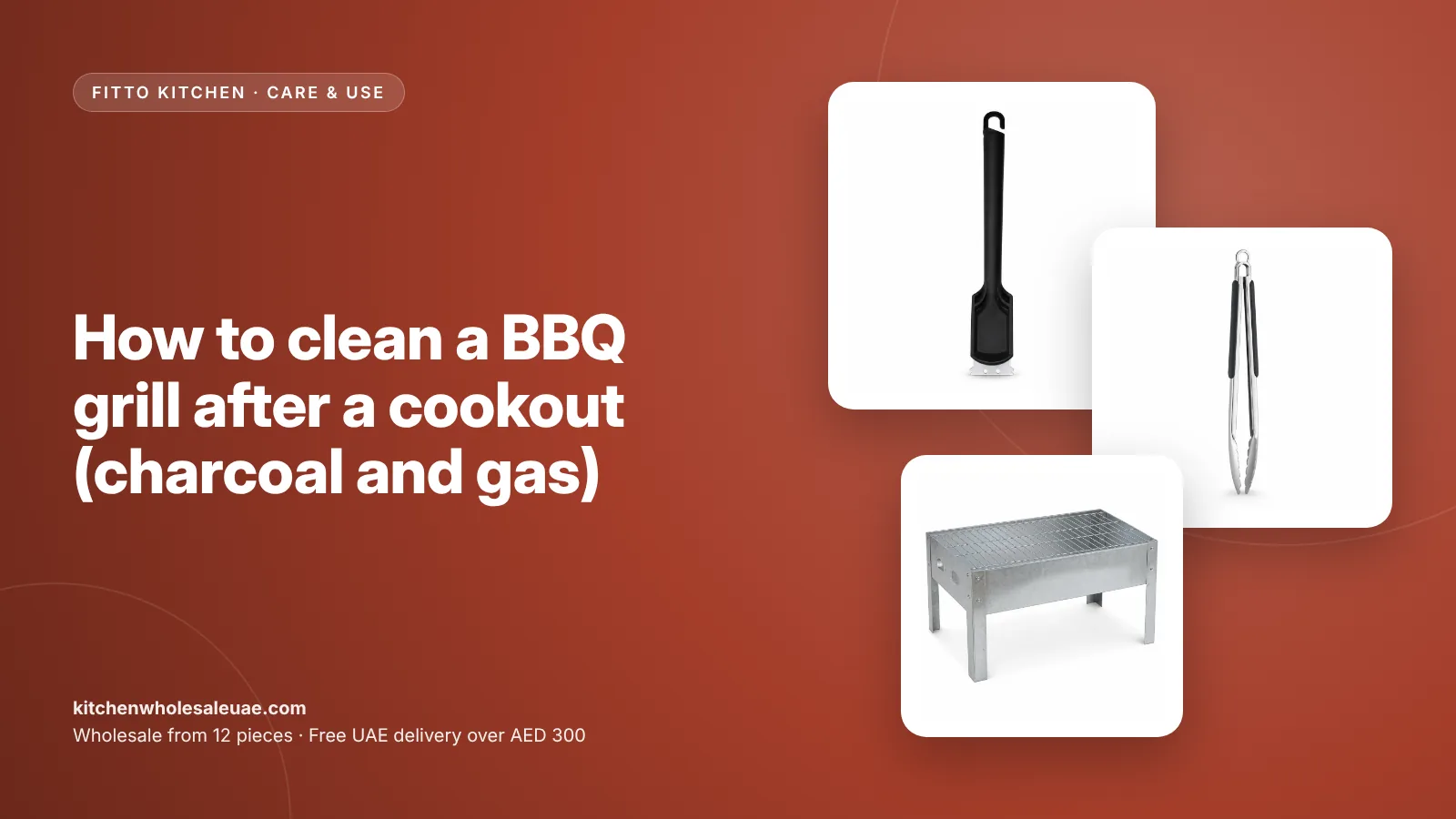
| Fine mesh strainer / sieve | Fine woven wire | 6-22 cm | Rice, tea, juice, flour, stock | Slow to drain; dents if knocked |
| Coarse mesh strainer | Wider woven wire | 14-22 cm | Vegetables, chickpeas, small pasta | Lets rice through |
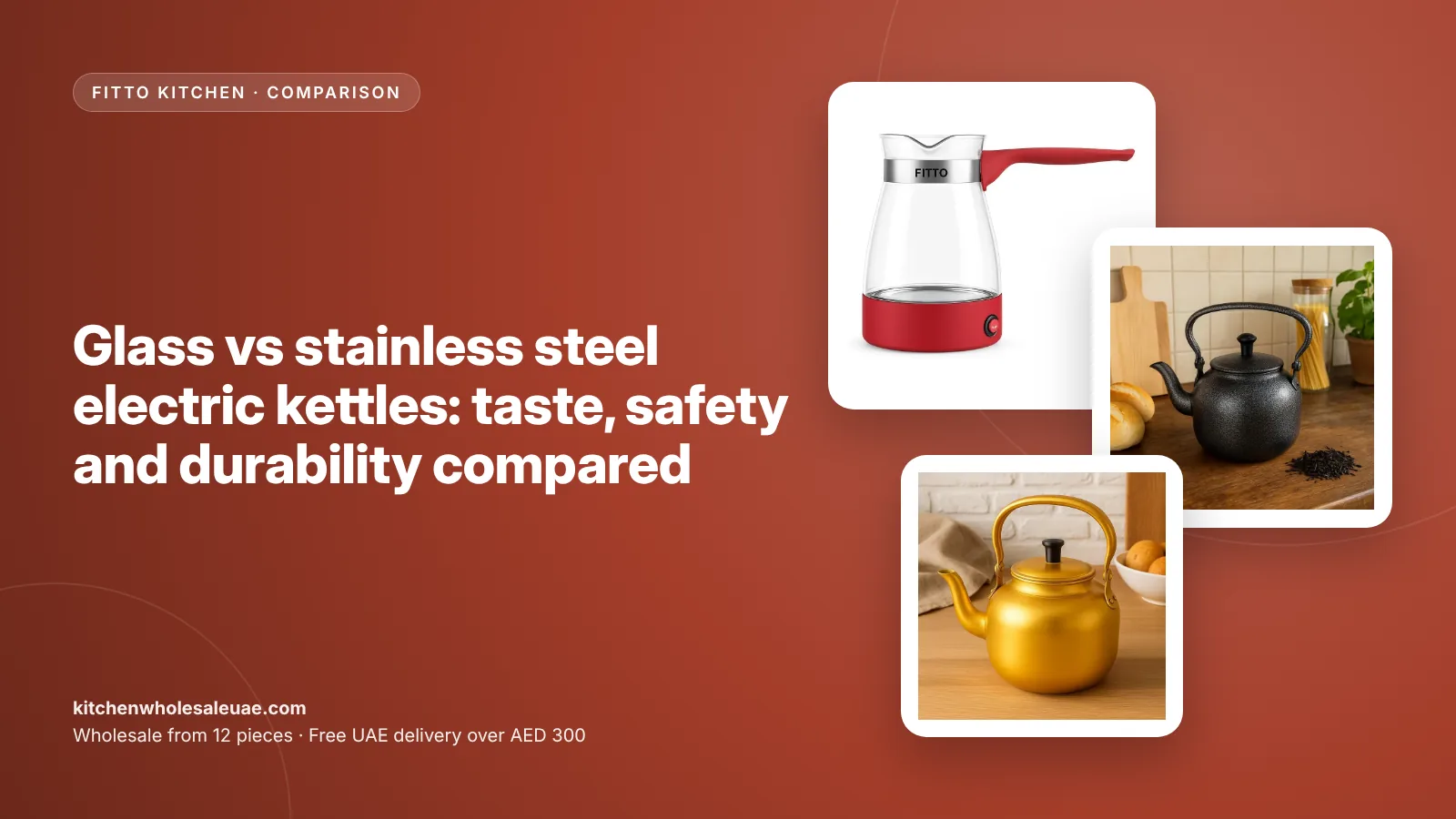
| Perforated colander | Punched holes | 20-36 cm | Pasta, salad, fruit, vegetables | Holes too big for grains |
| Rice strainer | Small punched holes | 25-36 cm | Large rice batches | Hand wash aluminium |
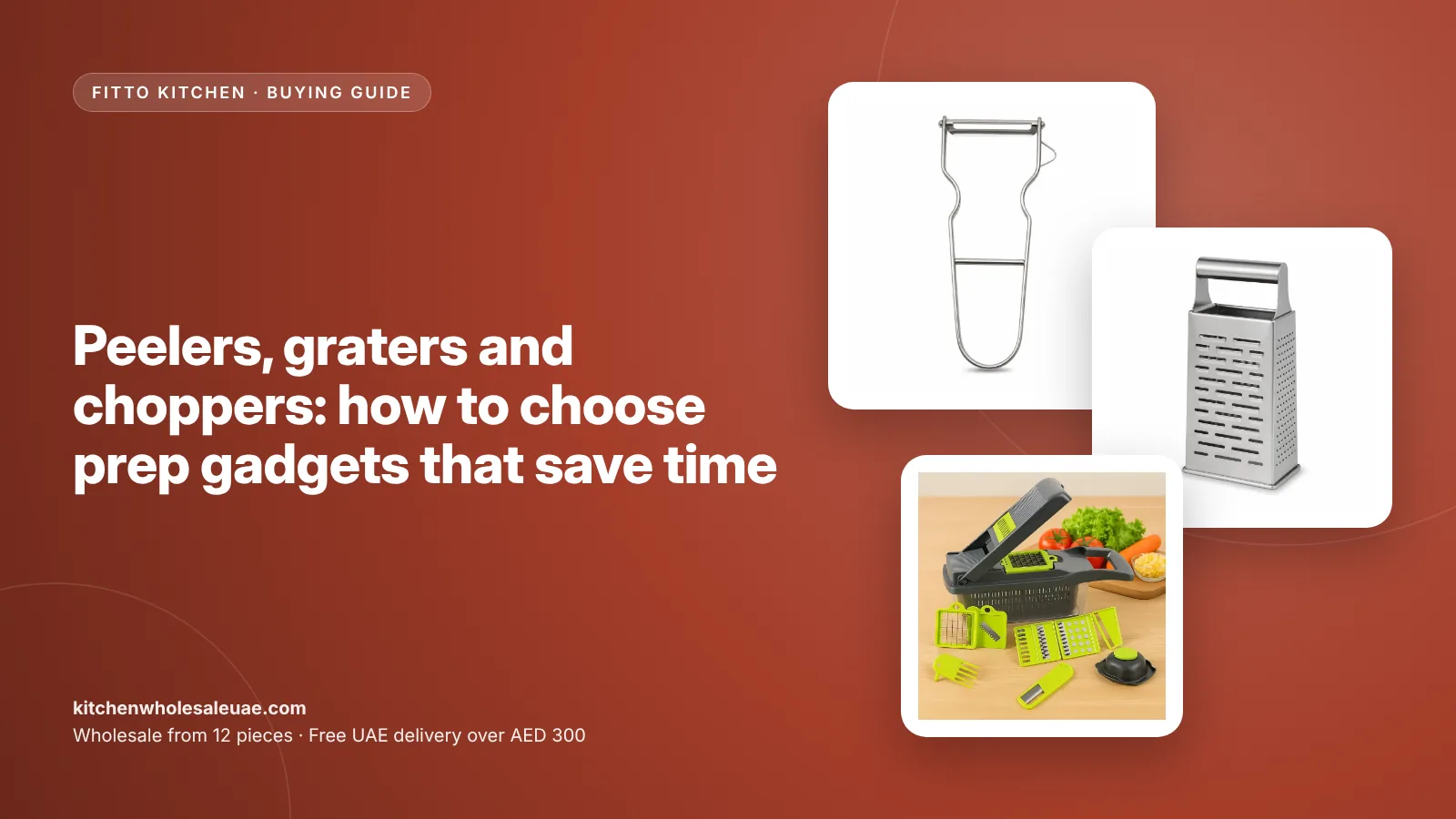
| Spider / skimmer | Open wire basket | 30-40 cm handle | Lifting food from oil or water | Not for fine foods |
Fine mesh or coarse: which do you need?
Choose fine mesh when the food is rice-sized or smaller or you want a smooth liquid; choose coarse mesh or a colander when speed matters more. Fine mesh drains slowly and clogs with starch, so it is wrong for a big pot of pasta.
Fine mesh rinses basmati and lentils, strains karak and juice, and sifts flour. Coarse mesh and colanders suit penne, broccoli and washed fruit, drain in seconds and scrub clean easily.
A practical test: if a grain of your rice could pass through a gap, the strainer is not for rice.
Which strainer and colander sizes cover rice, pasta, tea and frying?
Size by the batch, not the pot: the strainer should hold the whole batch without food reaching the rim. These are rules of thumb from common kitchen use, built on sizes we stock.
| Job | Suggested tool | Size to look for | Notes |
|---|---|---|---|
| Single cup of tea or karak | Fine tea strainer | 7-10 cm | Rests on the cup or glass |
| Rinsing 1-2 kg rice or lentils | Fine mesh strainer | 20-22 cm | Rest hook over a pot helps |
| Bulk rice for biryani or mandi | Rice strainer | 25-36 cm | Wide, shallow bowl spreads the grains |
| 500 g dry pasta | Colander | 24 cm | Deep bowl with feet |
| 1-2 kg dry pasta | Colander | 28-36 cm | Two side handles |
| Fresh juice for a juice bar | Fine juice strainer | 13-22 cm bowl | Side loops sit over a jug |
| Fries, samosas, luqaimat | Spider or fry basket | 30-40 cm long handle | Keeps hands back from hot oil |
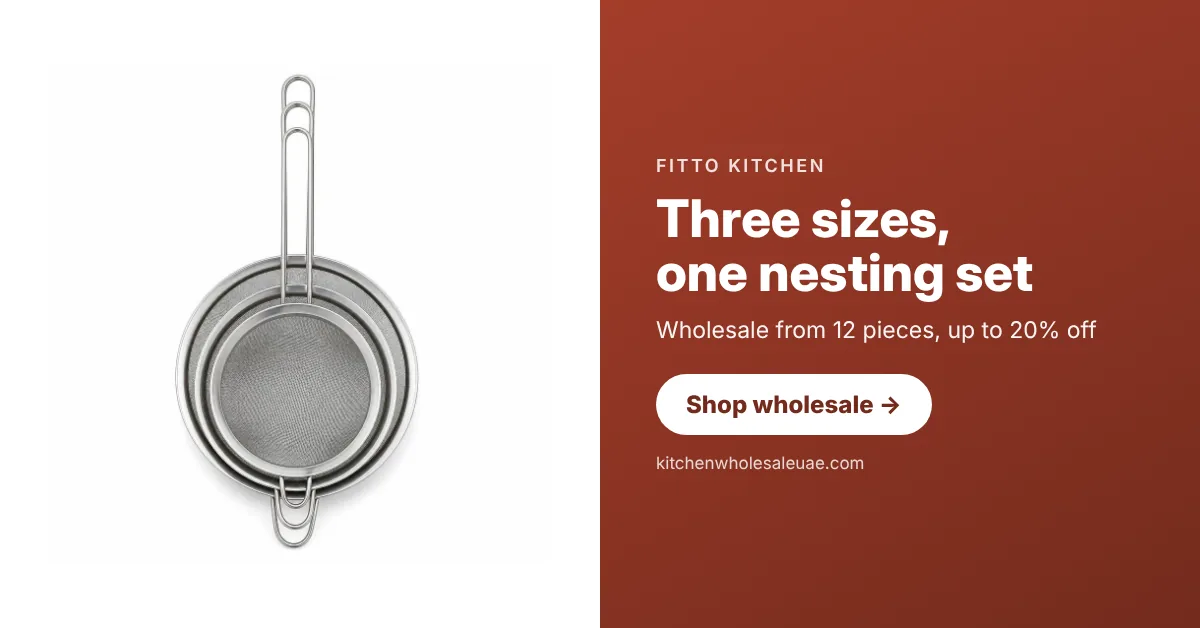
At home, three nesting sieves and a 24 cm colander cover almost everything; the 3-piece large mesh strainer set (20, 18 and 16 cm) nests into the space of one. Restaurants add a 28 cm colander, a rice strainer and a spider. Our restaurant kitchen equipment checklist shows where these sit in a full prep station.
What handle and hook design should you choose?
Pick a long handle with a rest hook for mesh strainers, two side handles and a raised base for colanders, and a heat-safe handle for anything near oil. These details decide whether staff can pour with both hands.
- Rest hook. A loop opposite the handle lets the strainer sit across a pot, so you pour with both hands.
- Handle length. About 20 cm for tea sieves; 30-40 cm for large strainers and spiders over deep pots and fryers.
- Handle material. Stainless steel survives heat and the dishwasher. Wood stays cooler but needs hand washing. Plastic belongs at the sink.
- Two side handles. On colanders above 24 cm, they make a full, wet load safer to lift.
- Feet or a raised base. The colander drains faster and stays out of dirty sink water.
The 28 cm deep colander with handles is 13 cm deep with a raised base, which suits pasta and vegetable prep in a restaurant.
Which material lasts longest in a UAE kitchen?
Stainless steel is the safe default for heat, oil and the dishwasher; aluminium is light for big rice batches; plastic and silicone suit cold rinsing. In humid coastal summers, drying habits matter as much as material.
- Stainless steel resists rust, handles boiling water and oil, and suits most dishwashers. Dry it fully to avoid spots.
- Aluminium, like the 14 inch aluminium rice strainer, stays light at large sizes. Wash by hand, as dishwasher detergent can darken it.
- Plastic and silicone suit cold rinsing; collapsible silicone colanders fold flat for small apartments. Keep both away from hot oil.
Kitchen strainer wholesale: what should cafés, juice bars and shops stock?
Stock by job: fine mesh for drinks, colanders for prep and spiders for the fryer, then add one size up from what you think you need. Undersized strainers are a common reason kitchens buy twice.
- Juice bars: two or three fine juice strainers per station, such as the No. 4 juice strainer with side loops.
- Cafés and karak counters: 7-10 cm tea strainers in quantity, because they get dropped and bent. A 3-piece small strainer set (10, 8 and 6 cm) covers tea and cocoa dusting.
- Restaurants: a 28 cm colander per prep station, a rice strainer per rice cook and a stainless steel spider with a wooden handle per fryer.
- Kitchenware shops: nesting mesh sets and 24 cm colanders sell year round; stock spiders and rice strainers ahead of Ramadan, when home frying rises.
Our kitchen utensils wholesale guide covers the rest of the prep range.
FITTO Trade Pick: One strainer for every station Pair the 3-piece large mesh strainer set with the 28 cm deep colander and the wooden-handle spider strainer and you cover rice, pasta and frying. Wholesale prices start from 12 pieces, with up to 20% saving per piece on 144-piece packs.
The bottom line
Match the holes to the food: fine mesh for rice, tea and juice, perforated colanders for pasta and vegetables, and spiders for oil. Size up to hold the whole batch, and choose hooks, side handles and stainless steel wherever there is heat or heavy use.
Browse our wholesale kitchen utensils and gadgets, request a quote for a mixed strainer order, or order samples to test the mesh first. Delivery is free across all seven emirates over AED 300, and the Trade Desk answers on WhatsApp at +971 55 672 6947. FITTO Kitchen: fit for the way you cook.
FAQ
Can I use a colander instead of a fine mesh strainer for rice?+
Only if the holes are smaller than the grain. Many pasta colanders lose basmati and broken rice through their holes. A fine mesh strainer or a rice strainer with small perforations is safer. For large biryani batches, a wide, shallow rice strainer spreads the grains and drains faster than a deep sieve.
How do I clean a clogged fine mesh strainer?+
Rinse it from the outside in, so water pushes trapped starch and pulp back out. Soak it in warm soapy water, then brush gently with a soft dish brush; steel wool can tear fine mesh. Dry it fully before storing, especially in humid summer months.
Is a stainless steel strainer safe to put in the dishwasher?+
Most all-stainless strainers and colanders handle the dishwasher well, but check the product page first. Wash wooden handles, aluminium bowls and coloured finishes by hand. Fine mesh can trap food a dishwasher misses, so rinse it first.
What is the difference between a spider and a slotted spoon?+
A spider has an open wire basket on a long handle, so oil drains almost instantly and you can lift a whole portion of fries at once. A slotted spoon has a solid bowl with slots; it suits smaller pieces and serving. For deep frying, the spider is faster and keeps hands further from the oil.